Sapphire crystals most commonly refer to transparent, lab-grown single-crystal aluminum oxide (corundum) machined into scratch-resistant watch-glasses, optical windows, and electronic substrates, though in gemology the term also describes uncut natural corundum mineral specimens. Circular sapphire watch-glasses are mounted with gaskets or adhesives and used on divers' watches tested for water depths of at least 100 m under ISO 6425:2018. Engineers and watchmakers pair single-crystal sapphire with vacuum-deposited optical coatings and case seals governed by active ISO, IEC, and ASTM standards.
What Sapphire Crystals Are: Synthetic Optics vs. Natural Rough
Buyers searching for sapphire crystals or a replacement sapphire crystal are usually looking for one of two distinct products that share crystalline aluminum oxide chemistry. In watchmaking, photonics, and semiconductor manufacturing, a sapphire crystal is colorless, lab-grown single-crystal alpha-aluminum oxide (synthetic corundum). Because the blank grows as one continuous crystal lattice without grain boundaries or internal pores, light passes straight through without scattering.
In gemology and mineral collecting, sapphire crystals mean raw, uncut natural corundum stones mined from alluvial gravel or hard-rock deposits. Natural rough grows in six-sided barrel, tabular, or bipyramidal habits with trace iron, titanium, or chromium impurities that produce blue, yellow, pink, or zoned color, alongside silk inclusions that make mined rough unsuitable for instrument windows or watch dials.
Component catalogs and bills of materials also list horological covers under watch crystals, sapphire watch-glasses, or inverted labels such as crystals sapphire. Engineers separate transparent single-crystal sapphire from opaque white sintered alumina ceramics: both are aluminum oxide, yet sintered alumina fuses microscopic grains together, scattering visible light while serving in high-temperature furnaces and electrical insulation.
Sapphire Crystal vs. Mineral Glass and Acrylic Watch Crystals
Choosing between a sapphire crystal, mineral glass, and acrylic plastic comes down to separating surface scratch hardness from point-impact flex. On the Mohs scratch hardness scale, single-crystal corundum sits directly below diamond and silicon carbide (moissanite), well above steel files, titanium clasps, and quartz sand. Because household dust, beach sand, and concrete grit contain quartz particles, routine wear hazes acrylic and scratches mineral glass while leaving bare synthetic sapphire unmarked.
Watchmakers use two main alternatives. Acrylic crystal (polymethyl methacrylate, sold under trade names such as Plexiglass or Hesalite) is a lightweight thermoplastic that scuffs easily against doorframes and zippers, yet flexes under heavy blows without breaking into sharp shards. Mineral glass is silica glass that is heat-tempered or chemically ion-exchanged to resist light scratches better than plastic at a lower machining effort than sapphire.
High scratch hardness does not make a crystal indestructible. Sapphire's rigid lattice resists indentation, yet it flexes less than acrylic when struck squarely against a sharp metal corner, stone ledge, or diving tank valve. Watch designers counter brittle edge chipping by setting flat sapphire crystals flush with or slightly below a protective bezel and grinding a perimeter chamfer.
| Crystal Material | Internal Structure | Everyday Scratch Resistance | Point-Impact Behavior | Glare and Field Care |
|---|---|---|---|---|
| Synthetic Sapphire Crystal | Single-crystal aluminum oxide (corundum) | Resists quartz sand and steel tools, scratched only by diamond or silicon carbide | Rigid lattice resists flexing, can chip at exposed edges or fracture under severe direct blows | Higher surface reflection, often paired with anti-reflective coating, replace if chipped |
| Hardened Mineral Glass | Surface-strengthened amorphous silicate glass | Resists keys and coins, scratched by quartz grit and masonry | Moderate flex before cracking into glass fragments | Moderate glare, deep scratches cannot be hand-buffed without distorting flatness |
| Untreated Mineral Glass | Annealed amorphous silicate glass | Develops hairline scratches during routine wrist wear | Low impact resistance, chips or cracks on sharp corner knocks | Moderate glare, used mainly on dress and wall timepieces |
| Acrylic Plastic (PMMA / Hesalite) | Amorphous thermoplastic polymer | Scuffs readily against cuffs, clasps, and dust | Flexes under blows, crazes rather than shattering into loose splinters | Low glare, shallow scuffs buff out easily by hand with polishing paste |
Crystal Profiles and Optics: Flat, Single-Domed, Double-Domed, and Box
Cross-sectional geometry controls how a watch sits under a cuff and how clearly you read the dial at an angle. Flat crystals have parallel planar faces, needing the least boule thickness and diamond grinding time. A flat face gives zero magnification straight on, though its planar surface reflects overhead lights or open sky across the dial at once.
A single-domed sapphire crystal pairs a convex outer face with a flat underside. Because its center is thicker than its rim, a single dome acts like a planoconvex lens. Viewed straight down, the dial looks sharp, yet tilting your wrist refracts light, stretching hour markers, bending hands near the chapter ring, and creating milky internal-reflection rings underwater.
A double-domed sapphire crystal eliminates oblique distortion by grinding concentric curves on both outer and inner faces so wall thickness stays uniform from rim to center. Light rays entering and exiting undergo equal and opposite angular shifts, keeping the dial legible at steep angles while adding center hand clearance and arched strength against water pressure.
Vintage-style chronographs and dress watches often specify a box-style sapphire crystal, where vertical sidewalls rise above the bezel into a flat or gently radiused top deck. Grinding the recessed inner cavity from a solid corundum blank requires slow diamond wheel profiling to avoid micro-cracks at the internal corner fillet.
Anti-Reflective Coatings and the Scratched Sapphire Myth
Synthetic sapphire bends light more strongly than mineral glass or acrylic. That higher refractive index bounces back more incident light at air boundaries, washing out dark dials under bright sun. To restore dial contrast, optical coaters place clean sapphire blanks inside vacuum chambers and deposit thin dielectric metal-oxide layers via Physical Vapor Deposition (PVD).
Single-sided anti-reflective (AR) coating places the PVD film strictly on the underside facing the dial, cutting internal bounce glare while leaving the outer face bare corundum. Double-sided AR coats both inner and outer faces, canceling nearly all surface reflection so the crystal appears almost invisible.
Double-sided AR accounts for nearly every report of a scratched sapphire crystal. Fine hairline marks or rub trails seen under angled light are almost always scratches in the softer external PVD film rather than in the sapphire underneath. Watchmakers either replace the crystal or buff off the worn outer coating with diamond or cerium-oxide paste to expose unmarked bare sapphire while keeping the inner AR film intact.
For industrial optics and instrument windows, ISO 9211-4:2022 (Edition 4, published March 2022, 15 pages) specifies environmental durability test methods for abrasion, adhesion, and resistance to water on optical coatings applied to components and substrates, excluding ophthalmic optics.
How Synthetic Sapphire Boules and Substrates Are Grown and Machined
Read more
Growing optical single-crystal sapphire requires melting high-purity aluminum oxide and solidifying it around an oriented seed crystal without gas bubbles, twin boundaries, or lattice strain. Watchmaking moved from pocket-watch glass and rock quartz to acrylic plastics, scaling sapphire watch-glasses once furnace boule growth and diamond slicing matured.
The Verneuil flame-fusion process drops fine alumina powder through an oxyhydrogen flame onto a rotating, lowering seed pedestal to form a cylindrical boule, providing an economical route for watch-glass blanks and jewel bearings. Wider optical windows and low-stress wafers rely on crucible melt growth: the Kyropoulos method solidifies a large single crystal inside a vacuum or inert-gas crucible under gentle thermal gradients, while the Czochralski method rotates and pulls a seed crystal upward from the melt.
Cooled boules are cored with diamond drills, sliced on diamond wire saws, lapped parallel with diamond slurry, and chemical-mechanically polished. Thin sapphire substrates serve as insulating wafers for gallium nitride LEDs, radio-frequency integrated circuits, and thin-film sensors, where free-state bow and vacuum-clamped flatness govern lithography alignment. Downstream cryogenic sensors built on crystalline substrates follow frameworks such as IEC 61788-22-1:2017 (Edition 1.0, published 2017-07-27, 27 pages, stability date 2027), which sets generic specifications for superconducting sensors and detectors measuring magnetic fields, electromagnetic waves, photons, electrons, and ions.
How to Identify a Real Sapphire Crystal Without Scratching It
Never drag a steel blade, screw tip, or carbide scribe across an unknown watch crystal. A sharp tool will gouge mineral glass or acrylic permanently, and on genuine sapphire it will slice a visible track through an outer PVD anti-reflective film. Use these four non-destructive checks instead.
- Water droplet beading check: Clean the face with isopropyl alcohol to strip skin oils and let it dry. Place a tiny drop of water near the center. On bare sapphire, surface tension pulls the water into a tall, tight bead when tilted, whereas on uncoated mineral glass it flattens and spreads. Because hydrophobic films or outer AR coatings alter wetting, always confirm with a thermal probe.
- Thermal conductivity probe check: Press an electronic thermal crystal tester straight down against the clean center. Single-crystal sapphire conducts heat away from the probe tip far faster than amorphous glass or insulating acrylic, triggering the sapphire indicator immediately. Clean sapphire also feels noticeably colder than acrylic against your forehead at room temperature.
- Oblique reflection and tint check: Tilt the watch under a single lamp. Bare sapphire gives a crisp white reflection without plastic stress fringes, while AR-coated sapphire usually shows a faint blue, violet, or green interference tint near the rim.
- Fingernail acoustic check: Tap the center lightly with a fingernail. Acrylic gives a warm, muted click, whereas glass and sapphire produce a sharper, higher-pitched tap that you can separate with the thermal probe.
Standards, Optical Drawings, and Watch Crystal Replacement
Read more
Specifying a sapphire window or upgrading a mineral watch glass requires matching seat tolerances, gasket compression, and surface quality rather than nominal diameter alone. ISO 14368-2:2003 (Edition 1, published February 2003, 5 pages, confirmed in 2022) defines case-mounting interface dimensions for circular mineral and sapphire watch-glasses assembled with adhesive or a gasket, such as radial I-ring seals or flanged L-ring seals. ISO 14368-3:2003 (Edition 1, published August 2003, 9 pages, confirmed in 2024) sets defect nomenclature, test methods, and minimum physical and aesthetic requirements. On dive watches, ISO 6425:2018 (Edition 4, published October 2018, 12 pages, confirmed in 2024) specifies test methods for divers' and saturation divers' watches rated to water depths of at least 100 m with darkness-legible time measurement.
For industrial sight ports and display covers, ISO 10110-1:2019 (Edition 3, published October 2019, 45 pages, confirmed in 2025) standardizes optical drawing layouts and tabular tolerances. Electronic screens behind sapphire covers apply ergonomic readability tests in ISO 9241-307:2008 (Edition 1, published November 2008, 217 pages, confirmed in 2024), while IEC 62262:2002 (Edition 1.0, published 2002-02-12, 15 pages, stability date 2026, consolidated as IEC 62262:2002+AMD1:2021) classifies enclosure mechanical impact protection via IK codes for equipment rated not above 72.5 kV (72,5 kV). For heated windows and substrates, ASTM E1269-24 (updated June 13, 2024, 7 pages) measures specific heat capacity by differential scanning calorimetry over a normal operating range from -100 °C to 600 °C, which spans 700 °C by our calculation from ASTM E1269-24 before extended-range holders are required.
Custom and replacement crystal cost depends on diameter, thickness, profile grinding time, single- or double-sided PVD coating, beveling, and batch quantity. Follow this six-step sequence when upgrading a mineral watch crystal to sapphire.
- Uncase the movement and press out the old glass: Remove the caseback, stem, and movement, then press the old crystal out from inside the case using nylon press dies.
- Measure the crystal and seat: Measure the removed crystal diameter at several points with digital calipers and record edge thickness, chamfer height, and step dimensions.
- Match profile and hand clearance: Match original edge thickness for a flush bezel fit, selecting a double-domed sapphire crystal if tall hands need center clearance without angled lens distortion.
- Fit a fresh seal: Install a new I-ring or L-ring nylon gasket matched to the channel, or clean and degrease the seat thoroughly for UV optical adhesive.
- Inspect and press squarely: Check the sapphire blank for edge chips, align the gasket, and press with parallel flat or cupped dies sized inside the bezel rim.
- Pressure-test the empty case: Run dry vacuum and wet condensation tests on the sealed empty case before reinstalling the movement.
| Standard | Status | Technical Scope | Key Scope Detail |
|---|---|---|---|
| ISO 14368-2:2003 | Edition 1, confirmed 2022 | Case-assembly interface dimensions using adhesive or gasket for round mineral and sapphire watch-glasses | 5 pages |
| ISO 14368-3:2003 | Edition 1, confirmed 2024 | Defect nomenclature, test methods, and physical and aesthetic criteria for circular watch-glasses | 9 pages |
| ISO 6425:2018 | Edition 4, confirmed 2024 | Requirements and test methods for divers' and saturation divers' watches | At least 100 m depth, 12 pages |
| ISO 9211-4:2022 | Edition 4, published 2022 | Abrasion, adhesion, and water resistance durability test methods for optical coatings | 15 pages |
| ISO 10110-1:2019 | Edition 3, confirmed 2025 | Layout and tabular tolerance indications on drawings for optical elements and systems | 45 pages |
| ISO 9241-307:2008 | Edition 1, confirmed 2024 | Ergonomic analysis and compliance test methods for electronic visual displays | 217 pages |
| IEC 62262:2002 | Edition 1.0, stability 2026 | IK-code enclosure protection against external mechanical impacts | Up to 72.5 kV (72,5 kV), 15 pages |
| IEC 61788-22-1:2017 | Edition 1.0, stability 2027 | Generic specification for superconducting electronic sensors and detectors | 27 pages |
| ASTM E1269-24 | Active, updated June 13, 2024 | Specific heat capacity of thermally stable solids and liquids by differential scanning calorimetry | -100 °C to 600 °C (700 °C span by our calculation), 7 pages |
Single-Crystal Sapphire vs. Sintered C799 Alumina Ceramics from GY Alumina
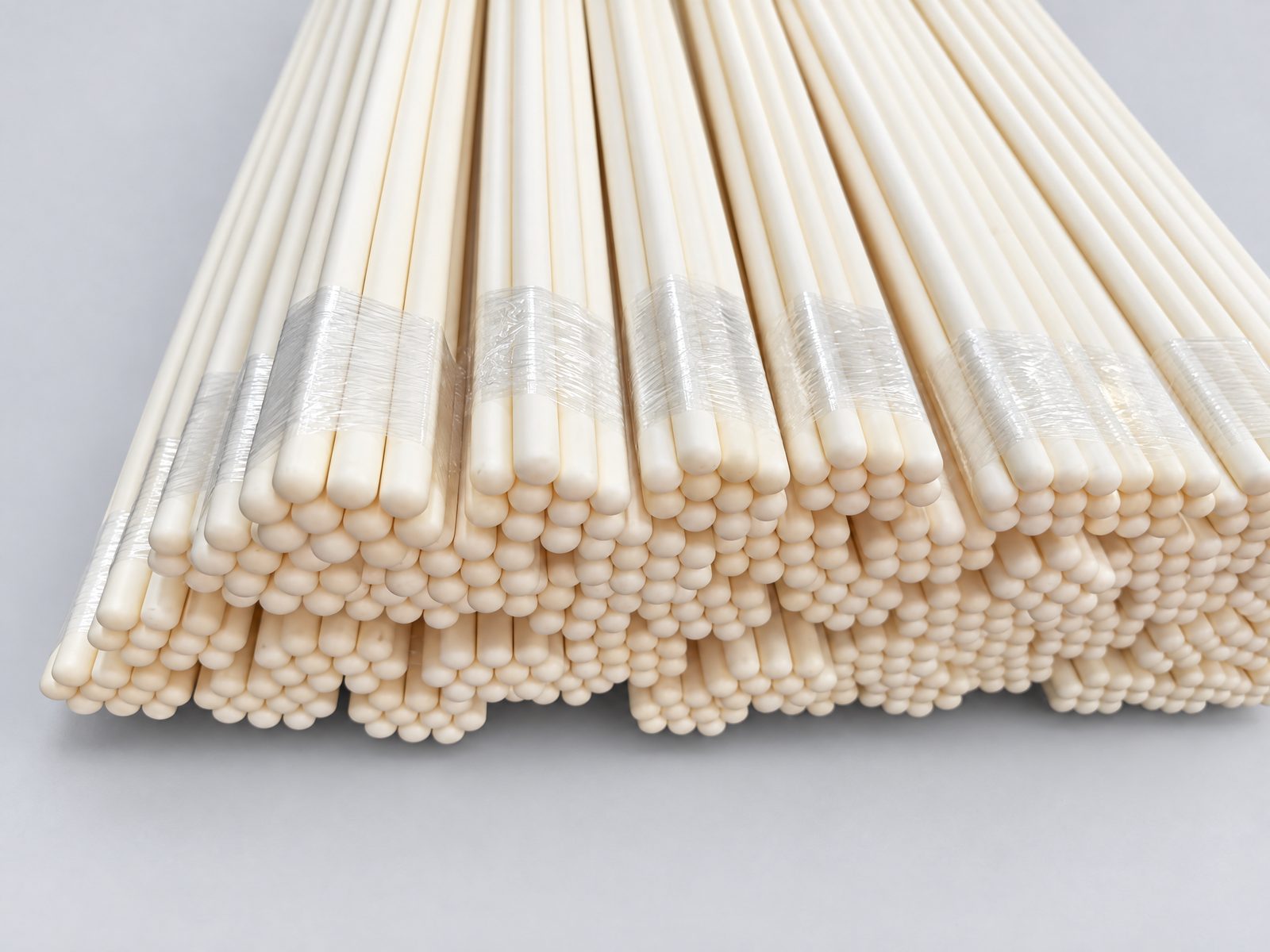
GY Alumina manufactures sintered polycrystalline alumina and corundum ceramic components rather than single-crystal sapphire watch-glasses, polished optical windows, or thin-film electronic substrates. Single-crystal boule growth, optical diamond lapping, and vacuum PVD coating belong to optical sapphire manufacturing, which we do not perform.
When your application calls for opaque, high-temperature aluminum oxide ceramics for furnaces, thermocouple protection, sample containment, or electrical insulation, we make C799 alumina and white alumina parts at our factory in Tangshan using slip casting, pressing, extrusion, and hot pressing, with secondary cutting to length, end slots, side holes, perforations, and closed ends with drilled holes.
Parts we produce to drawing or sample include thermocouple protection tubes, single-, twin-, and multi-bore insulators and capillaries, round, elliptical, and square furnace tubes, threaded, ribbed, and slotted tubes, crucibles and boats, solid alumina rods, square bars, balls, rings, washers, bushings, and discs. Send your drawing, the grade and the quantity. We usually reply with a quote within two working days.
Questions buyers ask
- Can a sapphire crystal scratch or shatter?
- Bare synthetic sapphire resists scratching from quartz dust, steel clasps, and everyday wear, so hairline marks on a watch crystal are almost always scratches in an outer anti-reflective coating rather than in the corundum itself. Because rigid single-crystal sapphire flexes less than acrylic, a sharp blow against metal or stone can chip an exposed edge or fracture the crystal, while coating abrasion and adhesion durability follow test methods in ISO 9211-4:2022.
- How can you tell if a watch has a real sapphire crystal or mineral glass?
- Wipe the face with isopropyl alcohol and place a small water drop near the center to check whether it forms a tall, tight bead when tilted rather than spreading flat as on uncoated mineral glass. Confirm the result with an electronic thermal conductivity crystal tester, which detects rapid heat transfer through single-crystal sapphire compared with amorphous glass or acrylic.
- What is the difference between single-domed and double-domed sapphire crystals?
- A single-domed crystal pairs a curved outer face with a flat underside, creating uneven center-to-edge thickness that acts like a lens and distorts the dial at oblique angles. A double-domed crystal grinds parallel curves on both faces so wall thickness stays uniform, keeping the dial clear and distortion-free from steep viewing angles.
- Which international standards govern circular sapphire watch-glasses?
- ISO 14368-2:2003 defines case-mounting interface dimensions for round mineral and sapphire watch-glasses assembled by adhesive or gasket, and ISO 14368-3:2003 specifies defect nomenclature, test methods, and physical and aesthetic criteria. On divers' watches, the assembled timepiece is tested for water depths of at least 100 m under ISO 6425:2018.
- Are sapphire crystals natural gemstones or lab-grown material?
- Both meanings are common depending on the field. Gemologists and mineral collectors use sapphire crystals to describe uncut natural corundum rough mined from geological deposits, while watchmakers, optical engineers, and semiconductor suppliers mean colorless lab-grown single-crystal aluminum oxide grown in furnaces.
Sources
- ISO 14368-2:2003 Mineral and sapphire watch-glasses Part 2
- ISO 14368-3:2003 Mineral and sapphire watch-glasses Part 3
- ISO 6425:2018 Horology Divers' watches
- ISO 9211-4:2022 Optics and photonics Optical coatings Part 4
- ISO 10110-1:2019 Preparation of drawings for optical elements and systems Part 1
- ISO 9241-307:2008 Ergonomics of human-system interaction Part 307
- IEC 62262:2002 Degrees of protection provided by enclosures against external mechanical impacts
- IEC 61788-22-1:2017 Superconducting electronic devices Generic specification for sensors and detectors
- ASTM E1269-24 Standard Test Method for Determining Specific Heat Capacity by Differential Scanning Calorimetry
Last checked .