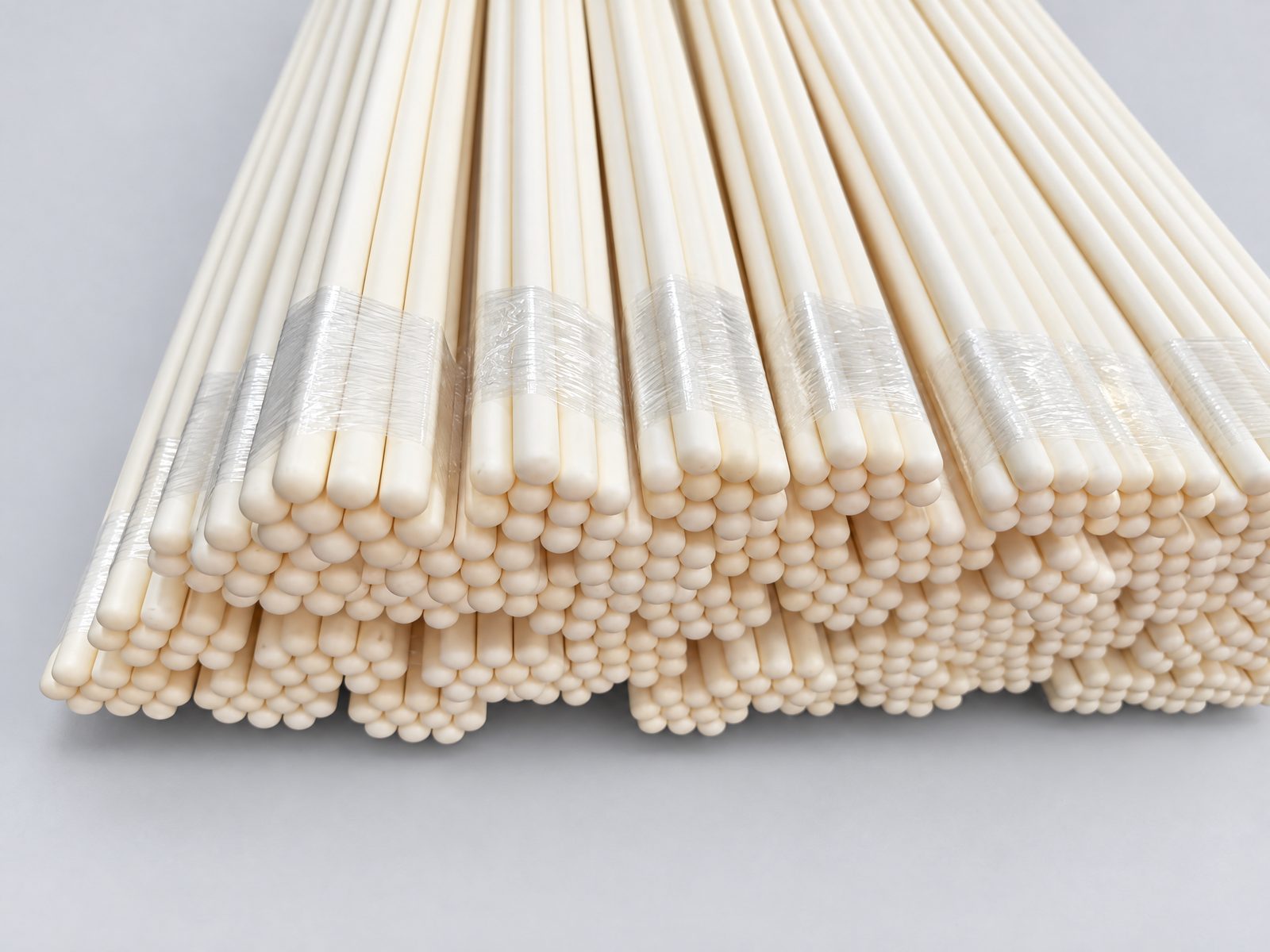
Machinable glass-ceramic and glass-mica materials are solid electrical insulators evaluated under international dielectric and fracture-mechanics standards. In international electrical engineering standards, ceramic, glass-ceramic, glass-mica, and glass insulating materials are classified with typical numerical property values in IEC 60672-3:1997 (Edition 2.0, stability date 2029). Under sustained or cyclic stress, fracture-mechanics testing in ASTM STP35238S found that machinable glass-ceramic has only moderate resistance to subcritical crack growth, making microstructure scale and stress-corrosion checks needed on load-bearing drawings.
What Macor material is and how glass-mica insulators work
On electrical and mechanical drawings, glass-ceramic and glass-mica electrical insulating materials are specified by international material classes and test standards rather than by a shop or brand name alone. Under IEC 60672-3, international standards group ceramic, glass-ceramic, glass-mica, and glass materials for electrical insulating purposes and list material classifications alongside typical numerical values for their major characteristics. Companion standard IEC 60672-2 specifies the laboratory test methods for these materials and notes that forming and processing methods impose practical limitations when comparing test pieces against finished insulating components.
At the same time, machinable glass-ceramic remains a brittle solid in service rather than a ductile engineering plastic or metal. Once the part leaves the spindle and gets bolted into an assembly, it responds to clamping preload, thermal gradients, surface scratches, and ambient moisture according to brittle fracture mechanics. International bodies classify its electrical insulation role under IEC 60672-1:1995 and standardize general ceramic terminology under ASTM C242-21, which directs inspectors to ASTM Terminology F109 when defining surface imperfections such as chips, cracks, and pits on finished ceramic faces.
International standards for glass-ceramic and glass-mica materials
Engineering drawings that only write a shop name without a material or test standard leave incoming inspection blind when comparing batches or qualifying alternate stock. Solid electrical insulating materials made of ceramic, glass, glass-ceramic, and glass-mica are governed internationally by the three-part IEC 60672 series prepared by IEC Technical Committee TC 15. Part 1 establishes the definitions and material group classifications, Part 2 specifies the laboratory test procedures, and Part 3 gives the classification tables and typical numerical values for major electrical, thermal, and mechanical characteristics.
As stated directly in the scope of IEC 60672-2:1999, because actual insulating components almost always differ in size and shape from standardized laboratory test pieces, test-piece numbers serve only as a guide to the real performance of a finished part. Forming direction, blank thickness, and machining marks all shift component strength.
Using international IEC designations also simplifies cross-border purchasing when your drawings go out to machine shops and ceramic factories in multiple countries. Under the IEC Affiliate Country Programme documented on the IEC Sustainable Development Goal 10 portal, participating developing countries can adopt up to 400 IEC International Standards for national use alongside the 4 global IEC Conformity Assessment Systems. Calling out the exact IEC specification and test method keeps buyer expectations aligned across export supply chains.
| Standard | Current Edition and Date | Document Length | Technical Committee | Scope on Engineering Drawings |
|---|---|---|---|---|
| IEC 60672-1:1995 | Edition 2.0, June 27, 1995 (stability date 2029) | 29 pages | IEC TC 15 | Definitions and classification for ceramic, glass, and glass-ceramic electrical insulators |
| IEC 60672-2:1999 | Edition 2.0, December 22, 1999 (stability date 2029) | 87 pages | IEC TC 15 | Standard methods of test and forming-limitation guidance for insulating materials |
| IEC 60672-3:1997 | Edition 2.0, October 17, 1997 (stability date 2029) | 25 pages | IEC TC 15 | Specifications and typical numerical values for ceramic, glass-ceramic, glass-mica, and glass materials |
| ISO 14704:2016 | Edition 3, April 2016 (confirmed September 7, 2021) | 28 pages | ISO/TC 206 | Room-temperature flexural strength test for monolithic fine ceramics with grain size below 200 µm |
| ASTM C20-00(2022) | Active, updated February 28, 2022 | 3 pages | ASTM C08.03 | Boiling-water test for apparent porosity, water absorption, apparent specific gravity, and bulk density |
| ASTM C242-21 | Active, updated November 22, 2021 | 12 pages | ASTM C21.01 | Standard terminology for ceramic whitewares and related products, referencing ASTM F109 for surface flaws |
Mechanical reliability, stress corrosion, and fatigue limits
Most vendor brochures for machinable glass-ceramic highlight short-term room-temperature strength and stop there. For a design engineer, the bigger risk in glass-matrix materials is delayed fracture under steady clamping or bending loads. In ASTM STP35238S (published January 1, 1984, pages 81 to 94, developed under ASTM Committee E08 from testing at the National Aeronautics and Space Administration Goddard Space Flight Center), researchers evaluated both the dynamic and static fatigue behavior of a machinable glass-ceramic to measure its vulnerability to stress-corrosion delayed failure.
Stress corrosion happens when ambient moisture or reactive gases reach the strained silicate bonds at the tip of a microscopic machining flaw. Even when the applied tensile stress sits well below the fast-fracture rating on a datasheet, slow subcritical crack growth can lengthen that flaw over days or months until the insulator snaps without warning. The NASA Goddard study in ASTM STP35238S concluded that resistance to subcritical crack growth in machinable glass-ceramic is only moderate and depends directly on the size of its microstructure. Coarser or uneven microstructural regions change how cracks deflect and coalesce under sustained tension.
To translate laboratory fracture data into safe service life predictions, ASTM STP844-EB (published 1984, 226 pages across 12 technical papers) outlines fracture-mechanics methods specifically addressing the structural reliability of brittle glasses and ceramics in actual hardware. For room-temperature strength verification on fine-grained ceramic and reinforced composite test bars, ISO 14704:2016 (presently under systematic review initiated July 15, 2026) applies to materials with a grain size below 200 µm. As the ISO 14704 abstract notes, flexural fracture initiates from tensile stress, so engineers combine flexural test results with Weibull statistics and the stressed component volume when estimating allowable uniaxial tensile stress.
Why test bar values differ from thick blocks and machined parts
Buyers frequently ask why a thick machined insulator plate cracks during bolt-up when its calculated bending stress is half the datasheet flexural number. Two physical mechanisms explain the gap: Weibull stressed-volume scaling and specimen-section bias during material processing. Both ISO 14704 and IEC 60672-2 warn that a small, finely ground flexural bar samples a tiny volume of material, whereas a thick machined manifold or flange exposes a much larger surface and interior volume to tensile stress and machining tool marks.
Standardized physical testing in ASTM C20-00(2022) (Book of Standards Volume 15.01) illustrates how strongly specimen geometry and cutting history affect measured ceramic properties. In laboratory studies documented in Section 3.4 of ASTM C20, researchers found a measurement bias between cast specimens formed directly at 50 by 50 by 50 mm (2 by 2 by 2 in.) and specimens quartered out of larger 228 by 114 by 64 mm (9 by 4.5 by 2.5 in.) blocks. By our calculation from the metric dimensions in ASTM C20-00(2022), the full 228 by 114 by 64 mm block holds 1,663,488 mm3, so each quartered piece holds 415,872 mm3 versus 125,000 mm3 for the formed 50 mm cube, or more than 3.3 times the specimen volume.
That same ASTM standard highlights two additional quality-control rules that apply whenever you verify bulk density or zero-porosity claims on incoming ceramic blanks. Second, water-immersion porosity methods assume the specimen does not react with water. In the ASTM C20 study, castables heated to 816 °C (1500 °F) and saturated with water under Test Methods C830 showed porosity errors caused by phase re-hydration. Confirm with your supplier which density and Impervious-porosity test method from IEC 60672-2 was run on your specific lot.
Friction, sliding wear, and vibration testing for ceramic insulators
Read more
Machinable glass-ceramic is easy to cut specifically because localized micro-fracturing cleaves tiny flakes ahead of a cutting edge. While that mechanism is helpful on a milling machine, it becomes a liability if your design puts a glass-mica part into unlubricated sliding contact, rotary rubbing, or high-frequency fretting against a metal shaft or ceramic plunger. Static compression strength alone does not predict wear debris generation in vacuum chambers or heated actuators.
ASTM STP1010-EB (Selection and Use of Wear Tests for Ceramics, published 1988, 100 pages, developed by ASTM Committee G02) and symposium paper ASTM STP19698S (published January 1, 1988, pages 24 to 42) detail how engineers test bare and solid-lubricated ceramic combinations under realistic thermal and mechanical duty cycles. In the apparatus described in ASTM STP19698S, 2 stationary rub shoes press from opposite sides against a rotating cylindrical rod heated by a compact infrared quartz lamp rather than a large furnace, tracking wear depth continuously across both surfaces.
When an electrical insulator on your print also acts as a linear guide bushing, cam follower, or vibrating spacer, review the operating conditions against the test variables in the table below. If your assembly combines high contact loads, cyclic vibration up to 50 Hz, and dry inert-gas purging where protective surface films cannot reform, dense sintered oxide ceramics generally outlast softer machinable glass-mica compositions.
| Test Variable | Documented Test Capability | Design Check for Ceramic Insulators |
|---|---|---|
| Sliding contact speed | 0.5 to 5.0 m/s | Captures frictional heating and surface pull-out across slow indexing and fast shaft speeds |
| Normal contact force | Up to 200 N | Checks contact-stress threshold where subsurface micro-cracking turns into flaking wear |
| Loading waveform | Steady-state or repetitive up to 50 Hz | Reproduces machine vibration and cyclic hammering that drive fretting damage |
| Stationary sample geometry | Flat, concave or convex cylindrical, or spherical | Matches point, line, or conformal contact pressure of your mating hardware |
| Surrounding purge atmosphere | Standard air, dry nitrogen, helium, or argon | Tests wear behavior in dry inert gas where ambient humidity is absent |
Worked example: specifying a machinable glass-ceramic insulator on a print
Worked example written by our team. The engineering scenario is invented to illustrate how to apply the standards above to a real part drawing.
Suppose you are designing a custom electrical stand-off block that supports a heated sensor rail inside a dry-nitrogen test chamber. You need 3 prototype blocks next week to validate sensor alignment, and you plan to machine them in-house from glass-mica insulating bar stock before freezing the design for batch manufacturing.
First, tighten the title-block material note. Instead of writing an informal trade name alone, specify the glass-ceramic or glass-mica material class from IEC 60672-3 alongside the supplier's lot datasheet, and require any verification testing to follow IEC 60672-2. That gives your quality team an unambiguous baseline for dielectric and physical checks.
Second, redesign the mounting ears for compression rather than cantilever bending. Because ASTM STP35238S established that machinable glass-ceramic has only moderate resistance to subcritical crack growth under stress corrosion, sustained tensile bending around a countersunk screw head invites delayed cracking. Replace countersunk flat-head screws with flat-faced shoulder bolts, broad compliant washers, and generous corner radii so clamping loads stay compressive across the block.
Third, add a surface-condition note referencing ASTM Terminology F109 (via ASTM C242-21) on all stressed edges and through-holes. Break sharp hole exits with clean chamfers so exit burrs or edge chips do not act as starter flaws, and account for Weibull stressed-volume scaling from ISO 14704 if your production block is cut from a thick slab rather than a thin bar.
Dental, food-contact, and additive ceramic standards to keep separate
Read more
Because the term glass-ceramic appears across electronics, kitchenware, medical devices, and 3D printing, procurement teams occasionally paste the wrong ISO or ASTM standard onto an industrial drawing. Keeping regulated end-use standards separate from electrical insulation specs prevents rejected quotes and unnecessary lab fees.
For dental prostheses, ISO 6872:2024 (Edition 5, published August 2024, 31 pages, prepared by Technical Committee ISO/TC 106/SC 2) governs dental ceramic materials used in fixed all-ceramic and metal-ceramic restorations. For consumer tableware and cookware, ISO 6486-1:2019 (Edition 3, published August 2019, 26 pages, prepared by ISO/TC 166) specifies the test method for lead and cadmium release from ceramic ware, glass-ceramic ware, and glass dinnerware used to prepare, cook, serve, or store food and beverages, while explicitly excluding vitreous and porcelain enamel articles under ISO 4531 as well as industrial food-manufacturing equipment.
If your team is evaluating 3D-printed ceramics as another tooling-free route alongside machinable glass-ceramic, watch the work of ASTM Committee F42 on Additive Manufacturing Technologies (formed in 2009, with 8 technical subcommittees, membership in excess of 809, and standards published in Book of Standards Volume 10.04). In an August 6, 2026 update, ASTM announced that Committee F42 proposed a dedicated design guide for ceramics establishing a framework to mitigate cracking and embrittlement in additively manufactured ceramic parts.
Buyer checklist before ordering machined or sintered ceramic insulators
Before you release a print for either workshop machining in glass-mica stock or factory production in technical alumina, run through this engineering checklist with your designer and purchaser. Catching tensile stress risers or over-specified features on paper saves weeks of rework once parts reach incoming inspection.
- Confirm the material classification and lot sheet: pair any machinable glass-ceramic callout with IEC 60672-3 and ask the stock supplier for the lot's electrical and thermal datasheet.
- Eliminate sustained tensile clamping loads: use flat washers, compliant gaskets, and compressive clamping shoulders to guard against the moderate subcritical crack growth resistance documented in ASTM STP35238S.
- Scale down allowable stress for thick blanks: apply Weibull volume thinking from ISO 14704 and test-piece size limits from IEC 60672-2 rather than copying thin-bar flexural numbers onto thick blocks.
- Check sliding and vibration duty: if the insulator rubs against a moving rod or sees cyclic loads up to 50 Hz, evaluate wear conditions per ASTM STP1010-EB and consider switching to dense sintered alumina.
- Define edge and surface acceptance clearly: add chamfers at hole exits to prevent breakout chipping and use standard defect terms from ASTM C242-21 and ASTM F109 on inspection drawings.
- Match the forming route to your order quantity and heat load: use in-house machined glass-ceramic for rapid one-off prototypes, and evaluate sintered oxide ceramics when higher thermal severity, abrasive wear, or repeat batch quantities apply.
When to use sintered C799 alumina and what GY Alumina makes
GY Alumina is the export brand of our ceramic factory in Tangshan, China, with 100+ customers served across furnace, thermocouple, laboratory, and industrial manufacturing. We do not manufacture or supply Macor or machinable glass-ceramic stock. Instead, we manufacture dense sintered alumina and corundum ceramic components, where our standard grade is C799 alumina alongside 95% white alumina for applications that outgrow machinable glass-ceramics in thermal demand, chemical wear, or production batch volume.
Using slip casting, pressing, extrusion, and hot pressing, we produce thermocouple protection tubes, twin- and multi-bore thermocouple insulators and capillaries, furnace tubes, crucibles and boats, solid alumina rods, square bars, balls, rings, washers, bushings, discs, and custom shapes to your drawing or sample.
For parts that need features beyond a plain extruded or cast profile, we perform cut-to-length work, end slots, side holes, perforated tubes, and closed ends with drilled holes at the factory, and 5-10 free samples are sent for approval first while the buyer pays the courier. If you are reviewing a drawing and want to check whether your insulator, tube, rod, or custom shape can be produced in sintered C799 alumina, our team is glad to review your print. Send your drawing, the grade and the quantity. We usually reply with a quote within two working days.
Questions buyers ask
- Which international standards cover glass-ceramic and glass-mica insulators?
- The three-part IEC 60672 series covers these materials for electrical insulation: IEC 60672-1:1995 sets definitions and classifications, IEC 60672-2:1999 specifies test methods, and IEC 60672-3:1997 provides material classifications and typical numerical property values.
- Is machinable glass-ceramic vulnerable to static or dynamic fatigue?
- Yes. Fracture-mechanics testing published in ASTM STP35238S evaluated dynamic and static fatigue in a machinable glass-ceramic and found only moderate resistance to subcritical crack growth under stress corrosion, with performance depending on the size of its microstructure.
- How is the flexural strength of monolithic technical ceramics measured?
- ISO 14704:2016 specifies the room-temperature flexural strength test method for monolithic fine ceramics and whisker- or particulate-reinforced composites with grain size below 200 µm. Engineers combine flexural test results with Weibull statistics and stressed component volume to estimate uniaxial tensile strength.
- Does GY Alumina make Macor or machinable glass-ceramic parts?
- Buyers who prototype in machinable glass-ceramic can send their drawing to check feasibility for repeat production in sintered alumina.
Sources
- IEC 60672-1:1995 Ceramic and glass insulating materials - Part 1: Definitions and classification
- IEC 60672-2:1999 Ceramic and glass insulating materials - Part 2: Methods of test
- IEC 60672-3:1997 Ceramic and glass-insulating materials - Part 3: Specifications for individual materials
- International Electrotechnical Commission SDG 10 Standards Overview
- ASTM STP35238S Dynamic and Static Fatigue of a Machinable Glass Ceramic
- ASTM STP844-EB Methods for Assessing the Structural Reliability of Brittle Materials
- ISO 14704:2016 Fine ceramics - Test method for flexural strength of monolithic ceramics at room temperature
- ASTM C20-00(2022) Standard Test Methods for Apparent Porosity, Water Absorption, Apparent Specific Gravity, and Bulk Density
- ASTM C242-21 Standard Terminology of Ceramic Whitewares and Related Products
- ASTM STP1010-EB Selection and Use of Wear Tests for Ceramics
- ASTM STP19698S Unique Friction and Wear Tester for Fundamental Tribology Research
- ISO 6872:2024 Dentistry - Ceramic materials
- ISO 6486-1:2019 Ceramic ware, glass ceramic ware and glass dinnerware in contact with food - Part 1: Test method
- ASTM Committee F42 on Additive Manufacturing Technologies
Last checked .