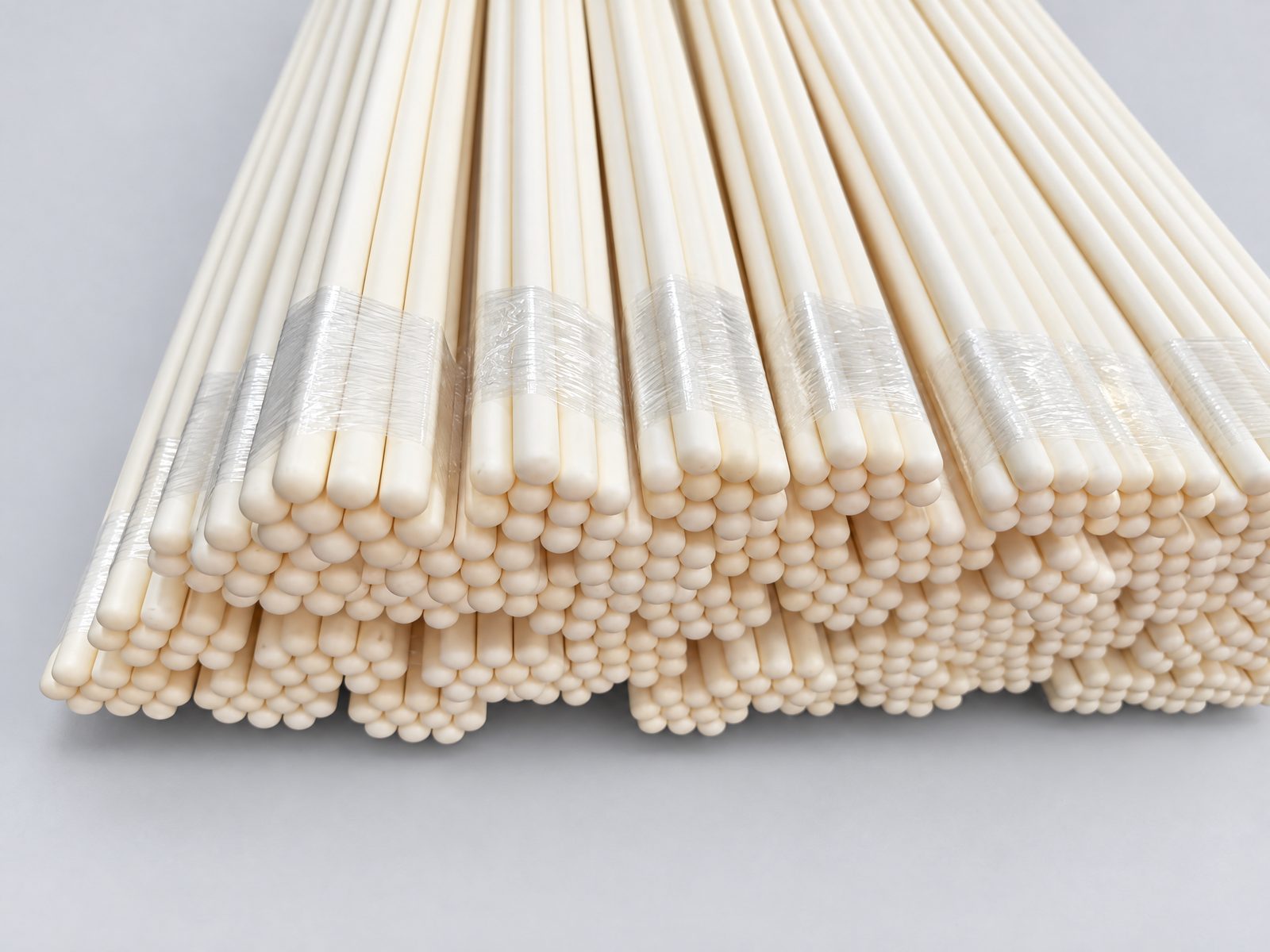
No, dense sintered alumina (aluminum oxide, Al2O3) is chemically stable and non-toxic in solid contact, to the point that ISO 6474-1:2019 and ISO 6474-2:2019 (for composites with an alumina mass fraction above 60%) standardize high-purity alumina for permanent bone and joint implants. Potential biological risks arise instead from loose particulate debris, lower-purity chemical constituents, or manufacturing residues, which are evaluated separately under ISO 10993-18:2020 and ASTM particle standards F1877-24, F1903-25, and F1904-23. Under ISO 10993-1:2025 and ASTM F748-25, whether aluminum oxide can harm you depends on its physical state, chemical purity, and the route and duration of body contact.
Alumina vs. Metallic Aluminum and Soluble Aluminum Salts
Alumina and aluminum oxide are two names for the exact same chemical compound, Al2O3. Much of the confusion around aluminum oxide safety happens because general health articles lump three chemically distinct materials together: bare metallic aluminum, water-soluble aluminum salts, and insoluble aluminum oxide ceramic.
Elemental metallic aluminum is a reactive metal that oxidizes on contact with air and dissolves in strong acids or bases. Soluble aluminum salts, such as the active compounds formulated for antiperspirants or water coagulants, are designed to dissolve in moisture and release free aluminum ions. Alumina is different because the aluminum atoms are already oxidized and locked tightly to oxygen atoms in a stable ceramic bond.
Physical processing further separates ceramic forms of Al2O3. When high-purity alumina powder is compacted and sintered at high kiln temperatures into dense polycrystalline corundum (alpha-alumina), the fused crystal lattice resists chemical attack, moisture, and biological fluids. International surgical standards such as ISO 6474-1:2019 classify dense high-purity alumina as a bio-stable ceramic, and electrical engineering standards such as IEC 60672-1:1995 group fired ceramic insulating materials for industrial service. By contrast, loose un-sintered powders and transitional alumina phases carry high specific surface area and can become airborne or release surface residues if handled without controls.
- Elemental aluminum: unoxidized metal that reacts chemically with acids, alkalis, and oxygen.
- Soluble aluminum salts: moisture-soluble compounds engineered to dissolve into ions in aqueous solutions.
- Dense sintered alumina (Al2O3): fired polycrystalline oxide ceramic that remains insoluble and chemically stable in solid handling.
- Loose alumina powder and grinding dust: fine solid particulates that pose respiratory hazards if inhaled in workplace air.
Safety by Physical Form and Exposure Route
When engineers, safety officers, or consumers ask if aluminum oxide is bad for you, international biocompatibility standards evaluate the answer along two axes: the physical state of the material and how it contacts the body. ASTM F748-25 states that material biocompatibility depends to a large degree on the particular nature and duration of tissue contact during intended use.
Touching dense sintered alumina ware, thermocouple tubes, laboratory crucibles, ceramic watch bezels, or cosmetic mineral coatings on intact skin does not drive aluminum into the bloodstream because solid Al2O3 does not dissolve in sweat or skin oils. Where skin reactions occur with coarse alumina scrubs or repeated rubbing, evaluators test for local mechanical or contact skin irritation rather than systemic poisoning. On ASTM Subcommittee F04.16, 5 of the 25 active biocompatibility standards address skin irritation and contact allergens, including ASTM F719-20(2025) for primary skin irritation and ASTM F2808-23 for repeated or extended skin contact.
Oral and fluid-contact pathways follow the same solubility rule. Solid alumina ceramic is an industrial material rather than an edible food ingredient, yet dense alumina coatings and high-purity ceramic fluid components resist chemical breakdown in neutral water. Safety testing for fluid-contacting ceramics focuses on chemical extractables and leachables, particularly when acidic fluids contact lower-purity ceramic binders or unconditioned activated alumina filter media, and on protecting patients with impaired kidney clearance who cannot excrete dissolved ions efficiently. Buyers working with food-contact coatings or drinking-water media confirm regulatory limits directly against U.S. Food and Drug Administration (FDA) food-contact listings and drinking-water equipment certifications.
| Physical Form | Exposure Route | Primary Health or Safety Focus | Active Standard or Evaluation Protocol |
|---|---|---|---|
| Dense monolithic high-purity alumina | Long-term surgical implantation in bone or joints | Bio-stable load-bearing solid, verified for density, grain size, and purity | ISO 6474-1:2019 and ASTM F603-12(2025) |
| Zirconia-reinforced alumina composite (above 60% Al2O3 mass fraction, ISO 6474-2:2019, and ISO 10993-1:2025 scope) | Orthopedic joint prostheses and bone spacers | Bio-stable matrix composite, checked for additive stability (Mg, Y, Ce) and toughness | ISO 6474-2:2019 and ISO 10993-1:2025 |
| Surface-contacting ceramics and topical mineral powders | Intact skin and external surface contact | Non-penetrating solid, screened for local skin irritation or contact hypersensitivity | ASTM F719-20(2025), ASTM F2808-23, and ASTM F2148-25 |
| Fluid-contacting ceramic components | Clinical fluid contact or liquid extraction | Control of process residues, extractables, leachables, and ion release | ISO 10993-18:2020, ASTM F619-20(2025), and ASTM F3306-26 |
| Loose alumina powder, grinding dust, and wear debris | Airborne workplace inhalation or local tissue debris | Workplace atmosphere control and cellular response to fine particles | IEC 62990-1:2019, ASTM F1877-24, and ASTM F1903-25 |
Why Loose Alumina Powder and Particulate Debris Require Controls
Handling loose alumina powder or generating fine particulate debris is the primary scenario where aluminum oxide requires active workplace and biological hazard controls. Particulate exposure arises in industrial and workshop operations when un-sintered ceramic powders are batched or when fired alumina parts are cut or ground dry without dust capture.
While a solid ceramic tube cannot enter your lungs, loose micron-scale Al2O3 particles can become suspended in workshop air during dry handling. Commercial aluminum oxide powder specifications vary across distinct classes of particle size, chemical grades, and levels of acidity, requiring testing for water-soluble content, particle size, and hydrogen-ion concentration when used as insulating coatings or ingredients of ceramic mixtures for electronic device components.
Materials standards treat loose particles as a distinct biological risk category from solid blocks of the exact same chemical formula. Out of the 25 active standards maintained by ASTM Subcommittee F04.16 on Biocompatibility Test Methods, 3 standards are dedicated specifically to particle hazards: ASTM F1877-24 for characterizing particle morphology and size, ASTM F1903-25 for testing cellular responses to particles in vitro, and ASTM F1904-23 for testing biological responses to particulate debris and degradation products in vivo, alongside cytotoxicity screening under ASTM F895-25.
Preventing inhalation risk on the shop floor requires engineering dust out of the breathing zone. International workplace atmosphere monitoring frameworks include IEC 62990-1:2019 and IEC 62990-2:2021. Before cutting, grinding, or pouring dry aluminum oxide powder, facilities should confirm current national permissible exposure limits for total dust and respirable fraction on official OSHA and NIOSH chemical tables and follow the respiratory PPE and local exhaust requirements on the powder supplier's Safety Data Sheet.
Medical Implants: Why High-Purity Dense Alumina Goes Inside the Body
The clearest proof that dense, pure aluminum oxide is not inherently toxic to human tissue is its decades-long standardization for permanent surgical implants. Orthopedic and dental manufacturers use high-purity sintered alumina for hip joint replacement bearings (femoral heads and acetabular inserts), bone spacers, bone replacements, and dental implants where low wear and chemical stability inside human tissue fluids are mandatory.
Three active international material standards define medical-grade alumina ceramics. Under ASTM Subcommittee F04.13 on Ceramic Materials (which oversees 10 active ceramic implant standards), ASTM F603-12(2025) covers the material requirements for high-purity, dense aluminum oxide for load-bearing surgical implant applications. It requires strict verification of physical properties (bulk density, weight, and grain size), chemical composition measured by ICP-AES, XRF, or mass spectroscopy, and mechanical properties (compressive strength, flexural strength, elastic modulus, Vickers hardness, and Weibull modulus). Notably, ASTM F603 qualifies the dense raw material as delivered to the parts manufacturer rather than finished femoral heads or dental implants.
Meeting a ceramic raw-material specification is only the first step in clinical safety. Both ISO 6474-1 and ISO 6474-2 state explicitly that the material standard alone does not cover biocompatibility, placing legal responsibility on the device manufacturer to evaluate the biological safety of the finished implant under ISO 10993-1.
Systemic Toxicity, Leaching, and How Regulators Evaluate Risk
Read more
Public concern around aluminum compounds often centers on systemic health questions, including neurotoxicity, bone issues, cancer potential, and chemical leaching. ASTM International works closely with regulatory bodies such as the U.S. Food and Drug Administration (FDA) and surgical and medical instrumentation groups to align medical device test methods with regulatory requirements. Evaluators address every systemic endpoint through quantitative testing rather than broad assumptions.
ISO 10993-1:2025 is the reference standard used worldwide to protect patients and users from unintended biological harm, operating inside the ISO 14971:2019 risk-management framework and alongside medical quality systems such as UNE-EN ISO 13485. Rather than repeating animal tests blindly, evaluators first review material composition, pre-existing toxicological data, and chemical characterization.
ISO 10993-18:2020 sets out that stepwise chemical characterization. Evaluators identify and quantify the materials of construction, chemical constituents and impurities, manufacturing contaminants (such as mold release agents, machining coolants, and sterilization residues, also assessed under ASTM F2847-26), laboratory extractables (see ASTM F619-20(2025)), and clinical leachables or ion release (tested for implants under ASTM F3306-26).
Where chemical extractables data or prior clinical history leave open questions for a specific tissue pathway, ASTM F748-25 maps contact type and worst-case clinical exposure duration to targeted biological tests. Active Subcommittee F04.16 test methods cover acute systemic toxicity of material extracts (ASTM F750-26), neurotoxicity evaluation for devices contacting the nervous system (ASTM F2901-26a), indirect hemolysis for devices contacting cerebral spinal fluid (because cerebral spinal fluid is reabsorbed into the venous system), long-term muscle and bone tissue response (ASTM F981-23), and lifetime bioassays for tumorigenic potential (ASTM F1439-24). High-purity, fully sintered alumina passes demanding implant evaluations precisely because its tightly bound crystal structure releases negligible ions compared with impure silicate-bonded ceramics or uncleaned parts carrying residual processing chemicals.
Worked Example: Screening an Alumina Tube Assembly for Health and Contamination Risk
Read more
Consider a practical engineering scenario written by our team. Suppose you are a process engineer building a high-temperature analytical furnace and fluid-sampling rig. Your bill of materials includes a sintered high-purity alumina protection tube and custom slotted alumina spacers. Your safety manager asks whether the alumina components pose an inhalation hazard to technicians during assembly or a chemical leaching risk to high-purity acidic liquid samples.
First, audit physical form and in-house machining. If you purchase raw stock rods and cut slots dry on an unventilated bench saw, your shop generates airborne Al2O3 dust, creating an immediate airborne particulate hazard that triggers workplace atmosphere controls (such as IEC 62990-1:2019 monitoring, wet diamond cutting, local exhaust capture, and rated respirators). If instead you specify the exact cut length, end slots, and side holes on your drawing so the ceramic factory performs those operations before shipping, your technicians handle only dense, dust-free solid parts.
Second, evaluate chemical purity and surface residues using the logic of ISO 10993-18:2020. Lower-grade ceramics rely on silicate fluxing glasses at grain boundaries, which hot acids can attack and leach. Specifying a high-purity sintered corundum grade minimizes secondary glassy phases. Before closing the analytical chamber, an ultrasonic wash in deionized water followed by a clean thermal bake-out removes surface handling oils and packing dust (mirroring manufacturing-residue control under ASTM F2847-26).
Third, match verification to end-use regulations. For an industrial furnace or lab analyzer, clean high-purity dense alumina poses no dermal hazard to operators and keeps sample contamination minimal. If that same subassembly is redesigned for a human medical device or potable-water system, you step up to formal extractables testing under ISO 10993-18:2020 and biological risk assessment under ISO 10993-1:2025, or verify potable-water leaching certification for the exact pH range of your water stream.
Six-Step Alumina Safety Checklist for Engineers and Buyers
Separating bulk ceramic safety from powder and residue hazards keeps both workers and end users safe. Use this six-step checklist written by our team before releasing a purchase order or shop procedure.
- Check physical state at receiving: apply standard clean-part handling for dense sintered ceramics, and enforce strict dust containment whenever receiving loose Al2O3 powders or granules.
- Order factory secondary machining: specify cut-to-length dimensions, slots, perforations, and drilled holes on your procurement drawing so your technicians do not dry-grind fired ceramics in-house.
- Control machining dust at the source: if in-house grinding is unavoidable, use wet coolant flood, enclosed local exhaust with HEPA filtration, and respiratory PPE matched to current OSHA and NIOSH limits on the supplier's Safety Data Sheet.
- Match alumina purity to chemical aggressiveness: select high-purity corundum grades rather than lower-alumina silicate bodies when parts contact hot acids, halogens, molten metals, or ultra-pure analytical media.
- Remove surface process residues before clean service: wash and bake out finished ceramic tubes, boats, and crucibles prior to vacuum, semiconductor, analytical, or cleanroom installation.
- Require medical-grade qualification for clinical devices: for surgical implants or human tissue contact, source raw materials qualified under ASTM F603-12(2025) or ISO 6474-1:2019 and complete finished-device evaluation under ISO 10993-1:2025.
Specifying Industrial vs. Medical-Grade Alumina Standards
Procurement drawings separate industrial aluminum oxide ceramics from implantable medical ceramics according to end-use service. Industrial electrical and thermal insulating ceramics are classified under IEC 60672-1:1995, IEC 60672-2:1999, and IEC 60672-3:1997, while commercial alumina powders for electronic insulating coatings and ceramic mixtures are specified across distinct particle size classes, chemical grades, and acidity levels.
When a component is intended for surgical implantation or human tissue contact rather than high-temperature kilns, sensors, or laboratory equipment, buyers source medical-grade raw stock under ASTM F603-12(2025), ISO 6474-1:2019, or ISO 6474-2:2019 and complete finished-device biological safety evaluation under ISO 10993-1:2025 and ISO 10993-18:2020.
Send your drawing, the grade and the quantity. We usually reply with a quote within two working days.
Questions buyers ask
- Is aluminum oxide bad for you on skin or in everyday ceramic products?
- No, solid sintered aluminum oxide (alumina) is insoluble in water and skin oils, so touching alumina ceramic parts, cookware surfaces, or mineral cosmetic coatings does not cause skin penetration. Under ASTM Subcommittee F04.16 test protocols such as ASTM F719-20(2025) and ASTM F2808-23, external contact evaluation focuses on local skin irritation, which in everyday use mainly applies if coarse abrasive alumina particles are scrubbed aggressively on sensitive skin.
- Why is alumina used in surgical hip and dental implants if people worry about aluminum?
- Unlike soluble aluminum salts, dense high-purity alumina locks aluminum and oxygen into a chemically stable crystal lattice that resists body fluids and mechanical wear. Standards such as ASTM F603-12(2025), ISO 6474-1:2019, and ISO 6474-2:2019 classify properly manufactured high-purity alumina and alumina-matrix composites (above 60% alumina mass fraction) as bio-stable materials for load-bearing joint prostheses and bone replacements.
- When does alumina require special biological or workplace safety controls?
- Alumina requires strict controls when handled as a loose airborne powder, generated as fine particulate debris, or exposed to fluids while carrying manufacturing residues. Workplace atmosphere standards such as IEC 62990-1:2019 govern industrial air monitoring, while ASTM particle standards F1877-24, F1903-25, and F1904-23 evaluate cellular and tissue responses to fine particulates.
- Does high-purity alumina leach toxic chemicals into liquids or tissue?
- Dense, fully sintered high-purity alumina has minimal solubility, whereas chemical leaching concerns usually trace back to impure glassy binders, acidic extraction of unconditioned filter media, or uncleaned manufacturing residues. In regulated medical devices, ISO 10993-18:2020 and ASTM F3306-26 require stepwise testing of chemical constituents, process contaminants, laboratory extractables, and clinical ion release to verify safety.
- Is industrial alumina ceramic the same as medical-grade implant alumina?
- Both can be high-purity dense aluminum oxide ceramics, but they are produced and documented under different standards for different end uses. Industrial ceramic insulating parts follow standards such as IEC 60672-1:1995 for furnaces, sensors, and laboratories, whereas surgical implant materials require raw-material qualification under ASTM F603-12(2025) or ISO 6474-1:2019 plus finished-device biocompatibility evaluation under ISO 10993-1:2025.
Sources
- ISO 10993-1:2025 Biological evaluation of medical devices, Part 1
- ISO 6474-1:2019 Implants for surgery, Ceramic materials, Part 1: High purity alumina
- ISO 6474-2:2019 Implants for surgery, Ceramic materials, Part 2: Alumina matrix composites
- ISO 10993-18:2020 Chemical characterization of medical device materials
- ASTM F603 Standard Specification for High-Purity Dense Aluminum Oxide for Medical Application
- ASTM F748-25 Standard Practice for Selecting Biological Test Methods for Materials and Devices
- ASTM Standard Specification for Aluminum Oxide Powder
- ASTM Subcommittee F04.16 on Biocompatibility Test Methods
- ASTM Subcommittee F04.13 on Ceramic Materials
- ASTM Medical Device Standards and Implant Standards
- ASTM Regional Medical Device Standards and Test Methods
- IEC International Standards and Conformity Assessment (SDG 10 )
Last checked .