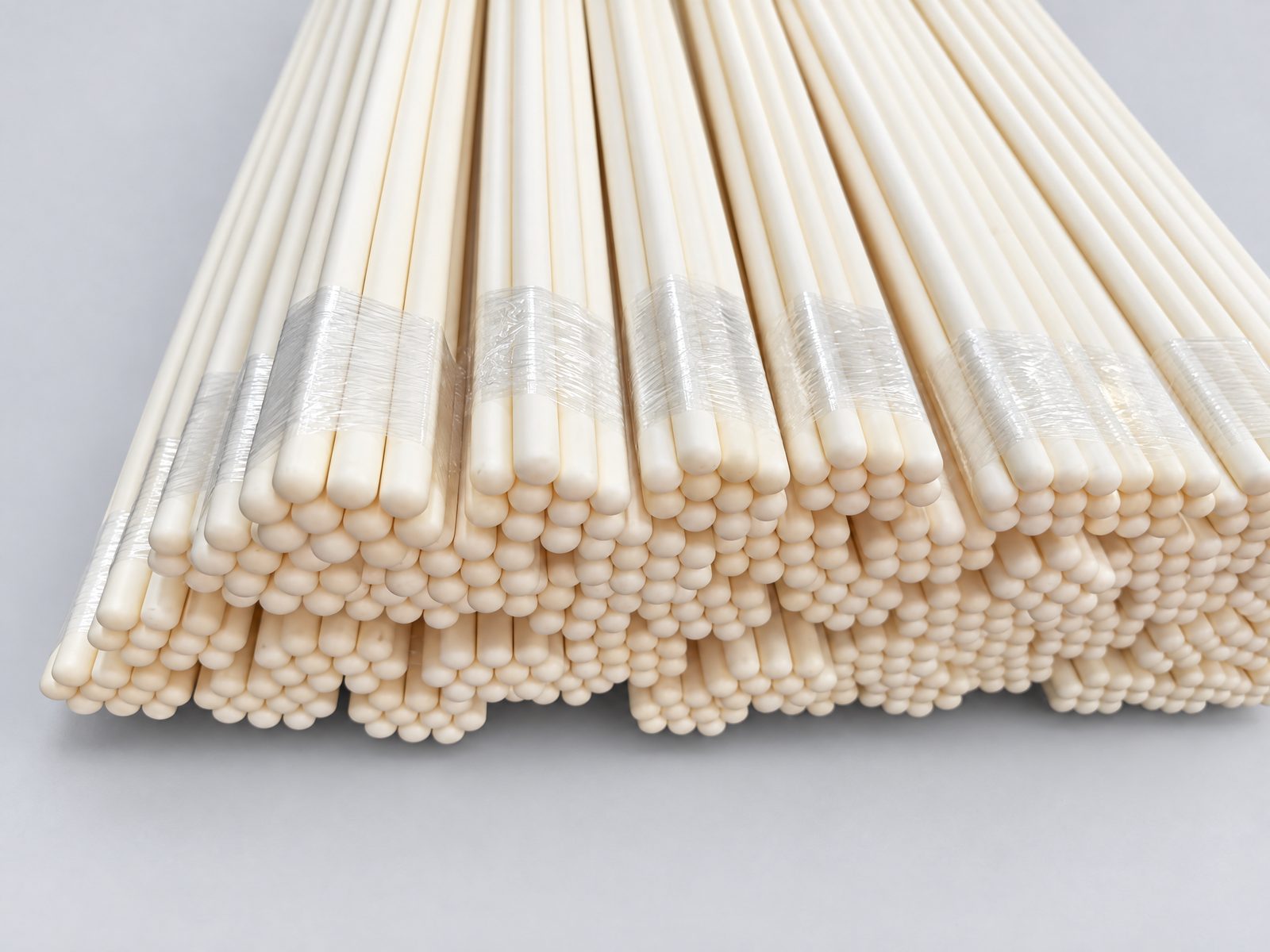
A ceramic plate rectangle refers to three distinct products depending on your setting: glazed serving platters and dinner plates, flat architectural wall and floor tiles, or dense technical plates and test bars for industrial equipment. Food-contact rectangular ceramic plates are tested for lead and cadmium release using acetic acid extraction under ISO 6486-1:2019 and ASTM C738, while structural ceramic plates with strengths of 50 MPa (about 7 ksi) or higher are evaluated in bending under ASTM C1161. Picking the right piece means matching aspect ratio, rim contour, water absorption, and mechanical strength to your table, installation, or furnace fixture.
Platters vs. Dinner Plates: Sizes, Aspect Ratios, and Cabinet Fit
Buyers searching for a ceramic plate rectangle, ceramic rectangle plate, rectangle ceramic plate, rectangular ceramic plate, or ceramic rectangular plate often run into a labeling trap in retail and hospitality catalogs. Vendors routinely group narrow serving platters together with individual rectangular dinner plates. Separating those formats by aspect ratio prevents ordering pieces that crowd table settings or jam commercial dishwashers.
Elongated platters use a narrow, linear footprint built for geometric plating along a single axis. Chefs use narrow rectangles for sushi rolls, yakitori skewers, kebabs, tapas flights, charcuterie lines, and shared pastry assortments. Individual rectangular dinner plates use a wider, balanced aspect ratio so a main protein, starch, and vegetable sit side by side without hanging over the border. Small rectangular trays handle soy sauce, condiments, and passed hors d'oeuvres.
Storage and washing clearances work differently for rectangles than for round plates. A round plate has one diameter in every orientation, while a rectangular plate has a corner-to-corner diagonal wider than either side length. Before ordering wide rectangular dinnerware or long platters, measure the interior shelf depth of your kitchen cabinets with the door closed and check the vertical gap beneath your dishwasher's rotating spray arms. Loading long platters along the outer rack perimeter keeps tall corners clear of center wash arms.
In architectural and industrial specifications, flat rectangular ceramics follow strict measurement definitions. Under ASTM C499 (active edition C0499-20R26), specifications for flat rectangular ceramic wall and floor tiles always define nominal size by the minor facial dimension and nominal thickness by the major thickness. International tile classifications in ISO 13006:2018 cover first-quality extruded and dry-pressed tiles while separating miniature mosaics, defined as any piece small enough to fit inside a square with a side below 7 cm.
| Plate Category | Aspect Ratio and Geometry | Primary Applications | Typical Edge Profile | Key Quality Check |
|---|---|---|---|---|
| Elongated Serving Platter | Narrow linear rectangle for shared center-table presentation | Sushi rolls, skewers, charcuterie, tapas, sliced desserts | Flat board or low flared lip | Dishwasher rack height and cabinet shelf length |
| Individual Dinner Plate | Wide balanced rectangle sized for a single place setting | Steak, fish, pasta, composed entrees with sauces | Raised curved or angled rim | Rim chip resistance and foot-ring stack stability |
| Small Appetizer or Sauce Tray | Compact rectangle for side service and condiments | Dipping sauces, petits fours, tea snacks, bread service | Deep upturned wall or stepped rim | Glaze acid resistance and nested stacking fit |
| Architectural Ceramic Tile | Flat pressed or extruded rectangle above 7 cm mosaic limit | Commercial floors, kitchen walls, laboratory counters | Square, cushioned, or rectified edge | Facial size, thickness, and corner squareness |
| Technical Industrial Plate | Dense monolithic, composite, or honeycomb flat stock | Setter plates, wear liners, combustion burner plates | Machined or as-fired square edge | Four-point flexural strength and thermal shock |
Ceramic Body Types, Porosity, and Cutlery Scratch Resistance
Not every rectangular ceramic plate shares the same clay chemistry or firing density. Tableware and tile bodies span porous earthenware, mid-fire stoneware, and fully vitrified white porcelain (covered for tableware under ISO 5644:2024). Industrial flat plates step away from clay whitewares entirely, relying on sintered oxides and carbides such as alumina, zirconia, cordierite, mullite, and silicon carbide.
Water absorption and open porosity separate light-duty decorative trays from heavy-duty commercial plates. ASTM C373 (active edition C0373-18R23) measures water absorption, bulk density, apparent porosity, and apparent specific gravity using a vacuum method for pressed ceramic and glass tiles and a boil method for extruded tiles and non-tile fired unglazed ceramic whitewares. For architectural tiles, ISO 10545-3:2018 provides the parallel international test for water absorption, apparent porosity, apparent relative density, and bulk density. Measuring porosity tells you how completely a ceramic body matured in the kiln. High-porosity bodies absorb wash water through unglazed foot rings or crazed glaze cracks, whereas dense non-porous bodies resist staining, bacterial retention, and freeze-thaw damage.
Tableware buyers pairing gloss or matte rectangular plates with dining flatware can also review international cutlery standards, which separate stainless steel and silver-plated cutlery requirements (ISO 8442-2:1997), cutlery sharpness and edge retention testing (ISO 8442-5:2004), and requirements for ceramic knives (ISO 8442-9:2018). Slicing proteins on a dedicated cutting board before plating protects both gloss glazes and matte surfaces during repeated table service.
| Material Type | Body Porosity | Edge Chip Resistance | Thermal Retention and Oven Use |
|---|---|---|---|
| Vitrified Porcelain | Very low to non-porous when fully matured | High when paired with a rolled rim | Strong heat retention and commercial oven suitability |
| Stoneware and Earthenware | Moderate in stoneware to high in porous earthenware | Moderate on thick rims and lower on porous edges | Gradual heat hold, sensitive to moisture in porous bases |
| Natural Split Slate | Variable natural rock cleavage and open pores | Brittle layered edges flake easily on impact | Not suited for baking ovens or rapid dishwash cycles |
Rim Profiles, Stackability, and Edge Chipping Resistance
Rim geometry controls how a rectangular plate carries sauces, clears dining tables, and survives back-of-house washing. Flat, rimless slate-style boards give chefs an uninterrupted edge-to-edge canvas for sushi, cheese boards, and geometric desserts, yet they offer zero barrier against thin pan jus or soy sauce and sit flush against tabletops, making pickup awkward without beveled undersides. Raised curved rims and upturned tray walls hold gravies inside the well and give servers a clean thumb purchase.
Stackability also hinges on the pairing between top rim and bottom foot ring. Rectangular clay pieces experience directional shrinkage in the kiln, which can leave slight bow along the long axis. Plates designed with a ground unglazed foot ring that nests inside the lower well of the plate beneath it stack straight in tight dish racks. Flat rimless boards stacked ceramic-on-ceramic trap moisture and grit between faces, accelerating surface scuffs.
Standardized impact testing explains why edge contour matters so much for service life. ASTM C368 (active edition C0368-88R24) evaluates impact resistance at the center of ceramic flatware and hollow ware alongside rim chipping tests on glazed or unglazed flatware. Center impact fractures initiate on the face opposite the blow and scale with the square of plate thickness and the brittleness of the body-glaze system, largely independent of overall plate size, while total fracture energy depends on piece design. At the outer border, chipping resistance is governed first by the contour of the rim, followed by rim thickness, inclination of the leaf, and fit of the glaze. A rounded, well-fitted rolled edge deflects dishpit knocks that immediately chip a crisp 90° rimless corner.
Glaze Food Safety, Thermal Care, and Heavy-Metal Testing
Any glazed rectangular ceramic plate used for food service needs verified heavy-metal extraction control, especially brightly colored studio glazes, vintage-style decals, and acidic dish pairings such as citrus dressings or tomato reductions. In the United States, ASTM C738 (active edition C0738-26) measures lead and cadmium extracted from glazed ceramic surfaces using acetic acid, chemical-resistant borosilicate glassware, and an atomic absorption spectrometer. Because acetic acid accelerates metal leaching from glaze networks, this extraction acts as a severe test exceeding ordinary table service.
Internationally, ISO 6486-1:2019 specifies the laboratory test method and ISO 6486-2:1999 sets the permissible release limits for lead and cadmium from ceramic ware, glass-ceramic ware, and glass dinnerware used to prepare, cook, serve, and store food and beverages. Buyers comparing kitchenware specs should note standard boundaries: enameled metal trays and pans coated with vitreous or porcelain enamel are excluded from ceramic dinnerware rules and tested instead under ISO 4531:2022 for chemical release and ISO 2747:1998 for thermal shock, while dedicated ceramic cooking vessels have release rules in ISO 8391-1:1986 and ISO 8391-2:1986.
For thermal durability in daily kitchen work, always confirm the maker's rated oven temperature ceiling before sliding a serving platter under a broiler or into a baking deck. Standard culinary porcelain and vitrified ceramic platters handle warming ovens, microwaves, and commercial dishwashers well, yet they are not built for direct gas flame or electric stovetop elements. Avoid thermal shock by letting chilled platters from a refrigerator or freezer warm toward room temperature before entering a hot oven, and let oven-hot platters rest on a dry trivet rather than a wet steel counter.
Corner Squareness and Wedging in Pressed Rectangular Plates
Read more
When rectangular ceramic plates are installed edge to edge as architectural tiles or seated inside machined metal frames as industrial wear liners, true 90° angle geometry matters as much as surface finish. Even when pressing dies are machined with exact 90° corners, firing physics can pull a long rectangle out of square.
ASTM C502 (active edition C0502-16R25) defines the test protocol for measuring wedging, or deviation from rectangularity, in flat rectangular ceramic wall and floor tiles. Minor differences in powder die fill from one end of a long rectangular cavity to the other, uneven compacting pressure, and temperature gradients inside the kiln produce acute and obtuse corners in the fired piece. Opposite edges end up slightly different lengths, giving the plate a subtle keystone or wedge profile.
On a dining table, slight wedging goes unnoticed. On a rectified tile wall with narrow grout lines or inside a tight industrial furnace channel, excessive wedging forces uneven joints and point-contact binding. Specifying wedging checks on incoming pressed lots catches die-fill drift before installation begins.
Flexural Strength Testing of Monolithic and Composite Plates
Read more
Engineers specifying rectangular ceramic plates for mechanical loads, kiln furniture, or structural substrates rely on bending tests rather than tensile pulls because brittle ceramics are hard to grip without crushing their ends. For pressed and extruded architectural tiles, ISO 10545-4:2019 measures modulus of rupture and breaking strength across full tiles. For dense advanced ceramics with ambient strength of 50 MPa (about 7 ksi) or higher, ASTM C1161 (active edition C1161-18R23) establishes the standard flexural test using machined or as-fired rectangular bars.
Standard specimens measure 3 mm by 4 mm by 45 mm to 50 mm and sit across a 40 mm outer support span in either four-point-quarter-point or three-point fixtures, while half-size or double-size specimen-fixture combinations accommodate thinner or thicker plates. Simple beam equations require the average grain size to stay at most one-fiftieth of the beam thickness. By our calculation from ASTM C1161, a standard 3 mm thick specimen permits a maximum average grain size of 0.06 mm under that one-fiftieth thickness rule.
Test fixture choice directly changes the strength figure printed on a material datasheet. Three-point loading concentrates peak tensile stress along a single narrow line under the center roller, so fewer strength-limiting flaws are sampled and measured flexural strengths read substantially higher than four-point values. Four-point bending exposes a broad central span to peak stress and is preferred for engineering characterization. Test atmosphere matters too: oxide ceramics, glasses, and ceramics with glassy grain boundaries undergo moisture-assisted slow crack growth in humid room air, whereas silicon carbide, boron carbide, aluminum nitride, and many silicon nitrides show no room-temperature slow crack growth sensitivity.
Continuous fiber-reinforced ceramic composites (CFCCs) require a separate method because they do not snap catastrophically from one flaw. ASTM C1341 (active edition C1341-13R23) tests rectangular bars formed directly or cut from unidirectional (1D), bidirectional (2D), or tridirectional (3D) composite plates and sheets at ambient or elevated furnace temperatures across three-point center loading (Geometry I), four-point half-span loading (Geometry IIA), or four-point third-span loading (Geometry IIB). Because CFCCs accumulate gradual damage through matrix cracking, fiber debonding, and delamination, flexural numbers serve quality control and lot comparison rather than direct tensile or compressive design allowables.
Porous Burner Plates and 3D-Printed Rectangular Ceramics
Read more
Porous rectangular ceramic plates with parallel internal channels serve as combustion burner plates, high-temperature particulate filters, catalytic supports, and energy dampers in alumina, cordierite, zirconia, spinel, mullite, silicon carbide, and silicon nitride. ASTM C1674 (active edition C1674-23) standardizes ambient flexural testing for honeycomb ceramic architectures having 30% or more porosity and channel cross-sections of 1 mm or greater, including Test Method B, which tests a 13 mm by 25 mm by above 116 mm rectangular bar over a 90 mm outer span in four-point-quarter-point bending for small-cell structures around a 2 mm cell pitch.
Standard continuum beam formulas ignore open cell walls and overestimate strength whenever too few cells span the shortest cross-section. Under this standard, fewer than 5 cells produces a 20% to 100% overestimate, 5 cells to 15 cells produces a 10% to 20% overestimate, and 15 cells or more keeps nominal beam strength within a 10% overestimate of true wall fracture strength. By our calculation from ASTM C1674, a 13 mm thick Test Method B bar with a 2 mm pitch fits 6 cells across its shortest thickness, placing it in the 5 cells to 15 cells bracket where continuum nominal beam equations overestimate strength by 10% to 20%, whereas reaching 15 cells at a 2 mm pitch requires at least a 30 mm specimen thickness or switching directly to the wall fracture strength and honeycomb structure strength equations.
When complex internal channels or small custom batches make pressing dies impractical, engineers turn to ceramic 3D printing. Research from the National Institute of Standards and Technology (NIST) Additive Manufacturing of Ceramics program (updated June 10, 2026) tracks dense ceramic suspensions in direct ink writing (DIW) across more than 20 laboratories to support ASTM F42 and ISO TC 261 standards, alongside vat photopolymerization (VPP) where rectangular bend bars are printed on build plates in UV-curable ceramic resins. Because printed ceramic parts require post-build sintering, flaw control governs part reliability: a NIST interlaboratory study across 6 international laboratories on additively manufactured alumina bend bars found that 7 flaw types account for 94% of flexural failures. To tighten dimensional tolerances during densification, NIST also developed a patented redox-driven reactive sintering route that achieves densities above 95% of theoretical while retaining composite features below 100 nm and holding net dimensional change below 5%.
Buyer Sourcing Checklist for Rectangular Ceramic Plates
Sourcing rectangular ceramic pieces depends on order volume and service environment. Boutique studio potters offer made-to-order glazed platters for hospitality concepts, architectural distributors supply pressed and extruded tile lots, and industrial ceramics factories produce technical oxide shapes from engineering drawings.
Use this checklist written by our team before placing a purchase order or releasing an engineering drawing:
- Separate narrow serving platters from wide individual dinner plates and verify diagonal clearance inside cabinets and commercial dishwashers.
- Choose rolled, curved rims with well-fitted glazes over sharp rimless corners when edge chipping in high-turn dishwashing is a concern.
- Request acetic acid lead and cadmium extraction test records for glazed tableware used with acidic foods and beverages.
- Check body water absorption and unglazed foot-ring smoothness to prevent moisture uptake, staining, and stacked surface scratching.
- Specify corner wedging limits and four-point versus three-point flexure conditions whenever comparing MPa strength datasheets for tiles or structural plates.
- Include complete dimensions, tolerances, bore or slot positions, ceramic grade, and order quantity on custom industrial part drawings.
Specifying Rectangular Ceramic Parts on Engineering Drawings
When releasing an engineering drawing for pressed, extruded, or machined rectangular ceramic components, align your inspection notes with the test geometry that matches your part class. Call out facial length, width, thickness, and allowable corner wedging on flat pressed pieces, and specify whether mechanical verification follows full-piece tile rupture testing, monolithic bar four-point flexure, composite bar flexure, or porous honeycomb flexure.
State the operating environment on your inquiry as well, since room-air humidity lowers measured flexural strength in oxide ceramics through slow crack growth compared with inert dry nitrogen or vacuum testing. Send your drawing, the grade and the quantity for review.
Questions buyers ask
- How are dimensions and thickness measured on a flat rectangular ceramic tile?
- Under ASTM C499, specifications for flat rectangular ceramic wall and floor tiles always define nominal size by the minor facial dimension and nominal thickness by the major thickness. To verify whether corners stay square after pressing and firing, laboratories measure wedging under ASTM C502.
- Why do flat rimless rectangular ceramic plates chip faster than curved-rim plates?
- According to ASTM C368, chipping resistance along the rim of ceramic flatware is strongly governed by rim contour, along with rim thickness, leaf inclination, and glaze fit. Rounded rims deflect dishwashing and stacking impacts that concentrate stress on sharp rimless corners.
- How is glaze food safety tested on rectangular ceramic dinnerware?
- Glazed food-contact ceramic surfaces are tested under ASTM C738 and ISO 6486-1:2019 by extracting leachable lead and cadmium with acetic acid to simulate severe service exposure. Atomic absorption spectrometry measures the extracted metals against permissible limits established in ISO 6486-2:1999.
- Why are four-point flexural strength values lower than three-point values for rectangular ceramic bars?
- Three-point bending applies peak tensile stress to only a small region directly beneath the center loading roller, lowering the probability of intersecting a strength-limiting flaw. Four-point bending subjects a larger volume of the rectangular bar to peak stress, yielding more representative engineering data.
- How does cell count affect flexural strength calculations in porous rectangular ceramic plates?
- Under ASTM C1674, standard nominal beam equations overestimate bending strength when too few open channels span the shortest specimen dimension. Maintaining a linear cell count of 15 cells or greater keeps calculated nominal beam strength within a 10% overestimate of wall fracture strength, whereas 5 cells to 15 cells produces a 10% to 20% overvalue.
Sources
- ASTM C1161 Standard Test Method for Flexural Strength of Advanced Ceramics at Ambient Temperature
- ASTM C1341 Standard Test Method for Flexural Properties of Continuous Fiber-Reinforced Advanced Ceramic Composites
- ASTM C499 Standard Test Method for Facial Dimensions and Thickness of Flat, Rectangular Ceramic Wall and Floor Tile
- ASTM C502 Standard Test Method for Wedging of Flat, Rectangular Ceramic Wall and Floor Tile
- ASTM C368 Standard Test Method for Impact Resistance of Ceramic Tableware
- ASTM C373 Standard Test Methods for Determination of Water Absorption and Associated Properties
- ASTM C1674 Standard Test Method for Flexural Strength of Advanced Ceramics with Engineered Porosity
- ASTM C738 Standard Test Method for Lead and Cadmium Extracted from Glazed Ceramic Surfaces
- ISO 6486-1:2019 Ceramic ware, glass ceramic ware and glass dinnerware in contact with food Part 1: Test method
- ISO 6486-2:1999 Ceramic ware, glass-ceramic ware and glass dinnerware in contact with food Part 2: Permissible limits
- ISO 13006:2018 Ceramic tiles Definitions, classification, characteristics and marking
- ISO 10545-3:2018 Ceramic tiles Part 3: Determination of water absorption, apparent porosity, apparent relative density and bulk density
- ISO 10545-4:2019 Ceramic tiles Part 4: Determination of modulus of rupture and breaking strength
- ISO ICS 97.040.60 Cookware, cutlery and flatware
- NIST Additive Manufacturing of Ceramics Project
Last checked .