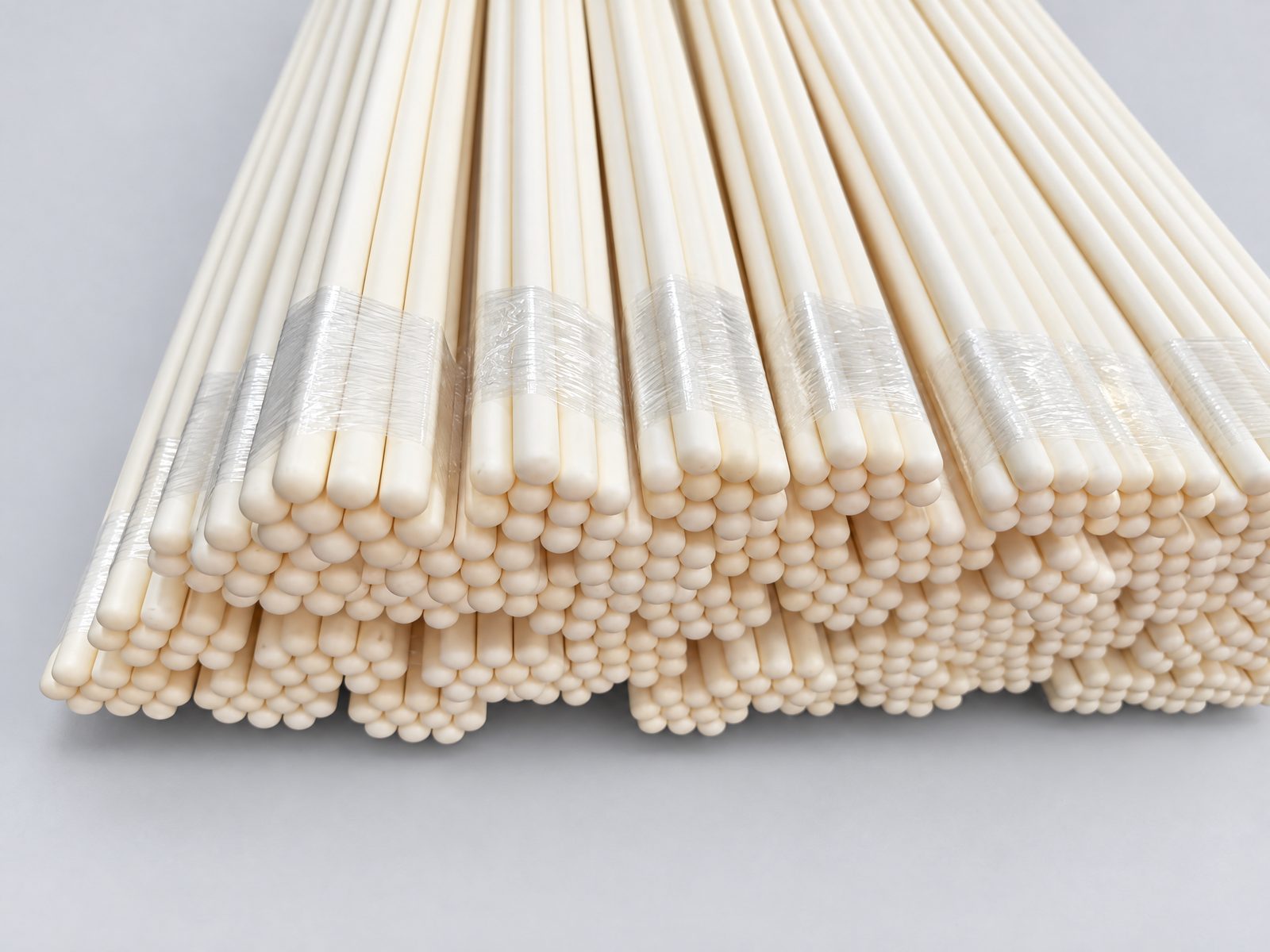
The chemical formula for aluminum oxide (also spelled aluminium oxide and called alumina in ceramic engineering) is Al2O3. According to the NIST Chemistry WebBook (Standard Reference Database 69), Al2O3 has a molecular weight of 101.9613 g/mol and is registered under CAS Registry Number 1344-28-1. In industrial standards such as ASTM E1652-21 and ISO 6474-1:2019, high-purity Al2O3 is specified for thermocouple insulators and ceramic components.
What is the formula for aluminum oxide and alumina?
The chemical notation for aluminum oxide, aluminium oxide, and alumina is always Al2O3. Each formula unit combines two aluminum atoms (Al) with three oxygen atoms (O).
In the NIST Chemistry WebBook (SRD 69), the neutral compound is indexed under the chemical name aluminium oxide with the formula Al2O3, a molecular weight of 101.9613 g/mol, and CAS Registry Number 1344-28-1. A formula search in the same database also lists two related gas-phase ionic species: the Al2O3 radical anion and the Al2O3- negative ion.
Across international standards and purchasing drawings, three naming conventions appear for the exact same Al2O3 formula. American chemical and ASTM standards (such as ASTM E1652) write aluminum oxide. International and IUPAC databases (such as NIST SRD 69) write aluminium oxide. Ceramic standards (such as ISO 6474-1) and industrial part drawings use the shorter engineering name, alumina.
| Property or Identifier | Official Value | Engineering & Purchasing Context |
|---|---|---|
| Chemical Formula | Al2O3 | Used on chemical analysis certificates and material specifications |
| Systematic Names | Aluminium oxide / Aluminum oxide | Standard chemical nomenclature in NIST and ASTM documents |
| Engineering Name | Alumina | Used on ceramic part drawings and ISO 6474-1:2019 |
| Molecular Weight | 101.9613 g/mol | Used for stoichiometric and molar thermochemical calculations |
| CAS Registry Number | 1344-28-1 | Universal chemical tracking number for safety data sheets and customs |
Solid phases of Al2O3: alpha, gamma, delta, and kappa
Although the chemical formula remains Al2O3, the solid compound exists in multiple crystalline polymorphs with distinct internal atomic arrangements and thermodynamic stabilities. The NIST-JANAF Thermochemical Tables (Fourth Edition, 1998, published in the NIST Chemistry WebBook) compile separate solid-phase thermochemical constants for four crystalline phases of Al2O3 across the temperature range of 298 K to 2,327 K.
Those four cataloged solid phases are the alpha phase, gamma phase, delta phase, and kappa phase. In the Shomate equation tables (last reviewed in December 1979 and compiled in the 1998 monograph), each phase has its own standard enthalpy parameter (H) and heat capacity polynomial coefficients.
Comparing the H parameter across the four polymorphs shows why the alpha phase is the most thermodynamically stable solid form of Al2O3. Its H parameter is -1,675.690 kJ/mol, which is lower in energy than the delta phase (-1,666.490 kJ/mol), the kappa phase (-1,662.300 kJ/mol), and the gamma phase (-1,656.860 kJ/mol). The enthalpy parameter of the alpha phase is 18.830 kJ/mol lower than that of the gamma phase, 9.200 kJ/mol lower than the delta phase, and 13.390 kJ/mol lower than the kappa phase.
| Shomate Parameter | Alpha Phase (Al2O3) | Gamma Phase (Al2O3) | Delta Phase (Al2O3) | Kappa Phase (Al2O3) |
|---|---|---|---|---|
| Temperature Range (K) | 298. to 2327. | 298. to 2327. | 298. to 2327. | 298. to 2327. |
| A | 102.4290 | 108.6830 | 106.9180 | 106.0880 |
| B | 38.74980 | 37.22630 | 36.62190 | 36.33740 |
| C | -15.91090 | -14.20650 | -13.97590 | -13.86730 |
| D | 2.628181 | 2.193601 | 2.157990 | 2.141221 |
| E | -3.007551 | -3.209881 | -3.157761 | -3.133231 |
| F | -1717.930 | -1701.600 | -1710.500 | -1705.970 |
| G | 146.9970 | 155.1360 | 151.7920 | 153.9350 |
| H | -1675.690 | -1656.860 | -1666.490 | -1662.300 |
Worked example: calculating Al2O3 heat capacity at t = 1
Read more
Process and furnace engineers regularly need the specific heat capacity of solid aluminum oxide at elevated operating temperatures. The NIST Chemistry WebBook defines solid-phase molar heat capacity (Cp, in J/mol*K) using the Shomate polynomial equation: Cp = A + B*t + C*t^2 + D*t^3 + E/t^2, where t is the absolute temperature in kelvins divided by 1000. (t = temperature (K) / 1000.).
Evaluating this equation when the temperature (K) equals the NIST divisor of 1000. is a convenient engineering benchmark because the scaled temperature variable t equals 1 (1000. / 1000.). At t = 1, every power of t (t, t^2, t^3, and 1/t^2) equals 1, so the molar heat capacity Cp is simply the direct sum of the five Shomate parameters: A + B + C + D + E.
By our calculation from the NIST-JANAF Shomate table for alpha-phase Al2O3 at t = 1, summing the five coefficients (102.4290 + 38.74980 - 15.91090 + 2.628181 - 3.007551) gives a molar heat capacity of 124.88853 J/mol*K. Dividing that molar value by the NIST molecular weight of 101.9613 g/mol yields a specific heat capacity of 1.22486 J/g*K.
Repeating the exact same t = 1 calculation for gamma-phase Al2O3 (108.6830 + 37.22630 - 14.20650 + 2.193601 - 3.209881) gives 130.68652 J/mol*K, or 1.28173 J/g*K when divided by 101.9613 g/mol.
- Step 1: Divide the target temperature in kelvins by 1000. per the NIST Shomate formula (t = temperature (K) / 1000.). When temperature (K) = 1000., t = 1.
- Step 2: Look up the five heat capacity coefficients (A, B, C, D, E) for the required Al2O3 phase in the NIST-JANAF table.
- Step 3: Substitute t = 1 into Cp = A + B*t + C*t^2 + D*t^3 + E/t^2.
- Step 4: Convert from molar heat capacity (J/mol*K) to mass specific heat (J/g*K) by dividing by the molecular weight (101.9613 g/mol).
How Al2O3 purity defines commercial ceramic grades
In raw chemical reagents, Al2O3 refers to a pure compound. In industrial ceramic manufacturing, however, structural parts are classified by the purity of Al2O3 in the fired body. The remaining fraction consists of sintering aids and minor oxide impurities.
At GY Alumina, our standard high-purity grade is C799 alumina. We also manufacture alumina crucibles and supply white alumina for applications that do not require a C799 body. Where a customer drawing names C 610 (in IEC 60672 a mullite class), we supply white alumina or our standard C799 instead. Neither is mullite.
| Grade or Material Type | Composition Basis | Typical Product Forms at GY Alumina |
|---|---|---|
| C799 (Standard Grade) | High-purity Al2O3 | Thermocouple protection tubes, multi-bore insulators, furnace tubes, rods, crucibles |
| Alumina Crucible Grade | High-purity Al2O3 | Crucibles and boats |
| White Alumina | Al2O3 ceramic | Supplied as an alternative where drawings call out C 610 |
ASTM and ISO standards for aluminum oxide (Al2O3)
When engineering buyers specify aluminum oxide for instrumentation, medical, or structural service, they reference international standards that define how the Al2O3 material is tested for chemical purity, density, and mechanical strength. The regional ASTM standards catalog lists over 12,000+ active standards, including dedicated specifications for aluminum oxide.
For temperature sensing, ASTM E1652-21 (active version E1652-21R26, where 21 indicates the year of original adoption or last revision, an 8-page standard developed by Subcommittee E20.13 in Book of Standards Volume 14.03) covers magnesium oxide (MgO) and aluminum oxide (Al2O3) powders and crushable insulators used to manufacture base metal thermocouples, metal-sheathed platinum resistance thermometers (PRTs), noble metal thermocouples, and their respective cables. To verify the material, ASTM E1652-21 specifies five tests: breaking force test, wet chemical analysis, fusion calorimetric analysis, quantitative analysis, and density determination.
For surgical implant raw materials, ASTM F603-12(2025) (active version F0603-12R25, where 12 indicates the year of original adoption or last revision, a 3-page standard in Book of Standards Volume 13.01 developed by Subcommittee F04.13) covers high-purity dense aluminum oxide for load-bearing surgical implant applications. It qualifies the material as delivered to the parts manufacturer (not finished parts such as femoral heads, acetabular inserts, or dental implants). ASTM F603-12(2025) requires physical testing of bulk density, weight, and grain size, chemical composition measurement by ICP-AES, XRF, or mass spectroscopy, and mechanical testing of compressive strength, flexural strength, elastic modulus, Vickers hardness, and Weibull modulus.
On the ISO side, ISO 6474-1:2019 (Edition 2, 9 pages, published in 2019-03 by Technical Committee ISO/TC 150/SC 1 and confirmed in 2024) specifies characteristics and test methods for bio-stable ceramic bone substitute material based on high-purity alumina for bone spacers, bone replacements, and orthopedic joint prostheses. ISO 6474-1:2019 notes that biocompatibility is evaluated separately by the manufacturer under the ISO 10993 series (where ISO 10993-5:2009, Edition 3, 34 pages, confirmed in 2022, covers in vitro cytotoxicity tests). For environmental lifecycle reporting of construction and industrial materials, ISO 14040:2006 (Edition 2, 20 pages, confirmed in 2022, with Amendment 1:2020) establishes the life cycle assessment (LCA) framework, while ISO 21930:2017 (Edition 2, 80 pages, confirmed in 2023) provides the core product category rules for environmental product declarations (EPDs).
| Standard Designation | Current Version & Pages | Primary Scope and Required Material Tests |
|---|---|---|
| ASTM E1652-21 | Active version E1652-21R26, 8 pages | Al2O3 and MgO powders and crushable insulators for thermocouples and PRTs: Breaking force, wet chemical, fusion calorimetric, quantitative analysis, and density tests |
| ASTM F603-12(2025) | Active version F0603-12R25, 3 pages | High-purity dense aluminum oxide material for surgical implants: Bulk density, grain size, ICP-AES/XRF/mass spectroscopy, compressive and flexural strength, elastic and Weibull modulus, Vickers hardness |
| ISO 6474-1:2019 | Edition 2 (2019-03), 9 pages | Bio-stable ceramic bone substitute material based on high-purity alumina for orthopedic joint prostheses and bone spacers |
| ISO 10993-5:2009 | Edition 3 (2009-06), 34 pages | Biological evaluation of medical devices: test methods for in vitro cytotoxicity using cultured mammalian cells |
| ISO 14040:2006 + Amd 1:2020 | Edition 2 (2006-07), 20 pages | Environmental management principles and framework for life cycle assessment (LCA) and life cycle inventory (LCI) studies |
| ISO 21930:2017 | Edition 2 (2017-07), 80 pages | Core rules for environmental product declarations (EPDs) of construction products and services |
How GY Alumina forms and sinters Al2O3 ceramic parts
Read more
GY Alumina manufactures industrial alumina ceramic components at our factory in Tangshan, serving furnace, thermocouple, laboratory, and industrial equipment companies. Our ISO 9001:2015 certificate covers the manufacturing of ceramic protective tubes for thermocouples.
To turn raw Al2O3 powder into dense ceramic shapes, we use four forming methods matched to the geometry of the part: slip casting, pressing, extrusion, and hot pressing. After green forming, our high-purity ware is sintered in high-temperature kilns.
For custom geometries to your drawing or sample, we produce round, elliptical, and square tubes (open both ends or one end closed), single-, twin-, and multi-bore tubes and capillaries, threaded, ribbed, perforated, and slotted tubes, solid rods, square bars, balls, rings, washers, bushings, discs, crucibles, and boats. Secondary operations we perform include cutting to length, end slots, side holes, perforated tubes, and closed ends with drilled holes.
Purchasing checklist for Al2O3 ceramic components
When you request a quotation or prepare an engineering drawing for aluminum oxide parts, providing complete specification details upfront prevents production delays. Use the checklist below to verify that your inquiry covers chemical grade, geometry, and order volume.
- Material specification: state the required Al2O3 grade on your drawing (such as C799 alumina or white alumina).
- Part geometry and drawing: attach a dimensioned 2D drawing or 3D model showing outside diameter, inside diameter, wall thickness, total length, bore count, and whether tube ends are open or closed.
- Secondary features: mark the exact position and dimensions of any cut lengths, end slots, side holes, perforations, threads, or drilled closed ends, and confirm bore diameters against your thermocouple wire before ordering.
- Order quantity and sampling needs: state the batch quantity and let us know if you require free samples for testing and approval before full production (the buyer pays the courier).
Requesting a quote for Al2O3 ceramic parts
Once your drawing or sample details are ready, our team reviews the geometry, selects the appropriate forming method, and confirms production lead times or stock availability.
Send your drawing, the grade and the quantity. We usually reply with a quote within two working days.
Questions buyers ask
- What is the chemical formula for aluminum oxide (or aluminium oxide)?
- According to the NIST Chemistry WebBook (SRD 69) and ASTM E1652-21, the chemical formula for aluminum oxide (also spelled aluminium oxide) is Al2O3. Each formula unit consists of two aluminum atoms and three oxygen atoms.
- What is the alumina formula in ceramic engineering?
- Alumina is the engineering name for aluminum oxide used in ceramic standards such as ISO 6474-1:2019, so the alumina formula is also Al2O3. In industrial ceramics at GY Alumina, high-purity alumina parts are supplied in grades such as C799 alumina and white alumina.
- What is the molecular weight and CAS number of Al2O3?
- The NIST Chemistry WebBook (SRD 69) lists the molecular weight of aluminium oxide (Al2O3) as 101.9613 g/mol and its CAS Registry Number as 1344-28-1.
- What solid crystalline phases exist for the formula Al2O3?
- The NIST-JANAF Thermochemical Tables (Fourth Edition, 1998) in the NIST Chemistry WebBook compile solid-phase thermochemical data from 298 K to 2,327 K for four crystalline phases of Al2O3: the alpha, gamma, delta, and kappa phases. Among these four phases, the alpha phase has the lowest enthalpy parameter H at -1,675.690 kJ/mol.
- How is the Al2O3 composition verified in ASTM standards?
- Under ASTM F603-12(2025) for high-purity dense aluminum oxide, chemical composition is measured by ICP-AES, XRF, or mass spectroscopy. Under ASTM E1652-21 for thermocouple and thermometer insulators, required tests include wet chemical analysis, fusion calorimetric analysis, quantitative analysis, density determination, and breaking force testing.
Sources
- NIST Chemistry WebBook, SRD 69: Aluminium oxide (CAS 1344-28-1)
- NIST Chemistry WebBook, SRD 69: Solid Phase Heat Capacity (Shomate Equation) for Aluminium oxide
- NIST Chemistry WebBook, SRD 69: Formula Search Results for Al2O3
- ASTM E1652-21: Standard Specification for Magnesium Oxide and Aluminum Oxide Powder and Crushable Insulators
- ASTM F603-12(2025): Standard Specification for High-Purity Dense Aluminum Oxide for Medical Application
- ASTM F603-12: Standard Specification for High-Purity Dense Aluminum Oxide for Medical Application
- ASTM International: Complete List of Available ASTM Standards
- ISO 6474-1:2019: Implants for surgery, Ceramic materials, Part 1: Ceramic materials based on high purity alumina
- ISO 10993-5:2009: Biological evaluation of medical devices, Part 5: Tests for in vitro cytotoxicity
- ISO 14040:2006: Environmental management, Life cycle assessment, Principles and framework
- ISO 21930:2017: Sustainability in buildings and civil engineering works, Core rules for environmental product declarations
Last checked .