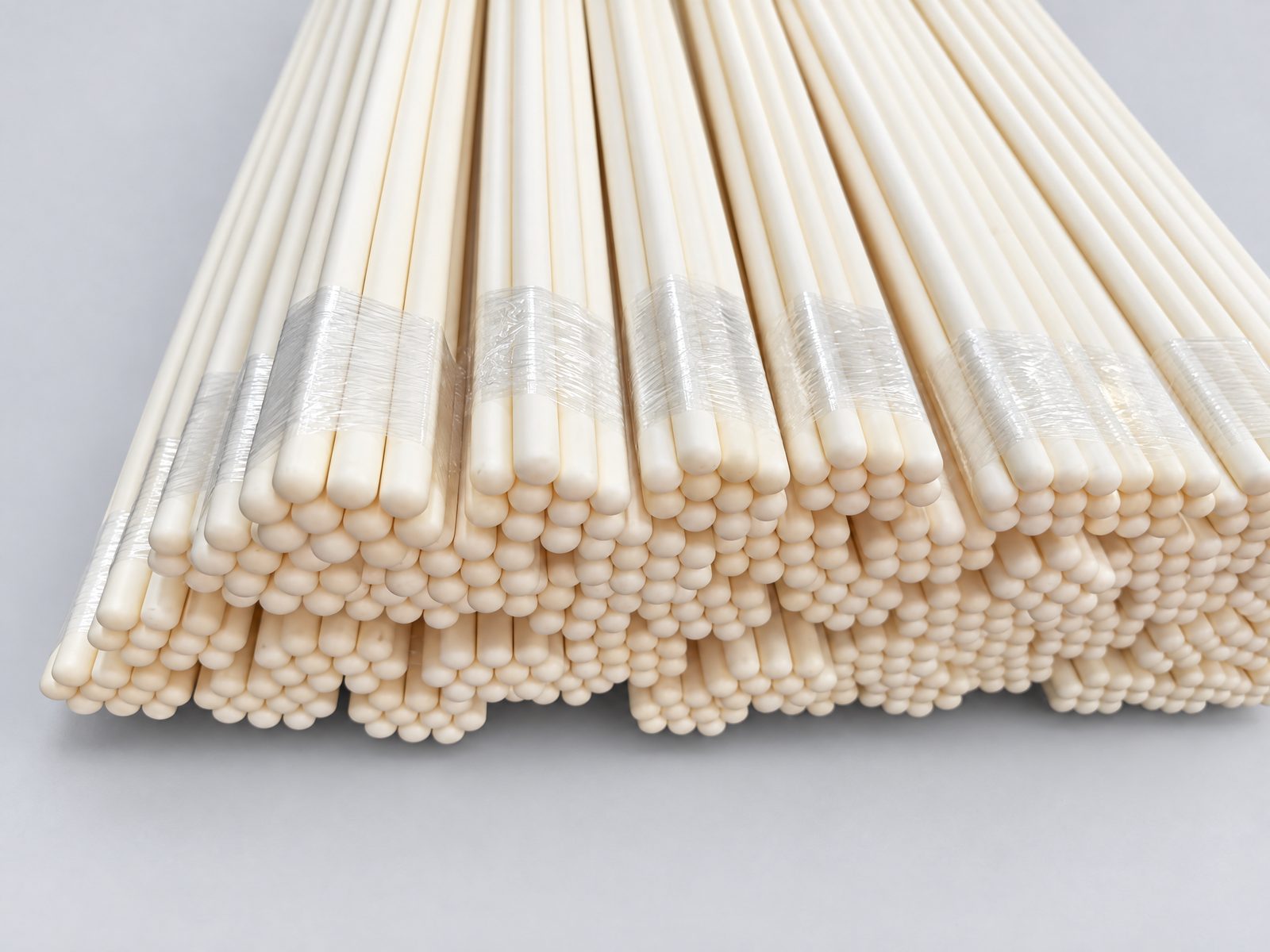
Searches for alumina wire split between two distinct engineering products: alumina (aluminum oxide) ceramic tubes and sleeves that insulate bare high-temperature wires, and metallic aluminum wire used to conduct current, wind coils, or weld alloys. Because aluminum takes its name from alumina ore, parts lists and translated catalogs frequently mix the two terms, even though ceramic alumina is an electrical insulator and metallic aluminum is a conductor. For metallic wires alone, ASTM Committee B01 maintains over 93 electrical conductor standards alongside IEC 60317-0-3:2024 for enamelled round aluminium wire and ISO 18273:2015 for welding wire.
Alumina wire vs. aluminum wire: clearing up what you are buying
Before you request a quote or release a drawing labeled alumina wire, confirm whether your assembly needs an oxide ceramic insulator or a metallic conductor. Alumina is aluminum oxide, a hard technical ceramic used to isolate bare thermocouple leads, furnace heating elements, and vacuum feedthrough wires from electrical shorts at elevated temperatures. Aluminum wire (spelled aluminium wire in international standards) is refined metal drawn through dies to carry electric current, wind electromagnetic coils, form cold-headed fasteners, or feed fusion welding torches.
The naming overlap traces back to how the metal entered industrial service. According to ASTM Standardization News (July 26, 2016), aluminum only became available in commercial quantities after an 1889 patent established a process to extract the metal from bauxite ore via alumina. Following World War II production expansion, ASTM Committee B01 on Electrical Conductors began writing aluminum wire standards in the 1940s and published its initial three aluminum wire and conductor specifications in 1948.
Today, buyers typing alumina wire into a search bar or procurement system usually need one of six distinct products. Checking the material state, electrical function, and governing specification upfront prevents sending a ceramic drawing to a wire mill or an electrical cable inquiry to a ceramics factory.
| Search term or drawing callout | Material composition | Primary engineering function | Applicable specification or product form |
|---|---|---|---|
| Alumina wire insulator or sleeve | Aluminum oxide ceramic | High-temperature electrical insulation over bare wire | Single-bore, twin-bore, and multi-bore ceramic tubes and bushings |
| Aluminum electrical wire | Unalloyed aluminum (1350) | Overhead transmission and bare electrical conduction | ASTM B230/B230M-22 |
| Aluminum alloy electrical wire | 6201 or 8000 series aluminum alloys | High-strength overhead strand or insulated building wire | ASTM B398/B398M-22 and ASTM B800-05(2021) |
| Copper-clad aluminum wire | Aluminum core with bonded copper cladding | Lightweight bimetallic electrical signal and power wire | ASTM B566 (active B0566-04AR25) |
| Aluminum-clad steel wire | Steel core with aluminum cladding | High-strength bare electrical guy, ground, and overhead wire | ASTM B415 (active B0415-16R25) |
| Enamelled round aluminium wire | Aluminum conductor with baked polymer film | Motor, transformer, and inductor coil windings | IEC 60317-0-3:2024 |
| Mechanical or welding aluminum wire | Wrought aluminum and alloy series | Cold-finished parts, rivets, extrusions, or fusion welding | ASTM B211/B211M-23, ASTM B316/B316M-25, and ISO 18273:2015 |
Aluminum electrical wire: 1350-H19, 6201, and 8000 series alloys
When your project calls for solid or stranded metallic aluminum electrical wire, ASTM Committee B01 (formed in 1909, with 89 members and jurisdiction over more than 93 standards in Volume 02.03 of the Annual Book of ASTM Standards) divides conductor wires by alloy chemistry and temper under Subcommittee B01.07 on Conductors of Light Metals. Selecting the wrong alloy or temper changes both tensile behavior and termination performance.
For unalloyed overhead and bare conductor stranding, ASTM B230/B230M-22 (updated October 18, 2022) covers aluminum 1350-H19 extra-hard round wire for electrical purposes. Prior to 1975, aluminum 1350 was designated EC (electrical conductor) aluminum, and it corresponds to UNS A91350. Under ASTM B230/B230M-22, the wire is drawn from stock and must be free of brittleness, demonstrated by coiling or looping the wire around its own diameter with or without a mandrel. Manufacturers may join wire during final drawing or in the finished wire using electric-butt welding, cold-pressure welding, or electric-butt, cold-upset welding, and every lot undergoes tension, elongation, bending, and electrical resistivity verification.
Where overhead spans require higher mechanical strength than extra-hard 1350 wire provides, engineers specify heat-treatable alloy wire under ASTM B398/B398M-22 (updated January 24, 2023). This specification covers round aluminum-alloy 6201 wire (UNS A96201) in two hard tempers that are solution heat-treated, cold worked, and artificially aged: 6201-T81 and higher-conductivity 6201-T83. Testing under ASTM B398/B398M-22 verifies chemical composition, tensile strength, elongation, bending performance, electrical resistivity, and wire density.
For insulated building wire, feeder cables, and flexible stranded single conductors, extra-hard tempers are too stiff and utility-grade 1350 is replaced by 8000 series alloys under ASTM B800-05(2021) (updated February 24, 2021). ASTM B800-05(2021) covers 8000 series aluminum alloys fabricated into round wires in annealed or intermediate tempers suitable for stranding or insulated solid single conductors. The drawing stock must satisfy chemical composition limits across 7 elements: aluminum, silicon, iron, copper, magnesium, zinc, and boron. In both ASTM B230/B230M-22 and ASTM B398/B398M-22, inch-pound and SI units are treated separately as independent standards that must not be mixed, whereas SI units govern density, resistivity, and temperature.
| Active ASTM standard | Alloy and UNS code | Temper covered | Primary conductor role and required tests |
|---|---|---|---|
| ASTM B230/B230M-22 | Aluminum 1350 (UNS A91350) | H19 (extra hard) | Uninsulated electrical wire. tension, elongation, self-diameter wrap, and resistivity |
| ASTM B398/B398M-22 | Alloy 6201 (UNS A96201) | T81 and higher-conductivity T83 | Solution heat-treated, cold-worked, aged electrical wire. chemistry, tension, bend, resistivity, and density |
| ASTM B800-05(2021) | 8000 series alloys | Annealed and intermediate tempers | Stranded or insulated solid single conductors. 7-element chemistry, tension, resistivity, diameter, and surface inspection |
Copper-clad aluminum wire and aluminum-clad steel wire
Bimetallic clad wires pair aluminum with either copper or steel so an engineer does not have to choose between pure-metal trade-offs. ASTM Subcommittee B01.06 on Bi-Metallic Conductors maintains separate standards for bare copper-clad aluminum wire and bare hard-drawn aluminum-clad steel wire.
ASTM B566 (active version B0566-04AR25) specifies bare round copper-clad aluminum wire for electrical applications. Each wire has an aluminum core surrounded by a continuous outer cladding of copper thoroughly bonded to the core throughout its length. ASTM B566 defines four classes based on copper volume fraction and temper: Class 10A and Class 15A in annealed temper, and Class 10H and Class 15H in hard-drawn temper. By our calculation from ASTM B566, the aluminum core accounts for a nominal 90 volume % of the cross section in Class 10A and Class 10H (a 9-to-1 aluminum-to-copper volume ratio) and a nominal 85 volume % in Class 15A and Class 15H, meaning Class 15 carries 1.5 times the nominal copper volume share of Class 10. Unlike solid 1350 or 8000 series aluminum wire where welded drawing joints are permitted, ASTM B566 requires finished copper-clad aluminum wire to contain no joints or splices, and tested samples must be free from seams, splits, and cladding delamination.
Where overhead ground wires, guy strands, or long-span electrical conductors need a structural steel core protected by conductive aluminum, buyers specify ASTM B415 (active version B0415-16R25). This standard covers four conductivities of bare, hard-drawn, round aluminum-clad steel wire for general electrical purposes. By our calculation from ASTM B415 using the exact factor of 25.4 mm per inch, the covered wire diameters run from 5.18922 mm down to 2.05232 mm (0.2043 in. to 0.0808 in. inclusive, corresponding to 4 AWG through 12 AWG), a diameter span of 3.1369 mm (0.1235 in.). Keep two scope limits in mind when ordering to ASTM B415: it does not apply to reinforcement core wires used inside ACSR conductors (which use ASTM B502), and wire supplied to ASTM B415 is not intended for redrawing unless you consult the manufacturer beforehand.
| ASTM B566 class | Nominal copper cladding | Temper condition | Finished wire joint rule |
|---|---|---|---|
| Class 10A | 10 volume % | 90 volume % | Annealed |
| Class 15A | 15 volume % | 85 volume % | Annealed |
| Class 10H | 10 volume % | 90 volume % | Hard-drawn |
| Class 15H | 15 volume % | 85 volume % | Hard-drawn |
Enamelled round aluminium wire for windings (IEC 60317-0-3:2024)
Motor, transformer, inductor, and solenoid builders often search for enamelled round aluminium wire (also called aluminum magnet wire) to reduce coil mass compared with copper windings. Internationally, IEC 60317-0-3:2024 (Edition 4.0, published September 11, 2024 by IEC Technical Committee TC 55 on Winding wires, 62 pages, with a stability date of 2027) sets the general requirements for enamelled round aluminium winding wires manufactured with or without an outer bonding layer.
Under the IEC 60317 framework, IEC 60317-0-3:2024 serves as the master general-requirements document, while the nominal conductor diameter range and specific polymer coating properties are called out in the relevant individual specification sheet for each thermal class. As a normative IEC International Standard (issued bilingually in English and French under IEC publication rules), its clauses define the agreed technical characteristics for winding wire conformity assessment. If you maintain incoming inspection templates, note that Edition 4.0 revised Clause 7 and Clause 10 to designate the tests in both clauses as inappropriate, so older procurement specs referencing prior editions should be updated.
Enamelled aluminium winding wire relies on thin organic polymer film insulation. That construction works inside motors, dry-type transformers, and ballast coils operating within the thermal rating of the enamel, where aluminum conducts current and the cured film prevents turn-to-turn shorts. Once operating temperatures move into kiln, furnace, heat-treating, or pyrometry ranges where polymer enamels char and vaporize, engineers switch to bare metallic resistance or thermocouple wires sleeved inside rigid alumina ceramic insulators.
Mechanical aluminum alloy wire and welding wire specifications
Read more
Not every aluminum wire carries electricity. Fastener plants, aerospace machine shops, and welding fabricators buy non-electrical aluminum alloy wire governed by ASTM Committee B07 and ISO welding consumable standards.
Within the 30 active standards maintained by ASTM Subcommittee B07.03, two sibling specifications cover adjacent wire forming routes. If the wire is hot-extruded without cold-finishing die reduction, specify ASTM B221-21 (inch-pound) or ASTM B221M-21 (metric). If the wire will be upset into rivets or cold-headed fasteners, specify ASTM B316/B316M-25 (Standard Specification for Aluminum and Aluminum-Alloy Rivet and Cold-Heading Wire and Rods).
For fusion welding filler metals, ISO 18273:2015 (Edition 2, published November 2015 by Technical Committee ISO/TC 44/SC 3, confirmed in 2020, 6 pages) governs the classification of solid wire electrodes, wires, and rods for welding aluminium and aluminium alloys. ISO 18273:2015 classifies solid welding wires strictly by their chemical composition so fabricators can match filler alloy chemistry to base-metal cracking sensitivity, corrosion service, and post-weld anodizing color.
Worked example and buyer checklist for specifying wire or insulators
Read more
Vague purchase requisitions that only write alumina wire 2.0 mm force suppliers to pause and ask clarifying questions. Below is a worked example written by our team contrasting how an electrical buyer and a furnace engineer rewrite that line into an unambiguous request.
Worked example, Case A (metallic conductor purchase order): An electrical cable buyer needs 2.0 mm annealed alloy conductor wire for insulated control cable stranding, plus a bimetallic option for high-frequency jumper leads. Writing aluminum wire invites quotes for extra-hard overhead ASTM B230/B230M-22 1350-H19 wire that is too stiff to terminate cleanly. Instead, the buyer specifies round 8000 series aluminum alloy wire to ASTM B800-05(2021), annealed temper, stating dimensions in standard inch-pound units with SI resistivity limits, or specifies bare round copper-clad aluminum wire to ASTM B566 (active B0566-04AR25), Class 15A (nominal 15 volume % copper, annealed, zero joints or splices).
Worked example, Case B (high-temperature ceramic wire insulator drawing): An instrumentation engineer routing two bare thermocouple leads through a furnace hot zone needs rigid electrical isolation so the two wires cannot touch. Rather than requesting alumina wire, the engineer specifies a rigid C799 alumina twin-bore thermocouple insulator tube, calling out the outer diameter, twin through-bore diameter sized with clearance for the wire diameter and thermal expansion, overall cut length, straightness, and piece quantity.
Use this 6-point checklist written by our team before sending out an inquiry:
- State oxide ceramic or metal first: write aluminum oxide (alumina) ceramic wire insulator for high-heat electrical isolation, or write metallic aluminum wire for current-carrying, mechanical, or welding stock.
- Name the active standard, alloy, class, and temper: pair the exact designation (such as ASTM B398/B398M-22 6201-T83, ASTM B566 Class 10H, IEC 60317-0-3:2024, or ISO 18273:2015) with the required temper or composition class.
- Keep unit systems separate on ASTM orders: ASTM B230/B230M-22 and ASTM B398/B398M-22 warn that combining inch-pound and SI values can cause nonconformance, while SI units are standard for resistivity and density.
- Specify splice and redrawing rules: note that ASTM B566 copper-clad wire forbids joints or splices in finished wire, and ASTM B415 aluminum-clad steel wire requires manufacturer consultation if you plan to redraw it.
- Match forming route to end use for mechanical alloys: choose ASTM B211/B211M-23 for cold-finished wire, ASTM B221-21 or B221M-21 for extruded wire, and ASTM B316/B316M-25 for cold-heading and rivet stock.
- Confirm bore clearance on ceramic wire sleeves: when buying rigid alumina tubes or multi-bore insulators for bare metal wires, verify the inner bore diameter against your wire gauge, bend path, and assembly tolerances before ordering.
Sourcing rigid C799 alumina wire insulators and tubes from GY Alumina
GY Alumina does not manufacture metallic aluminum wire, clad conductor wire, enamelled winding wire, or flexible ceramic fiber yarn. Metallic electrical, mechanical, and welding wires are produced by metal wire mills to the ASTM, IEC, and ISO specifications covered above. At our factory in Tangshan, we manufacture rigid alumina and corundum ceramic parts used by thermocouple, furnace, laboratory, and industrial companies to insulate, route, and protect bare wires and sensors at high temperatures.
For wire isolation and sensor assemblies, we supply C799 alumina and white alumina parts formed by extrusion, pressing, slip casting, and hot pressing. Our production covers single-bore, twin-bore, and multi-bore thermocouple insulators and capillaries, open or one-end-closed round, elliptical, and square protection tubes, furnace tubes, threaded, ribbed, perforated, and slotted tubes, solid alumina rods, square bars, rings, washers, bushings, discs, crucibles, and boats. Secondary operations include cutting to length, end slots, side holes, perforated walls, and closed ends with drilled wire-exit holes.
We supply stock sizes as well as custom ceramic parts made to your engineering drawing or physical sample, with free samples available for approval before full production (the buyer covers courier freight). Send your drawing, the grade and the quantity. We usually reply with a quote within two working days.
Questions buyers ask
- Is alumina wire the same as aluminum wire?
- No. Alumina is aluminum oxide ceramic, an electrical insulator made into rigid single-bore and multi-bore tubes, sleeves, and bushings to keep bare high-temperature wires from shorting. Aluminum wire is conductive metal drawn to ASTM, IEC, or ISO specifications, though buyers and translated catalogs frequently write alumina wire by mistake because aluminum's name derives from alumina ore.
- Which ASTM standards cover solid and alloy electrical aluminum wire?
- ASTM B230/B230M-22 covers extra-hard 1350-H19 round aluminum wire, ASTM B398/B398M-22 covers solution heat-treated and aged 6201-T81 and 6201-T83 alloy wire, and ASTM B800-05(2021) covers annealed and intermediate temper 8000 series alloy wire for stranded or insulated single conductors. All three specifications are maintained by ASTM Committee B01 in Volume 02.03 of the Annual Book of ASTM Standards.
- What is the difference between Class 10 and Class 15 copper-clad aluminum wire?
- Under ASTM B566 (active version B0566-04AR25), Class 10A and Class 10H wires have a nominal 10 volume % outer copper cladding, while Class 15A and Class 15H wires have a nominal 15 volume % copper cladding. The letter A indicates annealed temper and H indicates hard-drawn temper, and finished wire in all four classes must contain no joints or splices.
- Which international standard governs enamelled round aluminium winding wire?
- IEC 60317-0-3:2024 (Edition 4.0) specifies the general requirements for enamelled round aluminium winding wires with or without a bonding layer. Nominal conductor diameter ranges and thermal endurance ratings for specific enamel coatings are listed in the individual IEC 60317 specification sheets.
- Can ASTM B415 aluminum-clad steel wire be used in ACSR cores or redrawn?
- No. ASTM B415 (active version B0415-16R25) covers bare hard-drawn round aluminum-clad steel wire from 5.18922 mm to 2.05232 mm (0.2043 in. to 0.0808 in. inclusive, or 4 AWG to 12 AWG) for general electrical use and excludes ACSR reinforcement wires, which fall under ASTM B502. Wire ordered to ASTM B415 is also not intended for redrawing unless you consult the manufacturer first.
- What standards cover aluminum welding wire and cold-finished mechanical wire?
- ISO 18273:2015 classifies solid wire electrodes, wires, and rods for fusion welding of aluminium and aluminium alloys based on chemical composition. For non-electrical mechanical parts, ASTM B211/B211M-23 governs rolled or cold-finished bar, rod, and wire across 15 UNS alloys, while ASTM B316/B316M-25 covers rivet and cold-heading wire.
Sources
- ASTM B230/B230M-22 Standard Specification for Aluminum 1350-H19 Wire for Electrical Purposes
- ASTM B398/B398M-22 Standard Specification for Aluminum-Alloy 6201-T81 and 6201-T83 Wire for Electrical Purposes
- ASTM B800-05(2021) Standard Specification for 8000 Series Aluminum Alloy Wire for Electrical Purposes
- ASTM B566 Standard Specification for Copper-Clad Aluminum Wire
- ASTM B415 Standard Specification for Hard-Drawn Aluminum-Clad Steel Wire
- ASTM B211/B211M-23 Standard Specification for Aluminum and Aluminum-Alloy Rolled or Cold Finished Bar, Rod, and Wire
- ASTM Subcommittee B07.03 on Aluminum Alloy Wrought Products
- ASTM Committee B01 on Electrical Conductors
- ASTM Standardization News: Electrical Conductors
- IEC 60317-0-3:2024 Enamelled Round Aluminium Wire
- IEC International Standards and Publications
- ISO 18273:2015 Welding Consumables for Aluminium and Aluminium Alloys
- ISO/TC 44/SC 3 Record for ISO 18273:2015
Last checked .