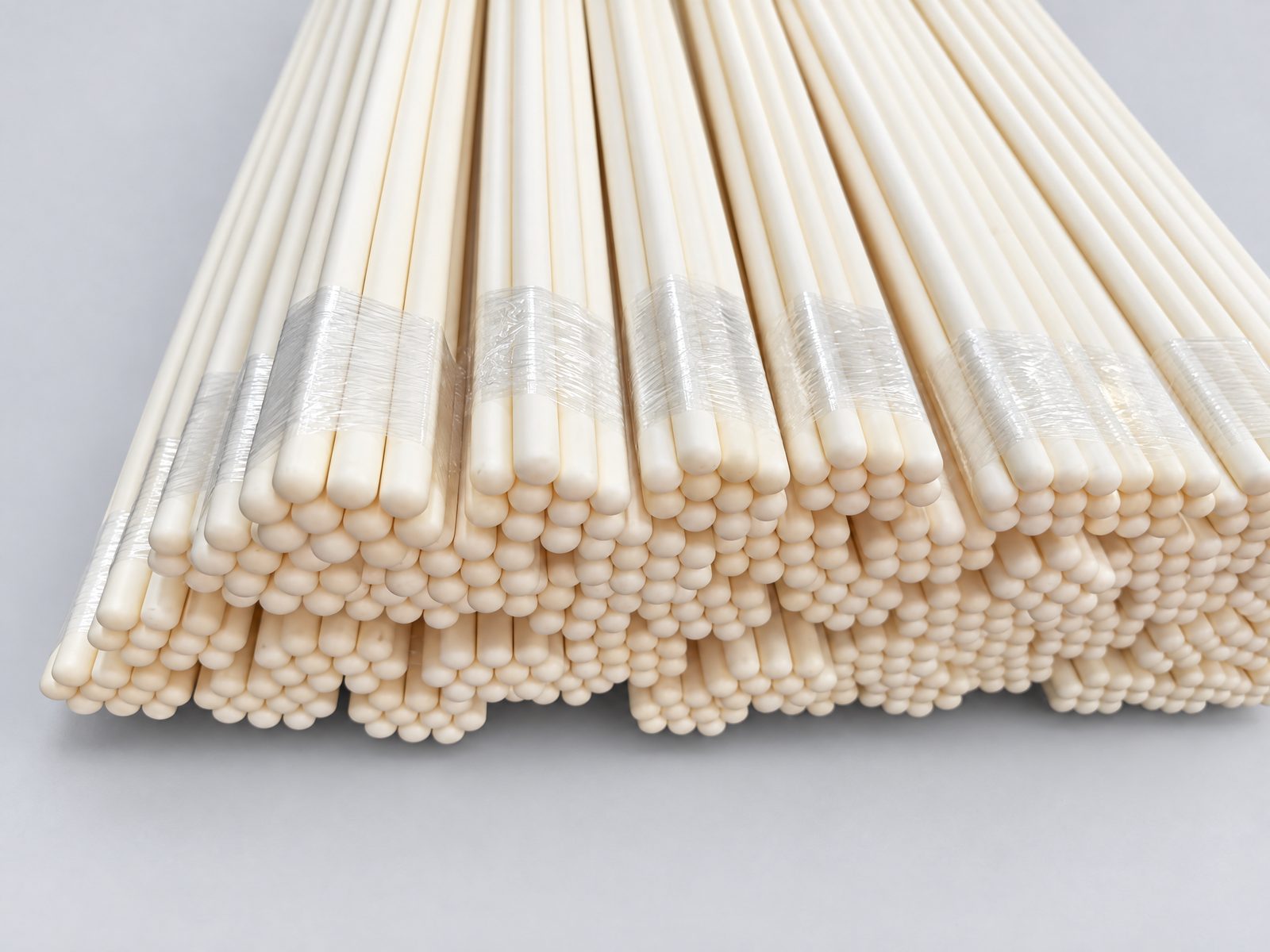
Alumina (aluminum oxide, Al2O3) is a crystalline oxide ceramic with a molecular weight of 101.9613 according to NIST Standard Reference Database 69 and a melting point of 2053 °C to 2072 °C (3727 °F to 3762 °F) per the NIST Standard Reference Material 742 Safety Data Sheet. Buyers select a grade by matching purity, particle size, green density, and forming method to the application.
Core Chemical and Physical Identity of Aluminum Oxide
According to The American Ceramic Society, ceramics are nonmetallic, inorganic, crystalline materials that include oxides, nitrides, carbides, and borides. Glasses are noncrystalline materials with wide composition ranges based mostly on silicate or borosilicate compositions. Both ceramic and glass materials are hard, chemically inert, and good electrical insulators.
Aluminum oxide (Al2O3, CAS Registry Number 1344-28-1, EC Number 215-691-6) is the primary oxide ceramic across refractories, metallurgy, electronics, and medical engineering. In the NIST Safety Data Sheet for Standard Reference Material 742 (issued 18 July 2014), the substance is also named alundum, dialuminum trioxide, aluminum sesquioxide, and alpha-alumina.
In its crystalline alpha-alumina form, the material is an odorless white to grey powder or dense sintered solid. It is insoluble in water, practically insoluble in nonpolar organic solvents, and slightly soluble in mineral acids and strong alkali. That slight solubility in both acids and strong alkali reflects amphoteric behavior, which buyers weigh when specifying crucibles or furnace tubes for corrosive atmospheres.
| Property | Recorded Value |
|---|---|
| Chemical Formula and CAS | Al2O3 (CAS 1344-28-1) |
| Molecular Weight | 101.9613 (101.96 g/mol in SRM 742) |
| Physical Appearance | White to grey odorless crystalline powder |
| Density | 3.965 g/cc |
| Melting and Freezing Point | 2053 °C to 2072 °C (3727 °F to 3762 °F) |
| Initial Boiling Point | 2980 °C (5396 °F) |
| Vapor Pressure | 1 mmHg at 2158 °C |
| Solubility | Insoluble in water, slightly soluble in mineral acids and strong alkali |
How Industrial Alumina Types Are Classified
Because aluminum oxide serves uses ranging from steelmaking furnace linings to surgical implants, no single grading scale covers every material form. Engineers and purchasing teams classify alumina types across four technical frameworks.
First, raw material families separate aluminum oxide feedstocks from silicate minerals. In its Survey of Raw Materials course, The American Ceramic Society divides raw materials into four parts: Part 1 covers alumina-based raw materials (their production, properties, and families), Part 2 covers silica and alumino-silica raw materials, Part 3 covers alumina- and silica-based aggregates that form the structural foundation of refractory compositions, and Part 4 covers clays, finely divided materials, and specialty raw materials selected for corrosive environments.
Second, end-use branches divide traditional ceramics from advanced or technical ceramics. Traditional ceramics include refractories, structural clay products, whiteware, earthenware, abrasives, and cements. Technical ceramics include structural ceramics, electroceramics, optoceramics, and medical ceramics used in vehicle catalytic converter substrates, steelmaking furnace refractory linings, bone scaffolds, ceramic armor, and cutting tools.
Third, official specifications from NIST and ASTM classify alumina by physical form and qualification testing, separating pyrometric reference powders, electronic powders and parts, and medical implant blanks. Fourth, dense sintered ceramic grades classify fired components by aluminum oxide mass percentage, where higher alumina content reduces secondary silicate phases.
ASTM and NIST Specifications for Powders and Dense Parts
When an engineering drawing names a material standard, verify whether the designation governs loose powder, raw material blanks, or finished parts. NIST and ASTM maintain distinct specifications for each category, with SI units regarded as standard in the ASTM documents.
For high-temperature instrument calibration, the National Institute of Standards and Technology supplies Standard Reference Material 742, Aluminum Oxide Pyrometric Standard, within its catalog of over 1200 Standard Reference Materials with well-characterized composition or properties. One unit of SRM 742 consists of 10 g of alumina powder with a nominal mass concentration above 99% aluminum oxide, intended for evaluating and calibrating pyrometric instruments.
For electronic powders, ASTM F7 (Book of Standards Volume 10.04, Committee F01) classifies aluminum oxide powder for insulating coatings or ceramic mixtures in electronic device components into two particle size classes, two chemical grades (Grades 1 and 2), and two levels of acidity. Class A specifies No. 500 nominal mesh with a nominal average particle size of 24.3 μm, and Class B specifies No. 900 nominal mesh with a nominal average particle size of 1.7 μm. Acidity ranges cover acid pH 4.5 to 6.5 and neutral pH 6.5 to 7.5, with qualification testing for water-soluble content, particle size, and hydrogen-ion concentration.
ASTM D2442 (active version D2442-75R25, Book of Standards Volume 15.02, Subcommittee C21.03) covers fabricated alumina parts suitable for electronic and electrical applications and ceramic-to-metal seals as used in electron devices. It establishes limits and test methods for electrical, mechanical, thermal, and general properties of the ceramic bodies regardless of part geometry.
ASTM F603 (active version F0603-12R25, Book of Standards Volume 13.01, Subcommittee F04.13) covers material requirements for high-purity, dense aluminum oxide as delivered to parts manufacturers for load-bearing surgical implant applications. It does not cover finished parts such as femoral heads, acetabular inserts, and dental implants. Qualification requires testing physical properties (bulk density, weight, and grain size), chemical composition (measured by ICP-AES, XRF, or mass spectroscopy), and mechanical properties (compressive strength, flexural strength, elastic modulus, Vickers hardness, and Weibull modulus).
| Designation | Material Form and Scope | Qualification Parameters |
|---|---|---|
| NIST SRM 742 | 10 g alumina powder unit (above 99% Al2O3) for pyrometric calibration | Melting point 2053 °C to 2072 °C (3727 °F to 3762 °F), density 3.965 g/cc |
| ASTM F7 | Alumina powder for insulating coatings and electronic ceramic mixtures | Class A (No. 500 mesh, 24.3 μm) and Class B (No. 900 mesh, 1.7 μm), Grades 1 and 2, acid pH 4.5 to 6.5 and neutral pH 6.5 to 7.5 |
| ASTM D2442 (D2442-75R25 ) | Fabricated alumina parts and ceramic-to-metal seals for electron devices | Electrical, mechanical, thermal, and general body properties regardless of geometry |
| ASTM F603 (F0603-12R25 ) | High-purity dense Al2O3 material delivered to surgical implant makers | Bulk density, weight, grain size, ICP-AES/XRF/mass spec chemistry, compressive and flexural strength, elastic and Weibull modulus, Vickers hardness |
Dense Sintered Grades: C799 and White Alumina
At GY Alumina, we manufacture sintered technical ceramic parts in Tangshan in our standard grade C799 (99.5% Al2O3), alongside 99% Al2O3 and 95% white alumina. We sinter our corundum (99.5% Al2O3) ware at about 1,760 °C. Buyers should note that the sintering temperature is a kiln firing temperature used to densify the ceramic body, not a service temperature rating.
Where a drawing names C 610 (in IEC 60672 a mullite class, 50-65% Al2O3), we supply 95% white alumina or our standard C799 instead. Neither grade we supply is mullite. For laboratory melting and thermal processing, we make crucibles and boats in 99% and 99.5% Al2O3.
Forming Methods and Size Limits for Dense Alumina Parts
GY Alumina shapes dense ceramic parts using four forming methods: slip casting, pressing, extrusion, and hot pressing. Extrusion forces ceramic paste through a die to form straight profiles such as single-, twin-, and multi-bore tubes and capillaries. Our largest extruded tube today is OD 17 x ID 10 mm.
When a tube exceeds extrusion diameter limits, we use slip casting and fire the corundum body at about 1,760 °C. Our largest slip-cast tube is OD 100 x ID 90 x 1,000 mm.
We also supply solid alumina rods in eight stock diameters from 2 to 12 mm, about 2,400 mm long, with a +0.2 mm grinding allowance on the diameter. Secondary operations include cut to length, end slots, side holes and perforated tubes, and closed ends with drilled holes. Custom parts made to a buyer's drawing or sample include round, elliptical, and square tubes (open or one end closed), threaded, ribbed, perforated, and slotted tubes, square bars and balls, rings, washers, bushings and discs, and crucibles, boats, and other shapes to drawing.
Submicron Transparent Alumina and Lithium-Aluminate Ceramics
Read more
Polycrystalline ceramics are normally opaque because internal pores and secondary phases scatter light. As reported by The American Ceramic Society in Ceramic Tech Today (June 18, 2026, summarizing research from the May 2026 issue of the Journal of the American Ceramic Society), reducing pores and restricting grain growth allows alumina-based ceramics to reach high optical transmission for optical, energy, and defense windows.
Within the Li2O-Al2O3 binary system, three phases form: lithium-rich Li5AlO4, intermediate LiAlO2, and aluminum-rich LiAl5O8, with only LiAl5O8 forming an optically isotropic cubic crystal structure. Optimizing spark plasma sintering of LiAl5O8 at 1,400 °C with a 30 min dwell time, followed by slow cooling to 1,100 °C and rapid cooling to room temperature across sample thicknesses of 1.034 mm, 1.053 mm, 1.032 mm, and 0.974 mm, eliminated cracking and raised transmittance at 500 nm from 75.4% to above 80%. GY Alumina manufactures opaque sintered C799 alumina structural parts rather than transparent optics, and buyers can send drawings of opaque tubes, rods, or custom shapes for review.
| System and Method | Green Body | Sintering Temperature | Grain Size | Optical Transmittance | Flexural Strength |
|---|---|---|---|---|---|
| Submicron Al2O3 pressure filtration | 180 nm / 65% density | 1,210 °C | 0.46 µm | 55.4% in-line | 829 MPa |
| Submicron Al2O3 coagulation casting | 180 nm / 58% density | 1,250 °C | 0.54 µm | 51.6% in-line | 696 MPa |
Dust Exposure Limits and Safe Handling of Alumina Powder
Read more
Alumina is not classified as an acute physical or health hazard (rat oral LD50 above 5 000 mg/kg) and is not listed by OSHA, IARC, or NTP as a carcinogen. Inhaling high dust concentrations may cause coughing, shortness of breath, mechanical respiratory tract irritation, and nasal deposits, while skin or eye contact may cause mechanical irritation.
Keep alumina away from halo carbons, halogens, combustible materials, and oxidizing materials. Facilities handling powder should provide local exhaust or process enclosure ventilation, wear chemical-resistant gloves and splash-resistant safety goggles with a face shield, and follow an OSHA 29 CFR 1910.134 respiratory protection program using applicable respirators under NIOSH 42 CFR 84 when workplace conditions warrant.
| Agency or Standard | Category | Recorded Limit or Rating |
|---|---|---|
| OSHA PEL | TWA total dust / respirable fraction | 15 mg/m3 / 5 mg/m3 |
| ACGIH TLV | TWA respirable fraction (insoluble Al compounds ) | 1 mg/m3 |
| NFPA 704 | Health / Fire / Reactivity | Health = 1, Fire = 0, Reactivity = 0 |
| Acute Toxicity | Rat oral LD50 | Above 5 000 mg/kg |
Worked Example and Buyer Checklist for Furnace Assemblies
In this worked example for specifying GY Alumina parts, consider an engineering team replacing two ceramic parts in a high-temperature laboratory furnace: an outer muffle tube (OD 100 x ID 90 x 1,000 mm) and an inner twin-bore thermocouple insulator (OD 12 mm, length 800 mm). Both legacy drawings call out IEC 60672 C 610.
First, upgrade the material grade. Because C 610 in IEC 60672 is a 50-65% Al2O3 mullite class with a large silicate fraction, the engineer selects our standard C799 (99.5% Al2O3, sintered at about 1,760 °C) to reduce silica exposure. Second, match each part geometry to its forming envelope: the 12 mm twin-bore insulator fits inside our OD 17 x ID 10 mm extrusion limit (confirm the bore against your wire before ordering), while the OD 100 x ID 90 x 1,000 mm muffle tube matches our maximum slip-cast envelope.
Use this engineering checklist when preparing your drawing or sample for quotation:
- Confirm the alumina grade: Specify C799 (99.5% Al2O3) for high-temperature tubes, rods, and insulators, 99% or 99.5% Al2O3 for crucibles and boats, or note if your drawing calls out IEC 60672 C 610 so we can quote 95% white alumina or C799.
- Verify forming dimensions: Match extruded multi-bore or capillary profiles to our extrusion envelope and large open-ended or closed-one-end tubes to slip casting.
- Account for stock rod allowances: Include the diameter grinding allowance when ordering stock solid alumina rods.
- Dimension all secondary features: Mark cut-to-length dimensions, end slots, side holes, perforated patterns, and closed ends with drilled holes clearly on your print.
- Check internal clearances: Confirm bore diameters against your thermocouple wire or heating element before ordering.
Order Terms, Samples, and Requesting a Quote
At GY Alumina, our ISO 9001:2015 certificate covers the manufacturing of ceramic protective tubes for thermocouples.
Before full production, 5-10 free samples are sent for approval first, and the buyer pays the courier.
Send your drawing, the grade and the quantity. We usually reply with a quote within two working days.
Questions buyers ask
- What is the melting point and density of alpha-alumina?
- According to the NIST Standard Reference Material 742 Safety Data Sheet, aluminum oxide (alpha-alumina, Al2O3) has a melting and freezing point of 2053 °C to 2072 °C (3727 °F to 3762 °F), an initial boiling point of 2980 °C (5396 °F), and a density of 3.965 g/cc.
- What is the difference between C799 alumina and IEC 60672 C 610?
- C799 is GY Alumina's standard dense corundum ceramic grade, whereas C 610 in IEC 60672 designates a mullite ceramic class. Where a drawing names C 610, GY Alumina supplies 95% white alumina or our standard C799 instead, and neither is mullite.
- Which ASTM specifications cover alumina parts for electronics and surgical implants?
- ASTM D2442 (active version D2442-75R25) covers fabricated alumina parts and ceramic-to-metal seals for electrical and electronic applications regardless of geometry, while ASTM F7 covers aluminum oxide powders in Class A (24.3 μm) and Class B (1.7 μm) particle sizes. ASTM F603 (active version F0603-12R25) covers physical, chemical, and mechanical qualification of high-purity dense aluminum oxide as delivered to manufacturers for load-bearing surgical implants.
- How does green body density affect submicron transparent alumina sintering?
- Higher green density allows full sintering at lower temperatures while limiting grain growth. In May 2026 Journal of the American Ceramic Society research, 180 nm alumina formed by pressure filtration (65% green density) sintered at 1,210 °C with 0.46 µm grains, 55.4% in-line transmittance, and 829 MPa flexural strength, compared to 1,250 °C, 0.54 µm grains, 51.6% transmittance, and 696 MPa strength for spontaneous coagulation casting (58% green density).
Sources
- NIST Chemistry WebBook, SRD 69: Aluminium Oxide
- NIST SRM 742: Aluminum Oxide Pyrometric Standard Safety Data Sheet
- National Institute of Standards and Technology: Standard Reference Materials
- ASTM F7: Standard Specification for Aluminum Oxide Powder
- ASTM D2442: Standard Specification for Alumina Ceramics for Electrical and Electronic Applications
- ASTM F603: Standard Specification for High-Purity Dense Aluminum Oxide for Medical Application
- The American Ceramic Society: What Are Ceramics?
- The American Ceramic Society: Survey of Raw Materials
- The American Ceramic Society (Ceramic Tech Today): Fabricating Transparent Ceramics
Last checked .