An alumina threaded rod (often cataloged as an alumina-threaded-rod) is an electrically insulating, corrosion-resistant aluminum oxide stud or fastener built for high-temperature furnaces, vacuum systems, high-voltage equipment, and chemical reactors. Because dense alumina shrinks by about 20% during sintering and carries 140 MPa to 200 MPa in tension compared with 2,000 MPa to 3,500 MPa in compression on Precision Ceramics datasheets, tight-fitting threads require post-sinter diamond grinding and fixtures that load the ceramic in compression rather than bolt tension.
How an Alumina Threaded Rod Is Formed and Machined
Engineers specify an alumina threaded rod when metal fasteners soften, oxidize, conduct electricity, or contaminate a process chamber. Whether a drawing labels the part an alumina threaded rod, an alumina-threaded-rod, a full-thread stud, or a double-ended tie rod with an unthreaded center shank, the manufacturing route determines what thread pitch, profile, and fit tolerance a shop can hold.
According to Precision Ceramics, alumina blanks are formed by extrusion, die pressing, isostatic pressing, slip casting, or injection molding, and can then be machined in three states: green (unfired), biscuit (partially pre-fired), or fully dense after sintering. Turning or milling threads in the soft green or biscuit state is much faster than grinding fired ceramic, as Morgan Technical Ceramics notes in its component design guide, which keeps pre-fired machining economical for coarse helical grooves, heater element supports, or loose-clearance spacers.
Green machining alone will not produce a tight fastener thread. Precision Ceramics states that sintering densifies the ceramic and causes the alumina body to shrink by about 20%, preventing tight pre-sintered tolerances. In the as-fired state without post-firing grinding, Morgan Technical Ceramics notes that pressed and green-machined features hold tolerances of +/- 0.127 mm (+/- 0.005 in) or +/- 1% of the feature dimension, whichever is larger. Over a multi-centimeter threaded span, a +/- 1% pitch variation causes pitch lead error that binds against a precision nut after just a few turns.
Once sintered, dense alumina can only be shaped by diamond grinding. Precision Ceramics describes using diamond-coated wheels and tools on 4th- and 5th-axis machining centers for grinding, turning, threading, and tapping after firing. Post-sinter diamond thread grinding eliminates firing shrinkage error on pitch diameter, thread lead, and shank concentricity, though slow material removal increases unit cost on small batches. For low-volume prototypes or fixtures staying at or below 800 °C under mechanical stress (1,000 °C unstressed), Precision Ceramics notes that Macor machinable glass ceramic can lower small-batch machining costs, though Macor has lower wear resistance and lower thermal shock resistance than sintered alumina.
Alumina Purity Grades Compared: 94% to 99.5% Al2O3
Purity governs how an alumina fastener behaves at high temperature, under high voltage, and inside corrosive atmospheres. Morgan Technical Ceramics groups component grades into standard alumina at 85% to 95% Al2O3 for general industrial wear parts and electrical insulators, high-purity alumina at 96% to 99.5% Al2O3 for semiconductor equipment, analytical instruments, medical devices, and vacuum systems, and ultra-high-purity grades for plasma chambers and ultra-high-vacuum hardware.
Silicate sintering aids in 94% to 96% alumina make those grades easier to metallize for brazed ceramic-to-metal assemblies, as Accuratus notes for its 94% composition. Moving to 99.5% Al2O3 reduces glassy grain-boundary phases, raising thermal conductivity, compressive strength, and resistance to hot chemical attack. According to Accuratus, dense alpha alumina resists attack by all gases except wet fluorine and resists all common reagents except hydrofluoric acid and phosphoric acid, while alkali metal vapors attack alumina at elevated temperatures, especially in lower-purity grades.
Published properties vary by maker, purity, and forming method. The table below compiles room-temperature mechanical, electrical, and no-load temperature figures directly from Accuratus, Precision Ceramics, and the February 2025 Kyocera Fineceramics Europe datasheet for DEGUSSIT AL23.
| Maker and Grade | Al2O3 Purity | Density (g/cm3) | Compressive Strength (MPa) | Flexural Strength (MPa) | Tensile Strength (MPa) | Max No-Load Air Temp (°C) | Dielectric Strength (kV/mm) |
|---|---|---|---|---|---|---|---|
| Accuratus 94% Alumina | 94% | 3.69 | 2,100 | 330 | Not stated | 1,700 °C (3,090 °F) | 16.7 (AC) |
| Precision Ceramics CeramAlox 96 | 96% | 3.75 | 2,000 | 200 to 300 | 140 | 1,600 °C | 9 (DC) |
| Accuratus 96% Alumina | 96% | 3.72 | 2,100 | 345 | Not stated | 1,700 °C (3,090 °F) | 14.6 (AC) |
| Accuratus 99.5% Alumina | 99.5% | 3.89 | 2,600 | 379 | Not stated | 1,750 °C (3,180 °F) | 16.9 (AC) |
| Kyocera DEGUSSIT AL23 (Feb 2025) | Above 99.5% | 3.70 to 3.95 | 2,500 | 300 to 350 | Not stated | 1,950 °C | 20 to 30 |
Why Ceramic Threads Fail Under Torque, and How to Design Around It
Treating a ceramic stud like a steel bolt is the fastest way to snap it during installation. On Precision Ceramics datasheets, CeramAlox 96 carries 2,000 MPa in compression versus 140 MPa in tension. By our calculation from Precision Ceramics' mechanical properties table, compressive strength is 14.3 times tensile strength in CeramAlox 96.
When an installer tightens a nut onto a threaded ceramic rod with a wrench, thread flank wedging converts rotary torque into axial tension down the core of the rod and concentrates peak tensile stress right in the root of the first engaged thread. Because ceramics do not yield plastically to redistribute load across adjacent threads, local stress at a sharp V-root or a misaligned nut face initiates a brittle fracture across the minor diameter.
Morgan Technical Ceramics outlines four mechanical design principles for brittle ceramic parts that apply directly when detailing a threaded stud or tie-rod assembly.
- Load the ceramic in compression rather than tension: design fixtures where alumina spacers, rings, or tubular sleeves take compressive clamping loads while a metallic tie bolt outside the hot zone, or gravity and deadweight inside the hot zone, maintains alignment, or snug ceramic nuts finger-tight with locking pins or jam-nut clearances rather than high preload torque.
- Replace sharp corners with generous radii and chamfers: Morgan Technical Ceramics advises adding chamfers or radii on edges and corners to avoid stress concentrations and limit handling chips. Specify rounded thread roots, truncated crests, lead-in chamfers on both ends of the rod, and smooth fillet radii where a threaded end meets an unthreaded shank.
- Simplify stepped geometries into modular assemblies: uniform cross-sections reduce internal density gradients and stress risers. Morgan Technical Ceramics notes that assembling several simple, uniform-wall shapes is often more reliable and economical than machining one complex multi-diameter part, such as pairing a smooth solid alumina rod with separate ceramic washers, bushings, and spacer rings.
- Account for flaw statistics in thick diameters: Morgan Technical Ceramics points out that ceramic strength distributions are wider than metal strength distributions (governed by Weibull modulus) and that thick sections have a higher statistical chance of containing a strength-limiting flaw than thin ones. Where a thick structural fastener requires higher crack resistance at lower temperatures, Morgan Technical Ceramics highlights zirconia as an alternative.
Worked Example: Thermal Expansion, Thermal Shock, and Flange Clearance
Read more
High-temperature fastener designs must also manage differential thermal expansion and rapid temperature drops. Morgan Technical Ceramics lists alumina's thermal downshock resistance at a temperature delta of 170 °C to 300 °C, compared with 400 °C for silicon carbide, 400 °C to 500 °C for zirconia, and 900 °C for silicon nitride. During a fast quench, the outer threaded surface cools and contracts faster than the hot core, putting thread roots into surface tension before any external mechanical load is applied.
Atmosphere and vacuum conditions shift maximum operating limits well below room-temperature no-load ratings. Precision Ceramics notes that alumina works up to 1,650 °C in oxidizing and reducing atmospheres and up to 2,000 °C in vacuum, while Accuratus records vacuum weight loss of 10^-7 to 10^-6 g/cm2·sec between 1,700 °C and 2,000 °C and use in oxidizing or reducing atmospheres to 1,925 °C for high-purity alumina.
Consider a practical sizing check that a furnace engineer runs before clamping a fixture: an above-99.5% alumina tie rod spanning 200 mm between two structural plates and heating from 20 °C to 1,000 °C (a 980 K rise). Kyocera Fineceramics Europe lists a mean linear coefficient of thermal expansion of 8.2 x 10^-6 /K from 20 °C to 1,000 °C for DEGUSSIT AL23. By our calculation from the Kyocera DEGUSSIT AL23 datasheet, that 200 mm alumina span grows by 1.61 mm (200 mm multiplied by 8.2 x 10^-6 /K multiplied by 980 K equals 1.6072 mm).
That 1.61 mm axial growth and steeper thermal gradient have two direct consequences when fastening alumina to metal flanges. If an alumina rod passes through a steel or superalloy frame whose thermal expansion coefficient exceeds 8.2 x 10^-6 /K, rigid nuts locked against the metal frame pull the ceramic threads into axial tension as the assembly heats up. Conversely, if a hot alumina rod expands inside a water-cooled housing with zero axial clearance, the rod binds or buckles. Engineers prevent thermal lockup by leaving calculated axial expansion clearance, seating ceramic flat washers against slip-fit bushings, placing spring washers on the cold side of a feedthrough, or using metallized and brazed ceramic-to-metal joints as described by Precision Ceramics and Morgan Technical Ceramics for hermetic vacuum feedthroughs.
Blank Rod Sizes and As-Fired vs Ground Tolerances
Read more
Many furnace and instrumentation assemblies avoid full-length diamond thread grinding either by pinning and collaring smooth stock rods or by starting from extruded solid rod blanks that carry an OD grinding allowance. Comparing standard stock diameters and as-fired ceramic tolerances helps you decide when an unground rod works as-is and when post-firing machining is required.
For pressed parts with internal features, Morgan Technical Ceramics notes that internal as-fired through-holes, blind holes, and counter-bores need a 2-degree draft angle unless the bore will be ground after firing.
| Supplier | Maximum Stock Length | Length and Straightness Notes |
|---|---|---|
| Accuratus (Extruded Rod) | Up to 1,500 mm (60 in) | |
| GY Alumina (Stock Solid Rod) | Cut to ordered length | Cut to length available as a secondary operation |
| Morgan Technical Ceramics (Pressed As-Fired Guide) | Not stated | 2-degree draft angle on as-fired internal holes |
Specification Checklist for a Ceramic Thread or Rod Drawing
Avoid copying a standard metal bolt callout onto a ceramic fastener drawing without defining root radii, thermal clearance, and which surfaces actually require tight fits. Run through this six-point checklist written by our team before sending a 2D print or 3D STEP model out for quotation.
- Dimensions and functional zones: state overall length, major shank diameter, and threaded length in mm, and put tight tolerances only on mating surfaces while leaving non-contact zones at standard as-fired tolerances.
- Thread geometry and edge relief: specify nominal pitch, pitch diameter tolerance, rounded root radius, lead-in end chamfers on both tips, and relief grooves or fillets at any shoulder transition.
- Material purity grade: call out the required Al2O3 percentage (such as 95%, 96%, or C799 at 99.5% Al2O3) based on maximum temperature, dielectric voltage, and exposure to acids, alkalis, or alkali vapors.
- Thermal and mechanical duty: state peak operating temperature, heating and cooling ramp rates relative to alumina's 170 °C to 300 °C thermal downshock range, furnace atmosphere (air, inert, reducing, or vacuum), and how the fixture avoids axial tensile preload.
- Companion ceramic hardware: note whether the rod pairs with alumina washers, rings, insulating bushings, or a mating nut, and include clearance on thread fit if the fastener must unscrew cleanly after high-temperature cycling or dust exposure.
- Fit check and quantity: specify any ring gauge, mating insert, or bore that the part must pass during inspection, along with prototype sample quantity and annual or batch production volume.
What GY Alumina Makes and How to Request a Quote
GY Alumina is the export brand of a Chinese factory in Tangshan that manufactures industrial alumina and corundum components, with 100+ customers served across furnace, thermocouple, laboratory, and equipment industries. We form custom parts to your drawing or sample by slip casting, pressing, extrusion, and hot pressing.
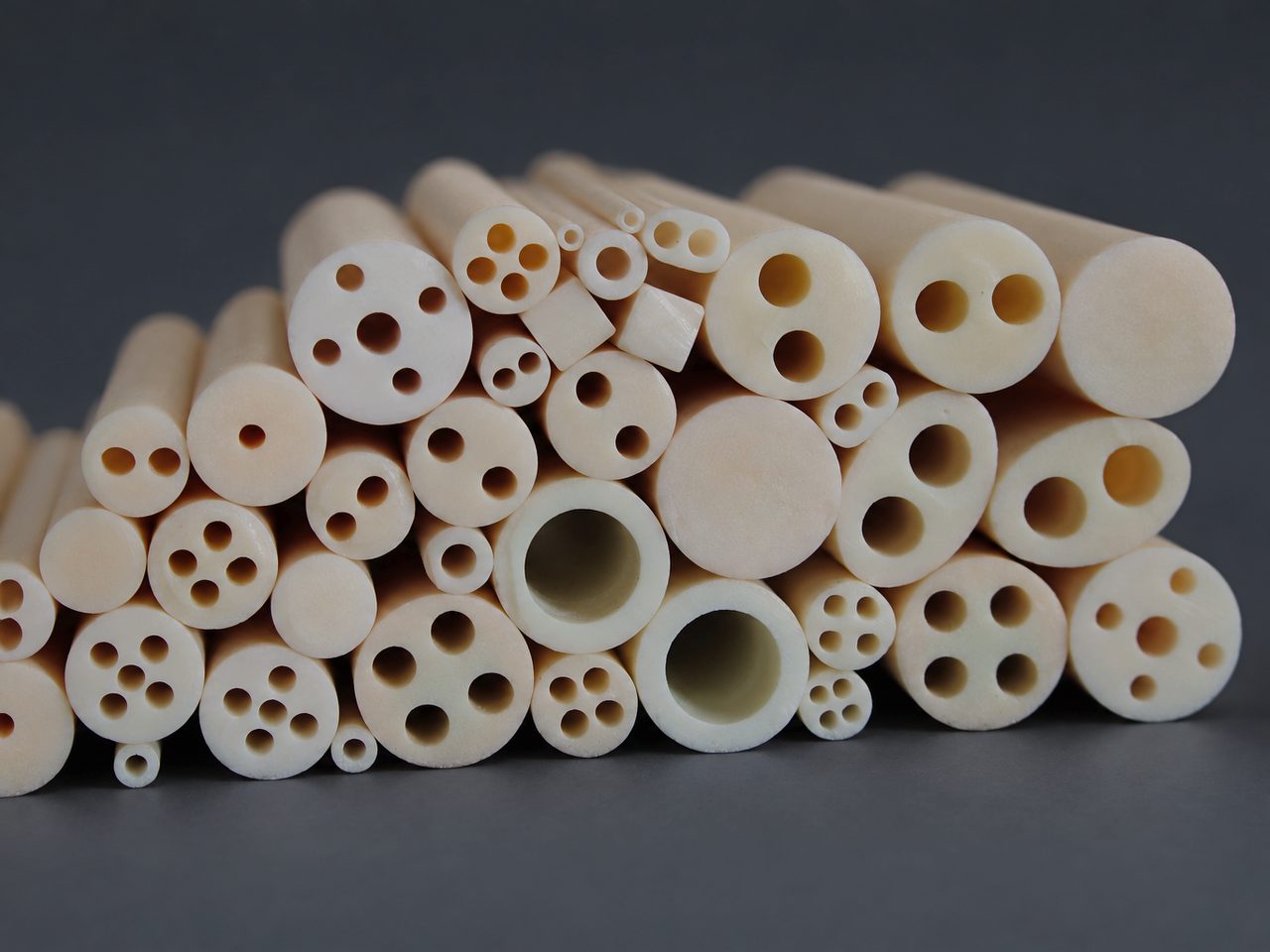
Custom configurations we manufacture include threaded, ribbed, perforated, and slotted tubes, round, elliptical, and square tubes (open or one end closed, up to OD 17 mm x ID 10 mm extruded and OD 100 mm x ID 90 mm x 1,000 mm slip-cast), single-, twin-, and multi-bore tubes, solid rods, square bars, balls, rings, washers, bushings, discs, crucibles, and boats. Secondary operations done in our factory cover cutting to length, end slots, side holes, perforated tubes, and closed ends with drilled holes.
Our standard grade is C799 alumina (99.5% Al2O3), which is sintered at about 1,760 °C (a firing temperature, not a service rating). An independent lab analyses one of our alumina tubes every year, recording 99.55% Al2O3 in 2024, 99.57% in 2025, and 99.61% in 2026, and our ISO 9001:2015 certificate covers the manufacturing of ceramic protective tubes for thermocouples. Where a buyer's drawing names C 610, we supply 95% white alumina or our standard C799 instead, as neither grade is mullite.
Stock sizes ship in about 3 days for small orders and about 7 days for bulk orders, while custom parts to drawing usually start at 100 pieces per item and take 25 to 30 days to produce after you approve 5 to 10 free samples (the buyer pays the courier). Send your drawing, the grade, and the quantity. We usually reply with a quote within two working days.
Questions buyers ask
- Can threads be machined into fully sintered alumina?
- Yes, once alumina is sintered to full density, Precision Ceramics notes that it can only be machined using diamond tools, including multi-axis grinding, turning, threading, and tapping. Pre-sintered green or biscuit machining is faster, but about 20% firing shrinkage prevents tight thread pitch tolerances without post-sinter diamond grinding.
- Why do alumina threaded rods snap when tightened like metal bolts?
- Alumina is far stronger in compression than in tension: Precision Ceramics lists 2,000 MPa compressive strength versus 140 MPa tensile strength for 96% alumina. Wrench torque pulls the rod core into tension and concentrates stress at sharp thread roots, so Morgan Technical Ceramics advises keeping ceramic parts in compression and adding generous radii and chamfers.
- What maximum temperature can a high-purity alumina rod withstand?
- Under no mechanical load in air, published limits vary by purity and maker: Precision Ceramics lists 1,600 °C for 96% alumina, Accuratus lists 1,750 °C (3,180 °F) for 99.5% alumina in air and 1,925 °C in oxidizing or reducing atmospheres, and Kyocera Fineceramics Europe lists 1,950 °C in air for DEGUSSIT AL23. Mechanical load, thermal shock drops of 170 °C to 300 °C, vacuum volatilization between 1,700 °C and 2,000 °C, and hot alkali vapors reduce the safe operating temperature.
- Which chemicals attack an alumina threaded rod?
- According to Accuratus, dense alpha alumina resists all gases except wet fluorine and resists all common chemical reagents except hydrofluoric acid and phosphoric acid. At elevated temperatures, alkali metal vapors also corrode alumina, particularly in lower-purity grades.
- What are GY Alumina's minimum order quantity and lead time for custom parts?
- Custom parts made to your drawing or sample at GY Alumina usually start at 100 pieces per item and take 25 to 30 days to produce, with 5 to 10 free samples sent for approval before production (the buyer pays courier freight). Stock sizes such as standard solid alumina rods ship in about 3 days for small orders and about 7 days for bulk orders.
Sources
- Precision Ceramics - Alumina Properties and Industrial Applications
- Kyocera Fineceramics Europe - DEGUSSIT AL23 Datasheet (February 2025)
- Morgan Technical Ceramics - Design Guide for Ceramic Components
- Morgan Technical Ceramics - High-Performance Alumina Ceramic Components
- Morgan Technical Ceramics - Thermal Shock Resistance in Ceramics
- Accuratus - Aluminum Oxide Material Properties
- Accuratus - Aluminum Oxide Ceramic Rod and Tube Sizes
- GY Alumina - Alumina Ceramics Factory in Tangshan, China
- GY Alumina - Custom Alumina Parts Made to Drawing or Sample
- GY Alumina - Buyer FAQ: MOQ, Lead Time, Samples, ISO 9001
Last checked .