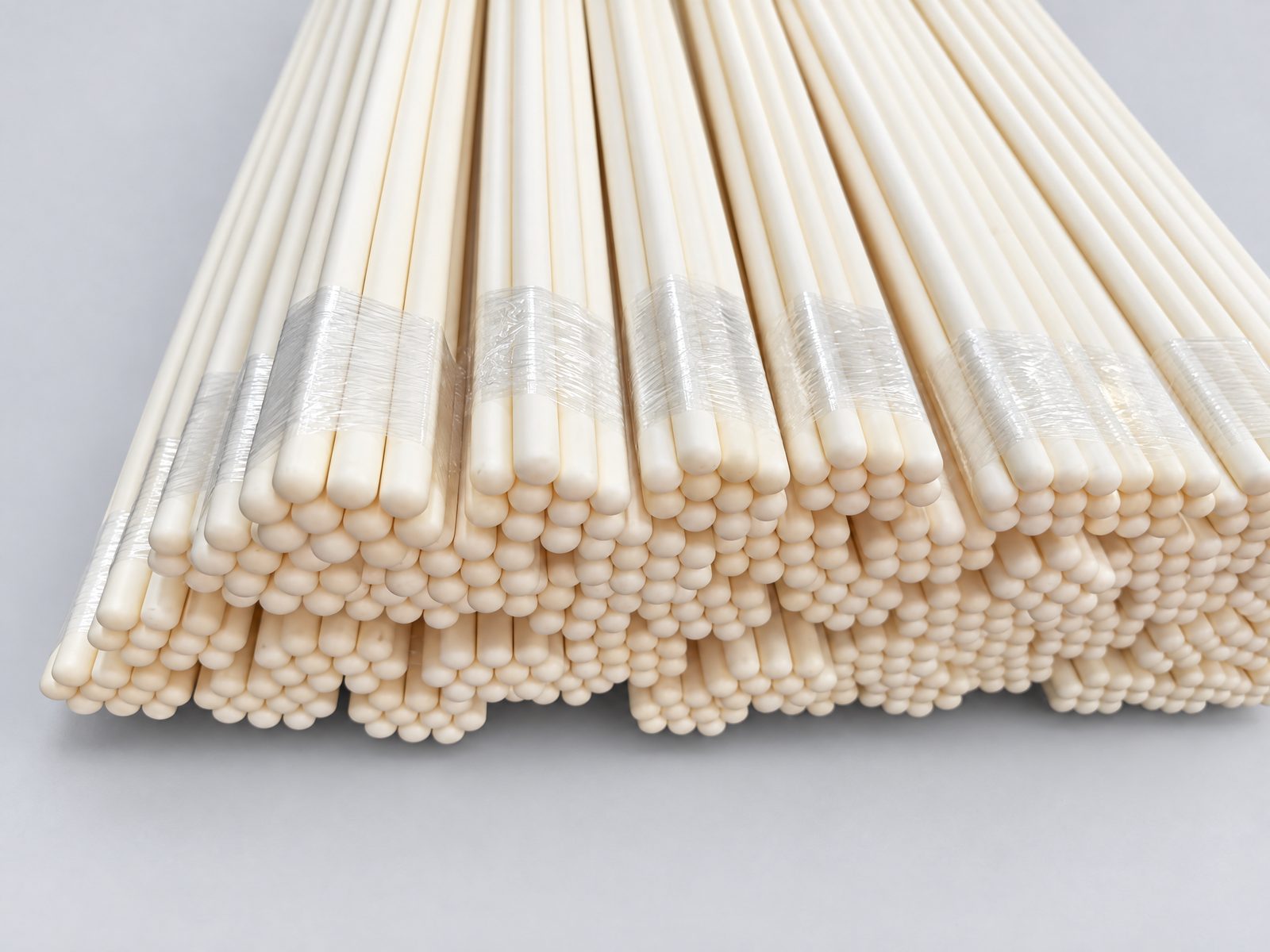
Alumina does not have a single periodic table symbol because it is a chemical compound rather than a pure element, so its symbol is the chemical formula Al2O3, as designated for aluminum oxide in ASTM E1652-21. Whether spelled aluminum oxide in US standards or aluminium oxide in British and international usage, the formula combines elemental aluminum (Al) and oxygen (O) in a fixed two-to-three ratio. On engineering drawings and purchase orders, buyers pair Al2O3 with a ceramic form or material specification to distinguish dense sintered parts from loose powders, crushable insulators, or metallic aluminum.
What Is the Symbol for Aluminum Oxide (Alumina)
When engineers, technicians, or students search for the alumina symbol, the symbol for aluminum oxide, or the symbol of aluminium oxide, they are looking for the chemical formula Al2O3. Alumina is the technical and ceramic industry name for aluminum oxide, an inorganic binary compound made of aluminum and oxygen. Because the periodic table assigns one- or two-letter atomic symbols only to pure chemical elements, no standalone periodic table box exists for alumina.
Depending on whether you are reading a chemical reaction, a thermocouple standard, a refractory datasheet, or a mechanical part drawing, related notations appear alongside or in place of Al2O3. Sorting out those notations immediately prevents mix-ups between raw metallic stock, oxide powders, and finished sintered ceramics.
| Notation | Category | Exact Meaning | Typical Engineering Context |
|---|---|---|---|
| Al2O3 | Chemical formula | Binary compound of aluminum and oxygen | Material callouts for oxide powders, insulators, and ceramics |
| Al 2 O 3 | Spaced chemical formula | Inline typography for aluminum oxide in standards text | Scope statements in thermocouple standards such as ASTM E1652-21 |
| Al | Elemental symbol | Pure metallic aluminum element | Conductive metal bar, sheet, housing, and alloy specifications |
| O | Elemental symbol | Oxygen element | Oxide formulas and furnace atmosphere descriptions |
| MgO | Comparison oxide formula | Magnesium oxide compound | Alternative crushable thermocouple insulator alongside Al2O3 in ASTM E1652-21 |
How the Al2O3 Chemical Formula Is Built and Why Al Is Different
Every chemical formula uses elemental symbols from the periodic table together with numeric subscripts that show the fixed atomic ratio in the compound. In Al2O3, Al is the elemental symbol for aluminum and O is the elemental symbol for oxygen. In technical standards typography where subscripts are spaced inline, such as the scope text of thermocouple specification ASTM E1652-21, the same formula also appears as Al 2 O 3, indicating two aluminum atoms chemically bonded to every three oxygen atoms in a neutral crystalline lattice.
That chemical bond transforms every physical property of the material compared with elemental Al. Metallic aluminum (Al) is an electrically conductive, ductile metal that melts at moderate furnace temperatures and machines with standard metalworking cutters. Aluminum oxide (Al2O3) is an electrically insulating, chemically stable ceramic oxide used to isolate live thermocouple wires, contain molten samples in laboratory crucibles, and shield sensors inside high-temperature kilns.
On a CAD drawing or bill of materials, abbreviating alumina as Al instead of Al2O3 is a costly error. Writing Al instructs a vendor to quote machined aluminum metal, whereas writing Al2O3 (paired with a ceramic form and specification) instructs a ceramic manufacturer to supply fired aluminum oxide.
Aluminium Oxide State Symbol and Physical Forms in Standards
Searches for the aluminium oxide state symbol focus on how aluminum oxide is represented in solid-state and industrial process documentation. Across room temperature and standard industrial furnace, medical, and electrical insulation environments, aluminum oxide is used as a crystalline solid, whether supplied as a fine powder, a crushable preform, a refractory brick, or a monolithic dense ceramic.
Rather than relying on a single generic state marker on engineering paperwork, technical standards define the exact physical state and consolidation form of solid Al2O3 for each application. For example, ASTM E1652-21 specifies aluminum oxide (Al2O3) as powders and crushable insulators that compact around thermometer and thermocouple wires, while ASTM F603-12 and ISO 6474-1:2019 specify high-purity, dense monolithic alumina for load-bearing surgical implants.
When preparing a process sheet or component drawing, stating the physical form explicitly alongside Al2O3 ensures that labs and manufacturers know whether the material enters the process as loose powder, a swageable preform, a thermally sprayed coating, or a rigid sintered ceramic part.
Aluminum Oxide vs Aluminium Oxide vs Alumina Across International Standards
Regional spelling differences create several search variations, including aluminum oxide symbol, aluminium oxide symbol, symbol of aluminum oxide, and symbol for aluminium oxide. All of these phrases refer to the exact same chemical compound and use the exact same symbol: Al2O3. American engineering organizations write aluminum oxide, British and international chemical conventions write aluminium oxide, and ceramic, medical, and refractory committees worldwide write alumina.
International standardization bodies align these naming variations through structured drafting rules and numeric subject codes so buyers and test labs never misread a cross-border specification. Under the International Electrotechnical Commission (IEC), normative and informative standards are published bilingually in English and French and follow the joint ISO/IEC Directives for the structure and drafting of documents, while the IEC Webstore indexes valid electrotechnical publications and test report forms across testing and manufacturing areas. Across the International Organization for Standardization (ISO) catalogue of over 26563 International Standards and deliverables, graphical symbols, codes, and terms are indexed in the ISO Online Browsing Platform (OBP) and grouped by International Classification for Standards (ICS) fields, including Field 71 for chemical technology, Field 81 for glass and ceramics industries, Field 11 for health care technology, Field 17 for metrology and measurement, and Field 29 for electrical engineering.
Comparing US and international standards under identical ICS codes shows this direct equivalence in action. Under ICS 11.040.40 for surgical implants, the US standard titles the material high-purity dense aluminum oxide while the corresponding ISO standard titles the material ceramic materials based on high purity alumina.
| Standard | Current Status | ICS Classification | Material Notation and Scope |
|---|---|---|---|
| ASTM E1652-21 (E1652-21R26) | Active (updated 2026) | 17.200.20 and 29.035.30 | Specifies aluminum oxide (Al2O3) and magnesium oxide (MgO) powders and crushable insulators for thermocouples and PRTs |
| ASTM C27-98(2022) | Active (updated 2022) | 81.080 | Classifies machine-made fireclay brick by physical properties and high-alumina refractory brick primarily by alumina content |
| ASTM F603-12 (F0603-12R25) | Active | 11.040.40 | Specifies material requirements in SI units for high-purity, dense aluminum oxide for load-bearing surgical implants |
| ISO 6474-1:2019 | Published (confirmed 2024) | 11.040.40 | Specifies bio-stable ceramic bone substitute material based on high purity alumina for orthopedic prostheses and spacers |
| ISO 14916:2017 | Published (confirmed 2022) | 25.220.20 | Determines tensile adhesive strength of thermally sprayed coatings under tension normal to the coating surface |
How Standards Classify Al2O3 Forms: Powders, Refractories, Coatings, and Dense Ceramics
Read more
Writing Al2O3 on a document tells your supplier the base chemical species, yet solid aluminum oxide is manufactured in radically different physical architectures depending on how it is processed. Active standards across temperature measurement, refractories, medical ceramics, and surface engineering illustrate why engineers pair the chemical formula with an application-specific form or specification.
In temperature sensing, ASTM E1652-21 (active version E1652-21R26, 8 pages, Book of Standards Volume 14.03, developed by Subcommittee E20.13) governs aluminum oxide (Al2O3) and magnesium oxide (MgO) powders and crushable insulators used inside metal-sheathed platinum resistance thermometers (PRTs), base metal thermocouples, noble metal thermocouples, and their cables. Rather than sintered rigid protection tubes, these crushable preforms compact around sensor leads during swaging or drawing, and the specification mandates five qualification procedures: breaking force test, wet chemical analysis, fusion calorimetric analysis, quantitative analysis, and density determination, with SI units regarded as standard.
In kiln and furnace linings, ASTM C27-98(2022) (2 pages, Book of Standards Volume 15.01, Subcommittee C08.92, ICS 81.080) classifies machine-made fireclay and high-alumina refractory brick, using inch-pound units as standard with SI conversions in parentheses. Because alumina-silica bricks span compositions from almost 100 % alumina and little silica to almost 100 % silica and little alumina, the classification groups fireclay brick by physical properties and classifies high-alumina brick primarily by alumina content.
At the dense monolithic end of ceramic engineering, ASTM F603-12 (active reapproval F0603-12R25, 3 pages, Book of Standards Volume 13.01, Subcommittee F04.13) sets SI-based material requirements for high-purity, dense aluminum oxide delivered to manufacturers of load-bearing surgical implants, excluding finished femoral heads, acetabular inserts, or dental implants. Alongside it, ISO 6474-1:2019 (Edition 2, published 2019-03-13, 9 pages, Technical Committee ISO/TC 150/SC 1, confirmed in 2024, with Draft International Standard ISO/DIS 6474-1 in development for monolithic high-purity alumina) defines test methods for bio-stable high-purity alumina used in bone spacers, bone replacements, and orthopedic joint prostheses, leaving biocompatibility evaluation to ISO 10993-1.
Where ceramic materials are applied as protective surface layers, ISO 14916:2017 (Edition 2, published 2017-03-02, 26 pages, ISO/TC 107) measures the tensile adhesive strength of thermally sprayed coatings normal to the substrate or interlayer interface.
Worked Example: Turning an Al2O3 Drawing Callout Into a Complete Ceramic Specification
Read more
Consider a practical engineering case prepared by our team. A furnace maintenance engineer inherits an older assembly drawing for a thermocouple sheath and twin-bore insulator assembly. In the title block, the material box contains only the chemical symbol Al2O3, with no purity percentage, density note, or consolidation state.
If a purchaser sends out an RFQ naming only Al2O3, vendors have to pause and ask clarifying questions before quoting. First, Al2O3 covers loose insulating powder, swageable crushable beads, porous refractory compositions, and dense sintered ceramic tubes. Second, alumina ceramics are produced in distinct alumina content tiers, and a lower-alumina refractory composition behaves differently in high-heat atmospheres than high-purity dense aluminum oxide. Third, tube drawings that omit end conditions leave open whether the outer protection tube needs both ends open or one end closed, and whether the inner multi-bore insulator needs cut-to-length ends or end slots.
To make the drawing immediately quotable, the engineer updates the material and notes block in four clear lines: Material: High-purity dense sintered Al2O3 ceramic. Outer protection tube: Round tube, one end closed, outer diameter, inner diameter, and overall length stated in millimeters. Inner insulator: Twin-bore round extruded Al2O3 tube, both ends open, cut to length, with bore diameter checked against the thermocouple wire gauge to allow smooth insertion without binding. Quantity: Prototype sample quantity plus production batch size. With that single revision, the chemical symbol Al2O3 is anchored to a specific sintered ceramic form, geometry, and fit check.
Drawing and Purchase Order Checklist for Specifying Al2O3 Parts
Read more
Before releasing a new ceramic drawing or sending a purchase order that uses aluminum oxide notation, run through this six-step verification checklist written by our team.
- Check Al2O3 versus Al in every title block and BOM field: Confirm that neither CAD auto-fill nor ERP part descriptions truncated Al2O3 to Al, which designates metallic aluminum.
- Pair the chemical formula with your required alumina purity or standard: Add the target alumina tier or material specification alongside Al2O3 so the supplier knows whether you require high-purity dense aluminum oxide or a lower-alumina composition.
- Define the consolidation form: State explicitly that the component is a dense sintered ceramic body rather than loose Al2O3 powder, a crushable preform for swaging, or a porous alumina-silica refractory.
- Specify open, closed, and machined features in metric units: State outer diameter, inner diameter or bore diameter, wall or length dimensions in mm, whether tubes are open both ends or one end closed, and any secondary features such as end slots, side holes, perforations, or drilled holes in closed ends.
- Verify mating clearances before ordering: Confirm the bore diameter against your thermocouple wire, heating element, or pin, and confirm the outer diameter against your furnace port or mounting gland so thermal expansion and firing tolerances are accommodated.
- State sample and batch expectations up front: Note your target batch quantity and whether pre-production approval samples are required before full tooling or batch firing begins.
Specifying and Ordering Custom Al2O3 Ceramic Components
At GY Alumina, our team reviews customer drawings and material callouts for industrial aluminum oxide (Al2O3) ceramic components used in thermocouples, laboratory furnaces, and high-temperature equipment.
When preparing an inquiry for custom or standard Al2O3 components, include the part geometry, metric dimensions, open or closed end configuration, bore count, and required secondary features so our engineering team can review your requirements.
Common industrial Al2O3 ceramic component geometries specified on buyer drawings include:
- Thermocouple protection tubes and furnace tubes in round, elliptical, and square cross-sections, open at both ends or with one end closed
- Thermocouple insulators, capillaries, and single-, twin-, and multi-bore tubes
- Threaded, ribbed, perforated, and slotted alumina tubes
- Solid alumina rods, square bars, and ceramic balls
- Laboratory and industrial alumina crucibles and combustion boats
- Custom shapes to drawing or sample, including rings, washers, bushings, and discs
How to Request a Quote for Al2O3 Parts
To move from an Al2O3 specification to a formal quotation, attach your 2D drawing or 3D model along with your required alumina grade and order quantity.
Send your drawing, the grade and the quantity. We usually reply with a quote within two working days.
Questions buyers ask
- What is the symbol for aluminum oxide?
- The symbol for aluminum oxide (alumina) is its chemical formula, Al2O3, as used in technical standards such as ASTM E1652-21. Because aluminum oxide is a chemical compound of aluminum (Al) and oxygen (O) rather than a single element, it uses a compound formula instead of a standalone periodic table symbol.
- What is the aluminium oxide state symbol in technical documentation?
- Across ambient and industrial operating environments, aluminium oxide is a solid material, and technical standards specify its exact solid consolidation form rather than relying on a standalone state marker. Standards distinguish between loose Al2O3 powder and crushable insulators (ASTM E1652-21), high-alumina refractory brick (ASTM C27-98(2022)), and high-purity dense monolithic alumina (ASTM F603-12 and ISO 6474-1:2019).
- Is there any difference between the symbol of aluminium oxide and aluminum oxide?
- No, both spellings share the exact chemical formula Al2O3 and refer to the same oxide material, also called alumina. US standards write aluminum oxide, while British and international texts write aluminium oxide or alumina.
- Why is alumina written as Al2O3 instead of Al?
- Al is the periodic table symbol for pure metallic aluminum, an electrically conductive metal. Al2O3 represents two aluminum atoms chemically bonded to three oxygen atoms, forming a hard, electrically insulating ceramic oxide.
- Is writing Al2O3 on an engineering drawing enough to order ceramic parts?
- Writing Al2O3 identifies the base chemical compound, which spans loose powders, crushable thermocouple beads, porous refractory bricks, and dense sintered ceramics. To get an accurate quote for a rigid ceramic component, pair Al2O3 with the required purity grade, full metric dimensions, and part geometry.
Sources
- ASTM E1652-21 Standard Specification for Magnesium Oxide and Aluminum Oxide Powder and Crushable Insulators
- ASTM C27-98(2022) Standard Classification of Fireclay and High-Alumina Refractory Brick
- ASTM F603-12 Standard Specification for High-Purity Dense Aluminum Oxide for Medical Application
- ISO 6474-1:2019 Implants for surgery: Ceramic materials based on high purity alumina
- ISO 14916:2017 Thermal spraying: Determination of tensile adhesive strength
- ISO Standards Catalogue by International Classification for Standards (ICS)
- ISO Online Browsing Platform (OBP)
- International Electrotechnical Commission (IEC) Webstore Products and Search
- International Electrotechnical Commission (IEC): Our Publications
- International Electrotechnical Commission (IEC): Reference Material and ISO/IEC Directives
Last checked .