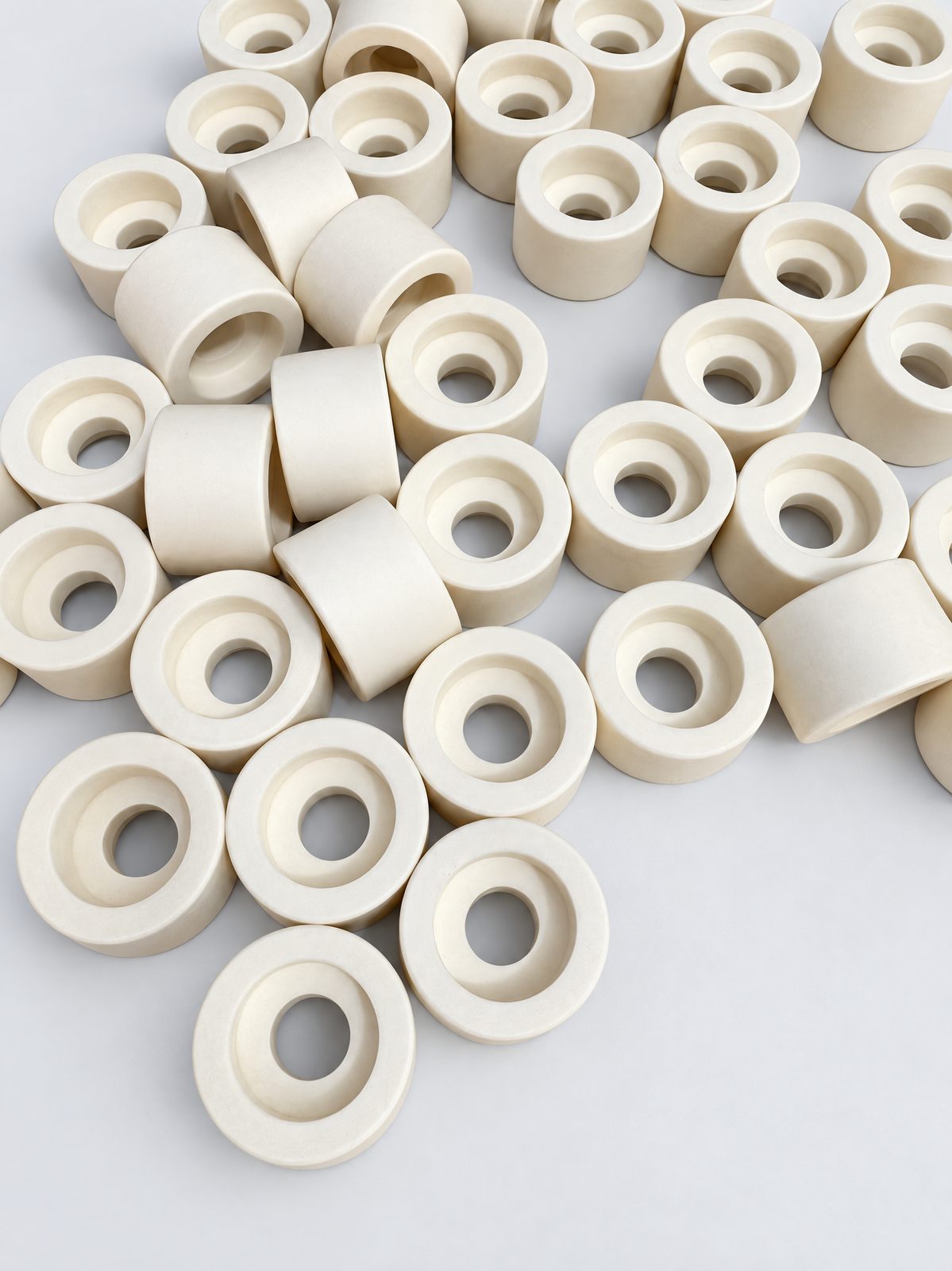
Alumina substrates are sintered alpha-phase aluminum oxide (Al2O3) ceramics that combine high electrical insulation, mechanical stiffness, and heat resistance. Depending on the purity grade, Accuratus and Precision Ceramics list thermal conductivity from 18 W/mK (94% Al2O3) to 35 W/mK (99.5% Al2O3), flexural strength from 200 to 379 MPa, a dielectric constant of 9.0 to 9.8 at 1 MHz, and volume resistivity above 10^14 ohm-cm at 25 °C. Specialized co-fired substrate grades from Kyocera reach flexural strengths up to 740 MPa.
Alumina substrate properties by purity grade (94% to 99.5%)
Aluminum oxide (Al2O3), commonly called alumina, relies on strong ionic interatomic bonding that reverts to a hexagonal alpha phase at elevated temperatures. According to Accuratus, alpha-phase alumina is the strongest and stiffest of the oxide ceramics, offering zero open porosity and stability from DC to GHz frequencies.
Material properties shift significantly as Al2O3 content increases from 94% to 99.5%. In the Accuratus engineering property tables, raising the purity from 96% to 99.5% increases room-temperature thermal conductivity from 25 W/mK to 35 W/mK. By our calculation from the Accuratus 96% and 99.5% alumina datasheets, that 3.5 percentage-point step in purity delivers a 40% increase in thermal conductivity and raises compressive strength from 2,100 MPa to 2,600 MPa.
For high-purity German technical grades, the February 2025 KYOCERA Fineceramics Europe datasheet for DEGUSSIT AL23 (above 99.5% Al2O3) records a bulk density of 3.70 to 3.95 g/cm3 (DIN EN ISO 18754), 0 Vol-% open porosity, a mean grain size of 10 micrometers (ISO 13383-1 A1), 4-point flexural strength of 300 to 350 MPa (DIN EN 843-1), compressive strength of 2,500 MPa (DIN ISO 17162), dynamic elastic modulus of 380 GPa (EN 843-2), Poisson's ratio of 0.22, Vickers hardness HV 1.0 of 17.1 GPa (DIN EN ISO 14705 Procedure A), and a maximum service temperature in air of 1,950 °C. Its thermal conductivity (DIN EN ISO 18755) is 34.9 W/mK at 20 °C, dropping to 6.8 W/mK at 1,000 °C and 5.3 W/mK at 1,500 °C, with a specific heat capacity of 900 J/(kg K) at 20 °C (DIN EN 821-3), a mean linear coefficient of thermal expansion of 8.2 x 10^-6 /K from 20 to 1,000 °C (DIN EN ISO 17562), and an electrical breakdown strength of 20 to 30 kV/mm (DIN EN 60243-1).
| Property | Accuratus 94% Al2O3 | Accuratus 96% Al2O3 | Precision Ceramics CeramAlox 96 (96%) | Accuratus 99.5% Al2O3 |
|---|---|---|---|---|
| Density (g/cm3) | 3.69 (230.4 lb/ft3) | 3.72 (232.2 lb/ft3) | 3.75 | 3.89 (242.8 lb/ft3) |
| Flexural Strength (MPa) | 330 (47 x 10^3 lb/in2) | 345 (50 x 10^3 lb/in2) | 200-300 | 379 (55 x 10^3 lb/in2) |
| Compressive Strength (MPa) | 2100 (304.5 x 10^3 lb/in2) | 2100 (304.5 x 10^3 lb/in2) | 2000 | 2600 (377 x 10^3 lb/in2) |
| Young's / Elastic Modulus (GPa) | 300 (43.5 x 10^6 lb/in2) | 300 (43.5 x 10^6 lb/in2) | 300 | 375 (54.4 x 10^6 lb/in2) |
| Fracture Toughness KIC (MPa m^1/2) | 3.5 | 3.5 | 4.5 | 4 |
| Hardness | 1175 kg/mm2 | 1100 kg/mm2 | 12 GPa | 1440 kg/mm2 |
| Poisson's Ratio | 0.21 | 0.21 | 0.23 | 0.22 |
| Thermal Conductivity (W/mK) | 18 | 25 | 25 | 35 |
| CTE (10^-6 /K or /°C) | 8.1 (4.5 x 10^-6 /°F) | 8.2 (4.6 x 10^-6 /°F) | 6.3 (25-300 °C), 7.0 (25-700 °C) | 8.4 (4.7 x 10^-6 /°F) |
| Specific Heat (J/kg K) | 880 (0.21 Btu/lb °F) | 880 (0.21 Btu/lb °F) | - | 880 (0.21 Btu/lb °F) |
| Max Use Temp, No Load (°C) | 1700 (3090 °F) | 1700 (3090 °F) | 1600 | 1750 (3180 °F) |
| Dielectric Constant @ 1 MHz | 9.1 | 9.0 | 9.8 (9.6 @ 10 MHz) | 9.8 |
| Dissipation Factor / Loss | 0.0007 (@ 1 kHz) | 0.0011 (@ 1 kHz) | 0.0001 (@ 1 MHz) | 0.0002 (@ 1 kHz) |
| Dielectric Strength (kV/mm) | 16.7 AC (418 V/mil) | 14.6 AC (365 V/mil) | 9 DC | 16.9 AC (420 V/mil) |
| Volume Resistivity (ohm-cm) | Above 10^14 | Above 10^14 | Above 10^14 | Above 10^14 |
Co-fired electronic packaging and microelectronic substrate grades
When an alumina substrate is built into a multi-layer microelectronic package or submount, the ceramic is formulated for co-firing with refractory or high-conductivity metals and for low dielectric loss at gigahertz frequencies. Kyocera's Alumina Packages and Substrates catalog details seven specialized formulations (A440, A443, A473, AO610W, AO700, AO800, and A476) designed for multi-layer lamination, dissimilar material bonding, thin-film processing on polished surfaces, metal brazing, and hermetic sealing.
Across these seven Kyocera packaging formulations, the coefficient of thermal expansion from room temperature to 400 °C sits between 6.9 and 7.5 ppm/K, which Kyocera notes is closer to silicon than organic laminates. High-strength grades AO700 and AO800 reach flexural strengths of 620 MPa and 740 MPa for ultra-small surface-mount and quartz crystal packages. By our calculation from Kyocera's Alumina Packages and Substrates table, AO800 (740 MPa) provides an 85% higher flexural strength than general-purpose A440 or high-frequency A473 (both 400 MPa).
| Property | A440 | A443 | A473 | AO610W | AO700 | AO800 | A476 |
|---|---|---|---|---|---|---|---|
| Color | Black purple | Black | White | Light pink | Gray | Gray | White |
| Laminating & Dissimilar Bonding | Applicable | Applicable | Applicable | Applicable | Applicable | Applicable | Not applicable |
| Key Characteristic | General-purpose | Higher flexural strength | Lower transmission loss | Lower conductor resistance | Higher flexural strength | Higher flexural strength | Higher reflectivity / flatness |
| Dielectric Constant | 9.8 (1 MHz) | 9.6 (1 MHz) | 9.1 (1 MHz), 8.5 (2 GHz) | 9.2 (1 MHz), 9.0 (2 GHz) | 9.4 (1 MHz), 9.2 (2 GHz) | 9.4 (1 MHz), 9.4 (2 GHz) | 9.4 (1 MHz) |
| Loss Tangent x 10^-4 | 24 (1 MHz) | 5 (1 MHz) | 5 (1 MHz), 10 (2 GHz) | 9 (1 MHz), 11 (2 GHz) | 6 (1 MHz), 6 (2 GHz) | 4 (1 MHz), 13 (2 GHz) | 4 (1 MHz) |
| CTE, RT to 400 °C (ppm/K) | 7.1 | 6.9 | 6.9 | 6.9 | 7.2 | 7.5 | 7.2 |
| Thermal Conductivity (W/mK) | 14 | 18 | 18 | 17 | 21 | 16 | 24 |
| Flexural Strength (MPa) | 400 | 460 | 400 | 460 | 620 | 740 | 350 |
| Young's Modulus (GPa) | 310 | 310 | 270 | 281 | 315 | 300 | 320 |
| Co-Fired Conductor Material | W, Mo | W, Mo | W, Mo | CuW, Mo | Mo | CuW, Mo | - |
Alumina substrate uses and applications
Because alumina combines electrical insulation from DC to microwave radio frequencies with chemical inertness and mechanical rigidity, it serves both as flat circuit substrates and as structural insulating hardware across electronics, power conversion, and semiconductor tools.
According to Kyocera, Morgan Technical Ceramics, Precision Ceramics, and Accuratus, standard electronic and industrial uses include:
- Power module substrates: High-strength alumina sheets compatible with the direct bonding of copper sheets (direct bonded copper, or DBC) for power electronics.
- Thick-film and thin-film substrates: Large-area thick-film circuit boards, plus fine-grain as-fired or polished thin-film substrates with high surface smoothness for high-density circuits and thin-film magnetic heads.
- Glazed and heat-dissipation substrates: Glazed alumina substrates with fewer surface voids for high-resolution thermal printheads, and monolithic ceramic heat-dissipation structures requiring no organic bonding layer.
- Microelectronic packages and submounts: Hermetic packages, submounts, and lids for quartz crystal devices, image sensors, light-emitting and sensing devices (using high-reflectivity white A476), and RF or optical communications.
- High-voltage and vacuum hardware: Ceramic-to-metal feedthroughs (coaxial, multi-pin, and subminiature D type), vacuum interrupter insulator tubes for medium-voltage switchgear (approximately 6 kV to 80 kV), X-ray tube insulators, klystron power tubes, and RF windows.
- Semiconductor chamber components: Wafer boats and carriers, electrostatic chucks (ESCs), vacuum chucks, polishing plates, gas nozzles, injector tubes, wafer lift pins, and anti-plasma domes and chambers.
Alumina substrate etching, surface finish, and metallization
Buyers searching for alumina substrate etching are usually dealing with one of two engineering problems: how the ceramic body resists aggressive plasma and wet-chemical attack inside semiconductor etching chambers, or how the surface is prepared and metallized for circuit traces and brazed assemblies.
In chemical and plasma environments, Accuratus states that alpha-alumina resists attack by all gases except wet fluorine and resists all common chemical reagents except hydrofluoric acid and phosphoric acid. At elevated temperatures, alkali metal vapors attack the ceramic, particularly in lower-purity grades where glassy grain boundaries are present. To prevent grain-boundary erosion during semiconductor etching, Morgan Technical Ceramics developed etch-grade aluminas (AL-998 and AL-998A). In AL-998, free silica in the grain boundaries is eliminated, and in AL-998A, soda and silica impurity levels are held below 100 ppm. This fine-grain, low-porosity microstructure maintains surface integrity during PVD, CVD, CMP, oxide etch, ion implant, and photolithography processes.
For substrate thickness and surface finish, Kyocera notes that thin-film alumina substrates are polished to achieve tight thickness tolerances, high flatness, and ultra-smooth surfaces. When a component requires complex 3D features, Precision Ceramics notes that alumina can be machined in the green or biscuit state before firing, though the body shrinks approximately 20% during sintering. Holding tight dimensional and thickness tolerances on a fully sintered part requires diamond grinding, lapping, or polishing.
For metallization and joining, the purity grade dictates the bonding chemistry:
- 94% to 95% Alumina (Morgan AL-500, A950, and Sintox FA Metallising): Formulated with controlled grain size to provide a keying surface that readily accepts molybdenum or moly-manganese (Mo-Mn) metallizing for high-temperature brazed vacuum assemblies.
- 97.5% to 97.6% Alumina (Morgan Deranox 975 and AL-300): Deranox 975 is a fine-grain grade tailored for noble-metal thick-film metallizing (conductor and resistor networks, dielectric layers, and solderable interfaces), while AL-300 accepts Mo-Mn metallizing for klystron and sensor hardware.
- 99.5% Alumina (Morgan AL-995): Combines high-purity semiconductor stability and low particle generation with the ability to accept Mo-Mn metallizing for brazed assemblies.
- Co-fired HTCC metallization (Kyocera A440 through AO800): Formulated to co-fire directly with tungsten (W), molybdenum (Mo), or copper-tungsten (CuW) conductors.
Alumina substrates vs alternative materials (FR-4, ZTA, and ATZ)
Engineers evaluating an alumina substrate vs FR-4 or other circuit board laminates are comparing an inorganic sintered oxide ceramic against an organic polymer composite. Morgan Technical Ceramics and Precision Ceramics document the exact ceramic properties that replace organic boards in harsh environments: alumina is totally non-combustible, non-outgassing in ultra-high vacuum, dimensionally stable across wide temperature swings, and rated for continuous no-load service up to 1,600 °C to 1,950 °C in air (and up to 2,000 °C in vacuum per Precision Ceramics, with vacuum weight loss of 10^-7 to 10^-6 g/cm2 sec between 1,700 °C and 2,000 °C per Accuratus).
When an application needs higher mechanical impact resistance or fracture toughness than monolithic alumina provides, manufacturers blend alumina with zirconia (ZrO2) or switch to aluminum nitride (AlN) for higher thermal dissipation. Precision Ceramics and Morgan Technical Ceramics publish direct comparative data for Zirconia Toughened Alumina (ZTA, containing 10% to 20% zirconia) and Alumina Toughened Zirconia (ATZ).
| Property | Accuratus 99.5% Al2O3 | Morgan ZTA (Mac-ZTA20W, 10-20% ZrO2) | Precision Ceramics CeramAlloy ATZ |
|---|---|---|---|
| Density (g/cm3) | 3.89 | 4.32 (0.156 lb/in3) | 5.5 |
| Flexural Strength (MPa) | 379 | - | 1800 (HIP) |
| Young's Modulus (GPa) | 375 | 350 (51 M.lb/in2) | 340 |
| Fracture Toughness KIC (MPa m^1/2) | 4 | - | 8 |
| Thermal Conductivity (W/mK) | 35 | 20 | 6 |
| CTE (10^-6 /°C) | 8.4 | 8.3 (RT to 400 °C) | 8 (25 to 400 °C) |
| Dielectric Constant | 9.8 (@ 1 MHz) | 12.5 (@ 1 kHz) | 25 (@ 1 MHz) |
| Dielectric Strength (kV/mm) | 16.9 AC | 85.3 DC (2166 V/mil) | 16 DC |
| Volume Resistivity (ohm-cm) | Above 10^14 (@ 25 °C) | 9 x 10^12 (@ 100 °C) | Above 10^16 (@ 25 °C) |
What GY Alumina manufactures and how to specify custom ceramic parts
GY Alumina is the export brand of our factory in Tangshan, China, where we manufacture industrial alumina and corundum ceramic components. We make structural and insulating ceramic parts to your drawing or sample by slip casting, pressing, extrusion, or hot pressing, including round, elliptical, and square tubes (open or one end closed), single-, twin-, and multi-bore tubes and capillaries, threaded, ribbed, perforated, and slotted tubes, solid rods, square bars, balls, rings, washers, bushings, discs, crucibles, and boats.
Our standard grade is C799 alumina (99.5% Al2O3), and where a drawing names C 610, we supply 95% white alumina or our standard C799 instead. Neither is mullite. An independent lab analyses one of our alumina tubes every year, recording 99.55% Al2O3 in 2024, 99.57% in 2025, and 99.61% in 2026. Our ISO 9001:2015 certificate covers the manufacturing of ceramic protective tubes for thermocouples. We have 100+ customers served.
In our factory, we perform secondary operations including cutting to length, end slots, side holes, perforated tubes, and closed ends with drilled holes. Our largest extruded tube today is OD 17 x ID 10 mm, and our largest slip-cast tube is OD 100 x ID 90 x 1,000 mm.
Use this specification checklist when preparing a request for custom pressed, extruded, or slip-cast alumina components:
- Drawing or physical sample: Attach a drawing or send a sample showing all geometries, slots, or holes.
- Critical dimensions and tolerances: Call out the outside diameter, inside diameter, thickness, or length tolerances that matter for your fit, and specify a one-sided bore tolerance if an insert or wire must pass through.
- Alumina grade: Specify C799 (99.5% Al2O3) or 95% white alumina.
- Operating conditions: Note the working temperature, heating rate, mechanical load, and furnace atmosphere.
- Order quantity and sampling needs: Parts made to a drawing usually start at 100 pieces per item and take 25-30 days to produce, with 5-10 free samples sent for approval first (the buyer pays the courier), while standard sizes ship from stock in about 3 days for small orders to about 7 days for bulk orders.
Summary checklist before sending your drawing
Read more
If your project requires pressed ceramic discs, insulating washers, bushings, spacers, solid rods, or multi-bore tubes in C799 (99.5% Al2O3) or 95% white alumina, you can send your drawing for our engineering team to review.
Send your drawing, the grade and the quantity. We usually reply with a quote within two working days.
Questions buyers ask
- What is the thermal conductivity of 96% vs 99.5% alumina substrates?
- According to Accuratus and Precision Ceramics datasheets, 96% alumina has a room-temperature thermal conductivity of 25 W/mK, while 99.5% alumina (Accuratus) reaches 35 W/mK. Kyocera's DEGUSSIT AL23 (above 99.5% Al2O3) measures 34.9 W/mK at 20 °C, 6.8 W/mK at 1,000 °C, and 5.3 W/mK at 1,500 °C.
- What are the dielectric constant and dielectric strength of alumina substrates?
- Across Accuratus, Precision Ceramics, and Kyocera datasheets, the dielectric constant at 1 MHz ranges from 9.0 to 9.8 depending on purity and formulation, and sits between 8.5 and 9.4 at 2 GHz for Kyocera co-fired packaging grades. Dielectric breakdown strength ranges from 9 to 16 kV/mm DC (Precision Ceramics) and 14.6 to 16.9 kV/mm AC (Accuratus), up to 20 to 30 kV/mm on Kyocera DEGUSSIT AL23.
- Which chemicals etch or attack alumina substrates?
- According to Accuratus, alpha-phase alumina resists all gases except wet fluorine and resists all common reagents except hydrofluoric acid, phosphoric acid, and high-temperature alkali metal vapors. For semiconductor plasma and oxide etching equipment, Morgan Technical Ceramics produces etch-grade alumina (AL-998 and AL-998A) with eliminated free boundary silica and below 100 ppm soda and silica impurities.
- Why choose an alumina substrate over organic laminates in high-temperature electronics?
- As documented by Morgan Technical Ceramics and Accuratus, sintered alumina is non-combustible, non-porous (0% porosity), non-outgassing in vacuum, and withstands no-load temperatures of 1,700 °C to 1,750 °C in air. Its coefficient of thermal expansion (6.9 to 7.5 ppm/K from room temperature to 400 °C on Kyocera substrate grades) also matches silicon closely.
- What custom alumina parts and order terms does GY Alumina offer?
- GY Alumina manufactures custom pressed, extruded, slip-cast, and hot-pressed ceramic components to drawing in C799 (99.5% Al2O3) and 95% white alumina, including rings, washers, discs, bushings, rods, crucibles, and tubes. Custom parts to drawing usually start at 100 pieces per item with a 25-30 day production lead time, and 5-10 free samples are available for approval first (the buyer pays the courier).
Sources
- Accuratus: Aluminum Oxide (Al2O3) Ceramic Properties
- Precision Ceramics: Alumina Properties and Industrial Applications
- Precision Ceramics: Alumina Toughened Zirconia (CeramAlloy ATZ)
- KYOCERA Fineceramics Europe: DEGUSSIT AL23 Datasheet (February 2025)
- Kyocera: Alumina (Al2O3) Packages and Substrates
- Kyocera: Fine Ceramics Alumina (Al2O3) Characteristics and Product Examples
- Morgan Technical Ceramics: 90-98% Aluminas
- Morgan Technical Ceramics: Over 98% High Purity Aluminas
- Morgan Technical Ceramics: Zirconia Toughened Alumina (ZTA)
- GY Alumina: Alumina Custom Parts Made to Drawing or Sample
- GY Alumina: Buyer FAQ (MOQ, Lead Time, Samples, ISO 9001)
- GY Alumina: Alumina Ceramics Factory in Tangshan, China
Last checked .