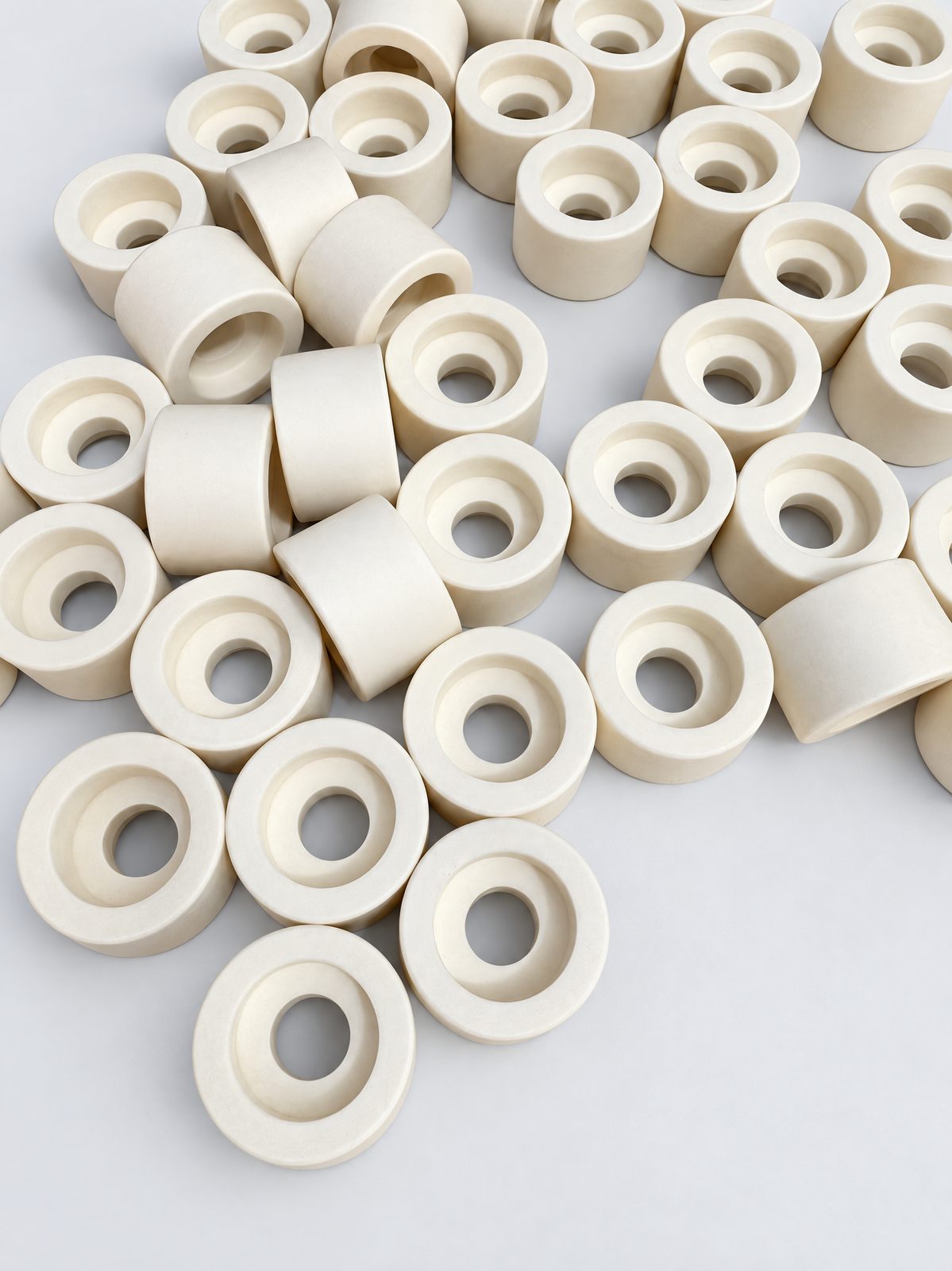
Alumina ceramic substrates (Al2O3) serve as electrically insulating, heat-dissipating circuit carriers in automotive engine control units (ECUs), pressure sensors, hybrid and electric vehicle power modules, and LED headlights. Standard 96% alumina grades deliver 25 to 26 W/(m-K) thermal conductivity and 310 to 380 MPa flexural strength in Accuratus and Kyocera datasheets, while 99.5% high-purity grades raise thermal conductivity to about 35 W/(m-K). Engineers specify alumina where under-hood heat, chemical exposure, and high-voltage isolation rule out organic boards, moving to zirconia-toughened alumina, aluminum nitride, or silicon nitride only when higher bending stress or heat flux requires it.
Where Automotive Systems Use Alumina Ceramic Substrates
Under-hood vibration, rapid thermal swings, and corrosive fluids push organic circuit boards past their limits. Kyocera's mobility and electronics catalogs document ceramic substrates and insulating plates across internal combustion, hybrid (HV and PHV), and electric vehicles (EV), where high-temperature mechanical strength and electrical insulation protect powertrain and safety electronics.
Thick-film and thin-film alumina substrates carry printed conductors, resistors, and bare semiconductor dies with zero open porosity and room-temperature volume resistivity above 10^14 ohm-cm. Manufacturers specify alumina substrates and ceramic packages across six core automotive subsystems:
- Engine Control Units (ECUs): Thick-film hybrid IC carriers and monolithic ceramic insulating plates.
- EV and hybrid power electronics: Heat-dissipation substrates for power modules, insulation plates for electrical boosters, and high-voltage supports near large-current terminal parts.
- Pressure and powertrain sensors: Printed substrates for engine oil, automatic transmission, air conditioning, and power steering hydraulic pressure sensors, plus combustion pressure sensors and tire pressure measurement systems (TPMS).
- Automotive LED headlights: Single-layer and multilayer ceramic sub-mounts and cavity packages for high-current LEDs, produced by suppliers such as Kyocera under IATF 16949 certification.
- RF and microwave modules: Low-loss alumina substrates for antennas, filters, and sensor circuits operating from DC to GHz frequencies, as noted by Morgan Technical Ceramics and Accuratus.
- Miniaturized passives and sensor caps: Alumina inductor cores and ultra-thin ceramic caps for crystal oscillators, gyro sensors, accelerometers, fuses, and surge absorbers.
94%, 96%, and 99.5% Alumina Grades Compared
Makers adjust Al2O3 purity, from 94% upward, with oxide additives to balance firing behavior, metal adhesion, surface finish, and dielectric loss. Accuratus describes 94% alumina as an easily metallizable grade suited to fired metal films for brazed and soldered assemblies, while 96% alumina is the automotive workhorse for thick-film circuits and sensors, pairing 25 to 26 W/(m-K) thermal conductivity with as-fired roughness of Ra 0.3 to 0.5 um.
Raising purity to 99.5% cuts grain-boundary glass, shrinks internal voids, and lowers dielectric loss, and polished high-purity thin-film grades such as Kyocera A493H reach below Ra 0.01 um for thin-film sputtering. For LED headlight sub-mounts, specialized white grades such as Kyocera A476A (97% alumina) trade thermal conductivity (19 W/(m-K)) for 91.0% optical reflectivity at 450 nm on a 1 mm thick plate.
The table below compares room-temperature benchmarks from Accuratus, Precision Ceramics, Kyocera Corporation (2019 Fine Ceramics for Electronics catalog), and Kyocera Fineceramics Europe (February 2025 DEGUSSIT AL23 datasheet).
| Maker and Grade | Al2O3 Purity | Density | Flexural Strength | Thermal Conductivity | CTE | Dielectric Strength |
|---|---|---|---|---|---|---|
| Accuratus 94% Alumina | 94% | 3.69 g/cm3 | 330 MPa | 18 W/(m-K) | 8.1 x 10^-6 /°C | 16.7 AC kV/mm |
| Accuratus 96% Alumina | 96% | 3.72 g/cm3 | 345 MPa | 25 W/(m-K) | 8.2 x 10^-6 /°C | 14.6 AC kV/mm |
| Precision Ceramics CeramAlox 96 | 96% | 3.75 g/cm3 | 200 to 300 MPa | 25 W/(m-K) | 6.3 x 10^-6 /K (25 to 300 °C) | 9 DC kV/mm |
| Kyocera A476T (Thick-Film / Power) | 96% | 3.78 g/cm3 | 380 MPa | 26 W/(m-K) | 7.0 x 10^-6 /K (40 to 400 °C) | 15 kV/mm |
| Accuratus 99.5% Alumina | 99.5% | 3.89 g/cm3 | 379 MPa | 35 W/(m-K) | 8.4 x 10^-6 /°C | 16.9 AC kV/mm |
| Kyocera DEGUSSIT AL23 (Feb 2025) | Above 99.5% | 3.70 to 3.95 g/cm3 | 300 to 350 MPa (4-pt) | 34.9 W/(m-K) at 20 °C | 8.2 x 10^-6 /K (20 to 1,000 °C) | 20 to 30 kV/mm |
Alumina vs. ZTA, Aluminum Nitride, and Silicon Nitride in EVs
Both Accuratus and Precision Ceramics identify alumina as one of the most cost-effective technical ceramics due to readily available raw materials, making 96% and 99.5% alumina the baseline for ECUs, sensors, booster insulation plates, and standard LEDs. When compact EV modules raise heat flux or clamping stress, engineers weigh three upgrades.
Zirconia-toughened alumina (ZTA, Al2O3 plus ZrO2) keeps thermal conductivity at 24 W/(m-K) while boosting bending strength. By our calculation from Kyocera's substrate table, Kyocera AZ211T ZTA (650 MPa) delivers 2.10 times the 3-point flexural strength of A476 96% alumina (310 MPa), helping thinner power substrates resist cracking. Optical ZTA grade AZ214T reaches 95.0% reflectivity at 450 nm with 450 MPa strength.
Aluminum nitride (AlN) targets severe heat bottlenecks in LED headlights and heat-uniformity plates. By our calculation from Kyocera's JIS R1611 table, Kyocera AN216A AlN (150 W/(K-m) at 20 °C) conducts heat 6.25 times faster than A476 96% alumina (24 W/(K-m) in that JIS table) and lowers CTE to 4.6 x 10^-6 /K, closer to silicon, though flexural strength stays at 310 MPa and Vickers hardness drops to 10.4 GPa versus 13.7 to 17.7 GPa on alumina substrates.
| Kyocera Grade and Material | Density | Flexural Strength | Young's Modulus | Thermal Conductivity | CTE (40 to 400 °C) | Dielectric Strength | Standard Thickness |
|---|---|---|---|---|---|---|---|
| A476 (96% Al2O3, Thick Film) | 3.70 g/cm3 | 310 MPa | 330 GPa | 26 W/(m-K) | 7.2 x 10^-6 /K | 12 kV/mm | 0.1 to 1.0 mm |
| A476T (96% Al2O3, Power / Thick Film) | 3.78 g/cm3 | 380 MPa | 340 GPa | 26 W/(m-K) | 7.0 x 10^-6 /K | 15 kV/mm | 0.32 to 2.7 mm |
| A493H (High-Purity Al2O3, Thin Film) | 3.96 g/cm3 | 550 MPa | 390 GPa | 30 W/(m-K) | 7.2 x 10^-6 /K | 18 kV/mm | Below 0.7 mm |
| AZ211T (Al2O3 + ZrO2 ZTA, Power) | 4.01 g/cm3 | 650 MPa | 360 GPa | 24 W/(m-K) | 7.0 x 10^-6 /K | 16 kV/mm | 0.32 to 1.0 mm |
| SN460 (Si3N4, Power, Under Dev.) | 3.50 g/cm3 | 750 MPa | 300 GPa | 55 W/(m-K) | 2.7 x 10^-6 /K | 15 kV/mm | 0.25 to 0.4 mm |
| AN216A (AlN, Heat Uniformity) | 3.4 g/cm3 | 310 MPa | 320 GPa | 150 W/(K-m) at 20 °C | 4.6 x 10^-6 /K | 14 kV/mm | Not stated |
Metallization, Glazing, and Liquid-Cooled Alumina Structures
Read more
Bare alumina becomes a circuit board through thick-film printing, plating, thin-film sputtering, or brazing. Kyocera's metallized alumina substrates pair high-adhesion molybdenum-manganese (Mo-Mn) base layers with silver (Ag) or copper (Cu) conductors, while surface-mount alumina inductor cores combine Mo-Mn or Ag bases with nickel (Ni) and tin (Sn) or gold (Au) finishes. For automotive LED headlights, single-layer and multilayer alumina (AO610W) and AlN packages support aluminum thin-film conductors for aluminum wire bonding, 3-D internal routing, stepped hermetic cavities, angled reflector walls, and copper heat-spreader fittings on alumina packages.
Where fine thin-film lines are needed on 96% or 97% alumina without mirror polishing, full or partial glass glazing (Kyocera GS-5 or GS-71 at 30 to 80 um thickness) reduces roughness below Ra 0.02 um. Because GS-5 and GS-71 conduct only 0.837 and 0.754 W/(m-K) at 20 °C, power dies are placed in unglazed windows using partial glazing.
For joint-free liquid cooling, Kyocera produces monolithic alumina substrates with internal coolant channels in 96% alumina (A476T, 26 W/(m-K)) and 99.5% alumina (A479T, 30 W/(m-K)), spanning 2 to 15 mm thick and up to 600 mm square, with channel heights of 0.5 to 10 mm, widths of 1 to 12 mm, and minimum 2 mm walls.
Dimensional Tolerances, Laser Scribing, and Through-Hole Rules
Precision Ceramics notes that alumina shrinks about 20% during sintering, which governs green-state tolerances unless parts are laser cut or diamond ground after firing. In Kyocera's thick-film alumina specifications, master cards span 50.8 mm square (2 in sq.) up to 320 mm wide (at 0.8 to 1.0 mm thickness), with long substrates reaching 1,250 mm x 125 mm x 0.635 mm at 0.6 mm per 500 mm camber. Thickness tolerance is ±10% standard or ±7% premium (minimum ±0.05 mm), and as-fired camber is held to 0.3% of the longer side on A476 and 0.2% on A476T.
Green punching lowers cost on high-volume runs, while post-fire laser cutting holds tighter snap-array alignment. Kyocera's laser-cutting rules specify a 30 um scribe width, a 5 mm (0.20 in) frame margin, and scribe depths near one-third of plate thickness, such as 0.13 mm (0.0051 in) on 0.381 mm (0.015 in), 0.21 mm (0.0082 in) on 0.635 mm (0.025 in), and 0.33 mm (0.0130 in) on 1.016 mm (0.040 in) substrates.
Keep through-hole pitch and edge-to-hole spacing larger than the substrate thickness. Laser drilling leaves an entry-to-exit taper equal to 10% of substrate thickness, with diameter tolerances of ±0.050 mm (±0.002 in) up to 0.762 mm (0.030 in), ±0.076 mm (±0.003 in) up to 2.54 mm (0.100 in), and ±0.127 mm (±0.005 in) above 2.54 mm.
| Feature or Tolerance | Green Punching | Laser Cutting |
|---|---|---|
| Outer dimensional tolerance (standard) | ±0.8% (minimum ±0.1 mm) | +0.20 mm / -0.05 mm |
| Outer dimensional tolerance (premium / super premium) | ±0.5% (min ±0.08 mm) / ±0.25% (min ±0.05 mm) | Not stated |
| Singulation scoring tolerance | ±0.8% std to ±0.25% super premium | +0.20 mm / -0.05 mm edge-to-score, ±0.05 mm score-to-score |
| Parallelism and perpendicularity | 0.5% standard, 0.3% premium of outer dimension | ±0.05 mm |
| Corner radius | 0.51 mm | Not stated |
| Minimum through-hole size | 0.20 mm round diameter, 0.38 mm square | Entry-to-exit taper equals 10% of thickness |
| Hole-to-hole and edge-to-hole spacing | Tolerance equals thickness (minimum ±0.51 mm) | Pitch and edge margin must exceed thickness |
High-Temperature Insulation and Under-Hood Chemical Resistance
Read more
Room-temperature ratings drop sharply near exhaust manifolds and hot power stages. In Kyocera's JIS C2141 tests, both 96% alumina (A476) and 99.5% alumina (A479S) exceed 10^14 ohm-cm at 20 °C, yet at 300 °C, 96% alumina falls to 10^10 ohm-cm while 99.5% alumina holds 10^13 ohm-cm (1,000 times higher hot resistivity), and at 500 °C they measure 10^8 versus 10^10 ohm-cm. Thermal conductivity also declines with heat: Kyocera's DEGUSSIT AL23 drops from 34.9 W/(m-K) at 20 °C to 6.8 W/(m-K) at 1,000 °C and 5.3 W/(m-K) at 1,500 °C. For high-voltage downsizing, Kyocera AH100A raises dielectric strength from 19 MV/m to 24 MV/m on 2 mm thickness, enabling up to 50% volume reduction in Kyocera simulations.
Dense alpha-phase alumina resists all gases except wet fluorine and all common reagents except hydrofluoric and phosphoric acids, according to Accuratus. In Kyocera's 24-hour hot immersion data, 99.5% alumina (A479S) loses 0.25 mg/cm2 in 95% sulfuric acid at 95 °C (versus 0.65 mg/cm2 for 96% A476), 0.07 mg/cm2 in 60% nitric acid at 90 °C, and 0.05 mg/cm2 in 30% caustic soda at 80 °C.
Specification Checklist for Automotive Ceramic Substrates
Sending an FR-4 board drawing to a ceramic maker without calling out warp, hole taper, and surface finish stalls prototyping. Our team wrote this eight-point checklist to lock down substrate drawings before quoting:
- Purity and circuit process: Specify 94% or 96% Al2O3 for thick-film printing (Ra 0.3 to 0.5 um), 99.5% Al2O3 for hot insulation above 250 °C, a high-purity thin-film grade for sputtering (Ra 0.05 to 0.08 um as-fired, below Ra 0.01 um polished), or ZTA, AlN, or Si3N4 for higher stress or heat flux.
- Panel layout and thickness: State single-unit size, multi-up array, waste margin (5 mm on laser-scribed cards), thickness, and standard (±10%) or premium (±7%, min ±0.05 mm) tolerance.
- Camber and flatness: Define maximum as-fired camber (0.2% to 0.3% of the longer side) or polished flatness in mm to prevent point-load cracking during clamping.
- Forming and singulation: Choose green punching for contoured volume parts or laser cutting and 30 um scribing for ±0.05 mm score-to-score accuracy.
- Through-hole rules: Keep pitch and edge margin wider than thickness, state minimum hole size (down to 0.20 mm), and mark the 10% laser-taper entry face if directional.
- Metallization and glazing: Call out Mo-Mn, Ag, or Cu conductors, Ni/Sn or Ni/Au plating, and unglazed die windows where 30 to 80 um glaze would block heat.
- Optical reflectivity: For bare LED sub-mounts, state minimum reflectivity at wavelength (such as 91% to 95% at 450 nm on 1 mm thickness).
- Quality and traceability: Note IATF 16949 requirements, laser-marked piece serialization, working voltage, temperature range, and annual volume.
What GY Alumina Makes and How to Request a Quote
GY Alumina is an export brand of a Chinese factory in Tangshan that makes alumina and corundum ceramic parts, including custom alumina components to your drawing or sample by slip casting, pressing, extrusion, and hot pressing. We make single-, twin-, and multi-bore tubes and capillaries, plus round, elliptical, and square tubes with open or one end closed. We also produce solid alumina rods, square bars, balls, rings, washers, bushings, discs, crucibles, boats, and custom shapes. Factory secondary operations include cutting to length, end slots, side holes, perforated tubes, and closed ends with drilled holes. Extruded tubes reach OD 17 x ID 10 mm, and slip-cast tubes reach OD 100 x ID 90 x 1,000 mm.
Our alumina materials and grades center on C799 alumina (99.5% Al2O3), plus 95% white alumina supplied where a drawing names C 610 (neither of our grades is mullite), and crucibles in 99% and 99.5% Al2O3. An independent lab analyzes one of our tubes yearly, recording 99.55% Al2O3 in 2024, 99.57% in 2025, and 99.61% in 2026. Our ISO 9001:2015 certificate covers the manufacturing of ceramic protective tubes for thermocouples (that scope only), with 100+ customers served.
Custom parts to drawing usually start at 100 pieces per item and take 25 to 30 days to produce, with 5 to 10 free samples sent for approval first (the buyer pays the courier), while stock sizes ship in about 3 days for small orders to about 7 days for bulk. Send your drawing, the grade and the quantity. We usually reply with a quote within two working days.
Questions buyers ask
- Why are alumina substrates used in automotive ECUs and sensors instead of standard PCBs?
- Alumina substrates maintain rigidity, zero open porosity, 25 to 35 W/(m-K) thermal conductivity across 96% to 99.5% grades, and room-temperature resistivity above 10^14 ohm-cm while resisting oils, acids, and under-hood heat. In Kyocera's mobility lineup, monolithic ceramic carriers handle ECU circuits, hydraulic and combustion pressure sensors, and EV booster insulation plates where organic boards degrade.
- What is the difference between 96% and 99.5% alumina substrates?
- Standard 96% alumina is the economical workhorse for thick-film automotive printing, offering 25 to 26 W/(m-K) thermal conductivity and Ra 0.3 to 0.5 um as-fired roughness. Stepping up to 99.5% alumina raises thermal conductivity to 35 W/(m-K) in Accuratus data, increases 300 °C volume resistivity 1,000-fold from 10^10 to 10^13 ohm-cm in Kyocera JIS C2141 tests, and polished high-purity thin-film grades such as Kyocera A493H reach below Ra 0.01 um for thin-film circuits.
- When do automotive engineers choose AlN, ZTA, or Si3N4 over alumina?
- Alumina covers ECUs, sensors, and auxiliary insulation at the lowest ceramic cost, while zirconia-toughened alumina (Kyocera AZ211T at 650 MPa) more than doubles the 310 MPa bending strength of 96% alumina. Aluminum nitride (150 W/(K-m) in Kyocera AN216A) handles dense LED and power heat flux, and silicon nitride (750 MPa in SN460 and 800 K thermal shock delta-T in SN240) withstands severe EV power-module cycling.
- What dimensional tolerances and minimum hole sizes apply to thick-film alumina substrates?
- Kyocera specifies thick-film alumina outer tolerances from ±0.8% standard down to ±0.25% super premium (minimum ±0.05 mm) via green punching, or +0.20 mm / -0.05 mm on outer edges and ±0.05 mm score-to-score via laser cutting. As-fired camber is 0.2% to 0.3% of the longer side, and green-punched round holes reach down to 0.20 mm diameter.
- What custom alumina ceramic components does GY Alumina manufacture?
- GY Alumina manufactures bulk custom ceramic parts to drawing or sample by slip casting, pressing, extrusion, and hot pressing in C799 alumina (99.5% Al2O3) and 95% white alumina, including discs, washers, rings, bushings, rods, and single- or multi-bore tubes starting at 100 pieces, and buyers can send a drawing for review.
Sources
- Kyocera Fine Ceramics: Automotive and Mobility
- Kyocera Ceramic Substrates and Packages for Automotive LEDs
- Kyocera Fine Ceramics: Thick Film Substrates
- Kyocera Corporation: Fine Ceramics for Electronics Catalog
- Kyocera Fineceramics Europe: DEGUSSIT AL23 Material Datasheet (February 2025)
- Kyocera Fineceramics Europe: Alumina Thick Film Substrates
- Accuratus: Aluminum Oxide (Al2O3) Ceramic Properties
- Precision Ceramics: Alumina Properties and Industrial Applications
- Morgan Technical Ceramics: High-Performance Alumina Ceramics
- GY Alumina: Custom Alumina Parts Made to Drawing or Sample
- GY Alumina: Alumina and Corundum Material Data
- GY Alumina: Buyer FAQ on MOQ, Lead Time, Samples, and ISO 9001
- GY Alumina: Alumina Ceramics Factory in Tangshan, China
Last checked .