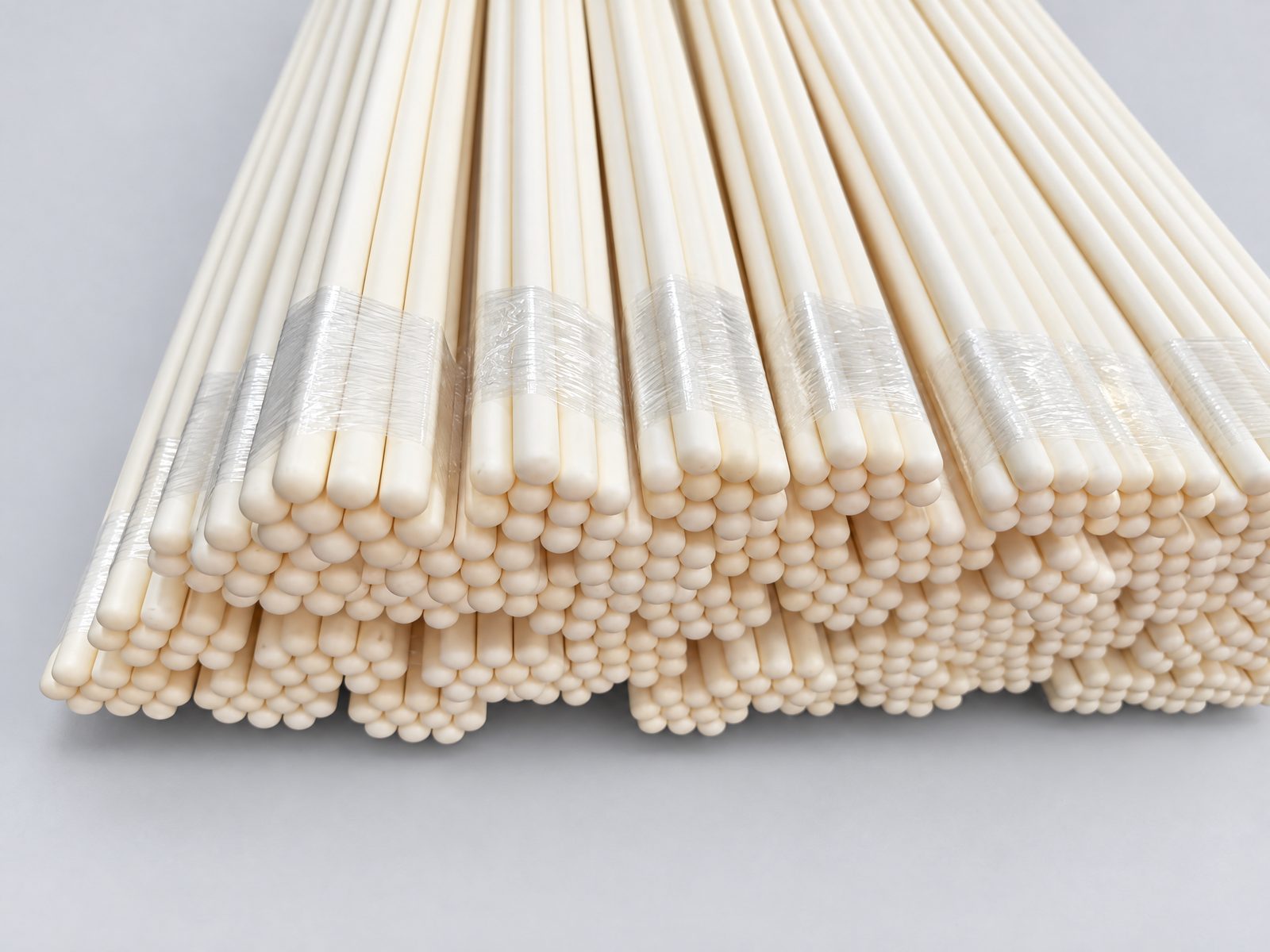
Alumina spacers are technical ceramic standoffs, bushings, rings, and multi-bore insulators sintered from crystalline aluminum oxide (Al2O3) to hold physical spacing while isolating electricity and heat. High-purity (99.5% or higher) sintered alpha-alumina melts at 2050 °C and delivers 3.0 GPa of compressive strength at 20 °C according to NIST Standard Reference Database 150. Engineers specify an alumina spacer whenever high temperature, high voltage, vacuum outgassing limits, or chemical wear rule out polymer and metal hardware.
Alumina Ceramic Spacers vs. Metallic Aluminum Spacers
Search catalogs often mix alumina spacers with metallic aluminum spacers, so confirm the material class on your bill of materials first. According to the American Ceramic Society, alumina (Al2O3) is an inorganic, nonmetallic, crystalline compound formed between aluminum and oxygen. In NIST Standard Reference Database 69, aluminum oxide carries CAS Registry Number 1344-28-1 and a molecular weight of 101.9613 g/mol.
Metallic aluminum spacers are conductive metal sleeves used for mechanical framing, sheet-metal standoffs, or architectural window glazing. They conduct electricity directly into the chassis and soften at low furnace temperatures.
An alumina spacer is an engineered oxide ceramic. As the American Ceramic Society notes, technical ceramics are hard, chemically inert, and effective electrical insulators. You use an Al2O3 spacer when two components must stay mechanically locked at a fixed gap without sharing electrical current, corroding in process gas, or deforming in high heat.
Spacer Geometries: 3D Standoffs, Multi-Bore Tubes, and 2D Shims
Most supplier catalogs split cylindrical standoffs and thin flat spacers onto separate pages, even though an assembly often needs both. Selecting the simplest geometry that carries your load in compression keeps tooling straightforward and reduces fracture risk.
Across vacuum chambers, furnaces, sensors, and power electronics, alumina spacers fall into six practical shapes:
- Unthreaded cylindrical tubes and bushings: Straight sleeves with a clearance bore that slip over metal bolts, studs, or tie rods to set an insulated gap.
- Solid spacer rods, pins, and square bars: Unbored cylinders or bars seated inside pockets as rest pads, kinematic locators, or thermal standoffs.
- Single-, twin-, and multi-bore tubes: Extruded insulators with parallel internal channels that keep bare thermocouple wires, platinum resistance thermometer leads, or vacuum feedthrough pins separated inside one outer profile.
- Stepped, ribbed, and slotted feedthrough spacers: Shouldered bushings that pilot directly into a bulkhead hole while adding surface ribs or end slots to lengthen the electrical flashover path.
- Threaded ceramic standoffs: Spacers tapped with internal threads or formed with external threads for direct screw mounting where polymer threads melt or outgas.
- Flat washers, rings, discs, and 2D planar shims: Low-profile axial spacers placed beneath bolt heads, heating elements, or electronic packages to isolate voltage while transferring clamp load across a wide face.
Validated Properties of Alumina from 20 °C to 1500 °C
Room-temperature datasheets rarely show how a ceramic standoff behaves once your furnace or power assembly heats up. NIST Standard Reference Database 150 compiles validated property values from 20 °C to 1500 °C for sintered alpha-alumina of 99.5% or higher purity, densified to at least 98% of theoretical density with a nominal grain size of 5 µm.
Two trends in this NIST dataset govern almost every alumina spacer design. First, compressive strength at 20 °C (3.0 GPa, or 3,000 MPa) is more than eleven times tensile strength (267 MPa) and nearly eight times flexural strength (380 MPa). Alumina supports heavy axial clamping loads when seated flat, yet fails at much lower stress if bent or pulled in tension.
Second, thermal conductivity drops sharply as temperature climbs, falling from 33 W/m·K at 20 °C to 7.22 W/m·K at 1000 °C. A high-purity alumina standoff conducts moderate heat away from electronics near room temperature, then acts as a much stronger thermal choke inside a hot zone.
| Property | 20 °C | 500 °C | 1000 °C | 1200 °C | 1400 °C | 1500 °C |
|---|---|---|---|---|---|---|
| Density (g/cm3) | 3.984 | 3.943 | 3.891 | 3.868 | 3.845 | 3.834 |
| Compressive Strength (GPa) | 3.0 | 1.6 | 0.7 | 0.4 | 0.3 | 0.28 |
| Flexural Strength (MPa) | 380 | 375 | 345 | 300 | 210 | 130 |
| Tensile Strength (MPa) | 267 | 267 | 243 | 140 | 22 | 13 |
| Elastic Modulus (GPa) | 416 | 390 | 364 | 354 | 343 | 338 |
| Vickers Hardness, 1 kg (GPa) | 15 | 8.5 | 4.6 | 3.7 | 2.9 | 2.5 |
| Fracture Toughness, 300 µm crack (MPa·m1/2) | 3.5 | 3.0 | 2.7 | 2.6 | 2.5 | 2.5 |
| Thermal Conductivity (W/m·K) | 33 | 11.4 | 7.22 | 6.67 | 6.34 | 6.23 |
| Specific Heat (J/kg·K) | 755 | 1165 | 1255 | 1285 | 1315 | 1330 |
| Thermal Expansion from 0 °C (10^-6 K^-1) | 4.6 | 7.1 | 8.1 | 8.3 | 8.5 | 8.6 |
| Creep Rate at 150 MPa (10^-9 s^-1) | 0 | 0 | 4 | 280 | 6600 | 24600 |
Purity Grades, Cryogenic Data, and Material Trade-Offs
Read more
Commercial alumina spacers are supplied in grades ranging from general electrical compositions around 95% and 96% Al2O3 up to high-purity 99% and 99.5% or higher alpha-alumina bodies. Lower-alumina grades contain a glassy silicate grain-boundary phase that aids sintering for general electrical standoffs and heater supports. Moving to 99.5% or higher Al2O3 minimizes secondary phases for ultra-high vacuum cleanliness, chemical corrosion resistance, noble-metal sensor purity, and elevated-temperature creep resistance.
Purity also shifts thermal transport, including inside cryogenic vacuum apparatus. In NIST Standard Reference Database 30 (Citation Z00317), evaluated steady-state heat-flow tests on a 96% pure polycrystalline alumina rod (Hitachi Alumina 552, 10 mm diameter by 34 mm length) show a thermal conductivity of 27 W/m·K at 300 K, compared with 33 W/m·K at 20 °C for the 99.5% or higher alpha-alumina in NIST Standard Reference Database 150. As cooled toward liquid nitrogen and liquid helium temperatures, the 96% alumina rod peaks at 95 W/m·K at 87 K before dropping to 0.42 W/m·K at 2.0 K, making alumina an effective thermal isolator at deep cryogenic stages below 11 K while conducting heat briskly near 87 K.
Before finalizing alumina, weigh it against polymer, metal, and other advanced ceramic families cataloged in the NIST Structural Ceramics Database. Molded nylon or PTFE spacers suit ambient circuit boards, while alumina takes over when heat, high voltage, radiation, vacuum bakeout, or abrasive wear would degrade plastics. Among technical ceramics, alumina balances electrical insulation, compressive stiffness, and tooling economy. Engineers step over to zirconia when impact fracture resistance outweighs thermal conductivity, silicon nitride when severe thermal shock or cyclic bending dominates, or high-conductivity carbides and nitrides when rapid heat spreading is the primary goal. For comparison, the same NIST Citation Z00317 records polycrystalline silicon carbide doped with 2 wt% BeO (Hitachi HITACERAM SC-101, 5 mm by 5 mm by 25 mm plate) at 270 W/m·K at 310 K, 390 W/m·K at 130 K, and 380 W/m·K at 87 K.
| Temperature (K) | Thermal Conductivity (W/m·K) |
|---|---|
| 2.0 | 0.42 |
| 4.8 | 1.1 |
| 11 | 3.9 |
| 26 | 31 |
| 51 | 81 |
| 87 | 95 |
| 140 | 63 |
| 200 | 46 |
| 300 | 27 |
Managing Thermal Expansion and Bolt Clearance
A common cause of cracked alumina spacers in furnaces and vacuum chambers is thermal expansion mismatch against a metal screw, pin, or housing. In NIST Standard Reference Database 150, the mean linear thermal expansion coefficient of sintered alpha-alumina measured from 0 °C starts at 4.6 x 10^-6 K^-1 at 20 °C and rises to 7.1 x 10^-6 K^-1 at 500 °C, 8.1 x 10^-6 K^-1 at 1000 °C, and 8.6 x 10^-6 K^-1 at 1500 °C.
Apply that expansion check in two directions on your assembly drawing. Radially, if a higher-expansion metal bolt or copper conductor passes through the spacer bore, the metal pin grows faster in diameter than the alumina inside diameter as the assembly heats up. Zero radial clearance at 20 °C turns into an internal hoop-tension wedge at 500 °C, splitting the tube from the inside out. Always size the inside diameter so positive diametral clearance remains at peak operating temperature, and confirm the bore against your wire or bolt before ordering.
Axially, if a lower-expansion alloy bolt passes through the alumina sleeve, the alumina grows faster than the bolt and spikes clamping load during heating. If a higher-expansion steel or copper bolt clamps the alumina sleeve, bolt growth loosens preload at temperature, or over-tightening while hot crushes the assembly on cooldown. A Belleville spring washer stack placed under the metal nut absorbs that differential axial travel while keeping compressive preload steady.
Fastening, Thread Limits, and High-Voltage Creepage Design
Because high-purity sintered alumina has a fracture toughness of 3.5 MPa·m1/2 at 20 °C and a Weibull modulus of 11 across 20 °C to 1500 °C in NIST Standard Reference Database 150, ceramics do not yield locally like steel to forgive uneven bolt seating. Good mechanical detailing eliminates point loads before they start a crack.
When bolting through a cylindrical alumina spacer or flat ceramic washer, keep both end faces perpendicular to the bore and seat them against smooth, flat metal surfaces. Place a compliant cushioning washer such as soft annealed copper, nickel, mica, or a spring washer between hard steel fastener heads and the ceramic end face so microscopic surface burrs cannot concentrate contact pressure. Specify small chamfers on inner and outer edges rather than razor-sharp corners to prevent edge chipping during assembly. If two alumina parts slide dry against each other under load, note the NIST Standard Reference Database 150 tribology finding: dry alumina-on-alumina friction and wear rise sharply at 200 °C (reaching a friction coefficient of 0.8 at 500 °C under 2 GPa contact stress compared with 0.40 at 20 °C) before decreasing roughly linearly between 600 °C and 900 °C.
Keep slender standoffs out of cantilever bending. Where side loads or vibration exist, step up the outer diameter to widen the seating footprint and capture the spacer with a through-bolt rather than relying on tiny internal ceramic threads. Unthreaded clearance tubes with standard metal studs cost less and carry far higher clamp force than tapped ceramic holes. When your layout requires a threaded alumina standoff, choose coarser thread pitches and add a generous lead-in countersink at both ends of the tapped hole so the first thread crest cannot spall during screw insertion.
For high-voltage standoffs, check two separate paths: clearance (the shortest line-of-sight distance through air, gas, or vacuum between live metal end caps) and creepage (the shortest path along the ceramic outer surface). Adding external ribs, sheds, or stepped shoulders increases creepage distance without lengthening your overall mechanical stack, while shielding the surface from conductive dust or condensation. Account for operating temperature in your electrical margin as well, because ceramic electrical resistance drops as furnace temperatures climb above 500 °C. Where a vacuum feedthrough requires a permanently brazed hermetic joint rather than dry mechanical clamping, engineers specify ceramic-to-metal sealing grades covered under ASTM D2442-75(2025) and apply metallized brazing rings.
Manufacturing Routes, Flaw Control, and ASTM Standards
Read more
How an alumina spacer is formed directly affects its internal flaw population and mechanical reliability. As summarized in NIST Standard Reference Database 150, polycrystalline alumina bodies are produced by compacting powder and sintering at about 1700 °C or by hot pressing, often with a small addition of magnesium oxide (MgO) to control grain growth during densification. NIST's ceramic manufacturing program notes that conventional ceramic production uses tooling, molding, and machining steps to reach tight final dimensions.
Engineers evaluating 3D-printed ceramic prototypes should weigh defect control carefully. As NIST notes, ceramic additive manufacturing methods such as vat photopolymerization (UV-curable ceramic-loaded resins) and direct ink writing yield non-dense green parts that still require post-build sintering, with consensus feedstock test methods under development through ASTM F42 and ISO TC 261 across more than 20 laboratories. In a 2024 NIST international interlaboratory study across 6 laboratories testing flexural strength in vat-photopolymerized alumina, 7 flaw types including layer seams and powder agglomerates accounted for 94% of fractures, and flaw populations varied substantially across labs. For load-bearing standoffs and production runs, pressed, extruded, or slip-cast sintered bodies remain the standard choice.
Two active ASTM International specifications anchor material callouts on engineering drawings depending on what your spacer isolates:
- ASTM D2442-75(2025), Standard Specification for Alumina Ceramics for Electrical and Electronic Applications (Book of Standards Volume 15.02, Subcommittee C21.03, updated June 25, 2025): Covers fabricated alumina parts for electrical and electronic assemblies and ceramic-to-metal seals in electron devices, defining body property limits and test methods across electrical, mechanical, thermal, and general parameters regardless of part geometry.
- ASTM E1652, Standard Specification for Magnesium Oxide and Aluminum Oxide Powder and Crushable Insulators (active edition E1652-21R26, Book of Standards Volume 14.03, Subcommittee E20.13, updated November 4, 2026): Covers aluminum oxide crushable insulators and powders used inside base metal thermocouples, noble metal thermocouples, metal-sheathed platinum resistance thermometers, and their cables, using breaking force, wet chemical, fusion calorimetric, quantitative, and density tests.
Buyer Checklist Before Sending a Spacer Drawing
A clear mechanical drawing prevents tolerance over-specification, avoids tooling delays, and gets you an accurate quote on the first pass. Confirm these six details before sending your request:
- Geometry and critical fits: Call out outer diameter, bore diameter, overall length, bore count and pitch for multi-bore spacers, plus edge chamfers and which faces carry axial clamp load.
- Tolerances where needed only: Apply tight tolerances only to mating pilot diameters, pin bores, or stack-height faces, and leave non-contact outer walls at standard sintered tolerances to avoid unnecessary machining.
- Operating temperature and thermal cycle: State peak continuous temperature and heating rate so clearance bores and spring-washer cushioning account for thermal expansion.
- Purity grade: Specify the required aluminum oxide purity percentage based on whether the spacer serves in general electrical isolation or in high-temperature furnaces, clean vacuum hardware, corrosive atmospheres, and sensor insulation.
- Fastening and sealing method: Note whether the spacer mounts dry under a cushioned bolt, slides over a guide rod, or sits inside a potted or brazed assembly.
- Prototype and batch quantities: List both your initial approval sample count and your target production batch quantity so forming routes such as pressing, extrusion, or slip casting match your volume.
- Send your drawing, the grade and the quantity.
Questions buyers ask
- What is the difference between an alumina spacer and an aluminum spacer?
- An alumina spacer is an inorganic, crystalline oxide ceramic (Al2O3) that insulates electricity, resists chemical corrosion, and melts at 2050 °C according to the American Ceramic Society and NIST Standard Reference Database 150. An aluminum spacer is a metallic hardware sleeve that conducts electricity and heat.
- What purity grade should I choose for an alumina ceramic standoff?
- Grades around 95% and 96% Al2O3 handle general-purpose electrical standoffs, heater supports, and mechanical bushings. High-purity 99.5% or higher sintered alpha-alumina is chosen for ultra-high vacuum systems, high-temperature furnaces, corrosive chemical environments, and precision temperature sensors.
- How strong are alumina spacers under bolted clamping loads?
- In NIST Standard Reference Database 150, high-purity (99.5% or higher) sintered alpha-alumina provides 3.0 GPa of compressive strength at 20 °C and 0.7 GPa at 1000 °C, compared with 267 MPa in tension at 20 °C. Always load ceramic spacers in axial compression between flat, parallel surfaces using soft metal, mica, or Belleville spring washers to prevent point-load cracking.
- How much does an alumina spacer expand when heated to 1000 °C?
- NIST Standard Reference Database 150 lists a thermal expansion coefficient from 0 °C of 7.1 x 10^-6 K^-1 at 500 °C and 8.1 x 10^-6 K^-1 at 1000 °C for high-purity sintered alpha-alumina.
- Which ASTM standards apply to alumina spacers and sensor insulators?
- ASTM D2442-75(2025) specifies electrical, mechanical, thermal, and general body requirements for fabricated alumina parts in electronic and electrical devices and ceramic-to-metal seals regardless of geometry. For temperature sensors, ASTM E1652 (active edition E1652-21R26) governs aluminum oxide crushable insulators and powders used in base metal thermocouples, noble metal thermocouples, and metal-sheathed platinum resistance thermometers.
- Are pressed and extruded alumina spacers stronger than 3D-printed alumina?
- Conventional sintered parts avoid layer-boundary defects common in slurry printing. A 2024 NIST interlaboratory study across 6 laboratories found that 7 flaw types, including seams and agglomerates, caused 94% of flexural failures in vat-photopolymerized alumina, making conventionally pressed, extruded, or slip-cast sintered alumina the standard choice for structural standoffs.
Sources
- NIST Standard Reference Database 150: Sintered Alumina Property Data Summary
- NIST Standard Reference Database 30: Low-Temperature Thermal Conductivity of Alumina (Citation Z00317)
- NIST Structural Ceramics Database (SRD 30)
- NIST Chemistry WebBook (SRD 69): Aluminium Oxide
- ASTM D2442-75(2025): Standard Specification for Alumina Ceramics for Electrical and Electronic Applications
- ASTM E1652: Standard Specification for Magnesium Oxide and Aluminum Oxide Powder and Crushable Insulators
- NIST: Additive Manufacturing of Ceramics
- NIST: Additive Manufacturing Interlaboratory Studies
- The American Ceramic Society: Engineer and Scientist Resources
- The American Ceramic Society: What Are Ceramics?
Last checked .