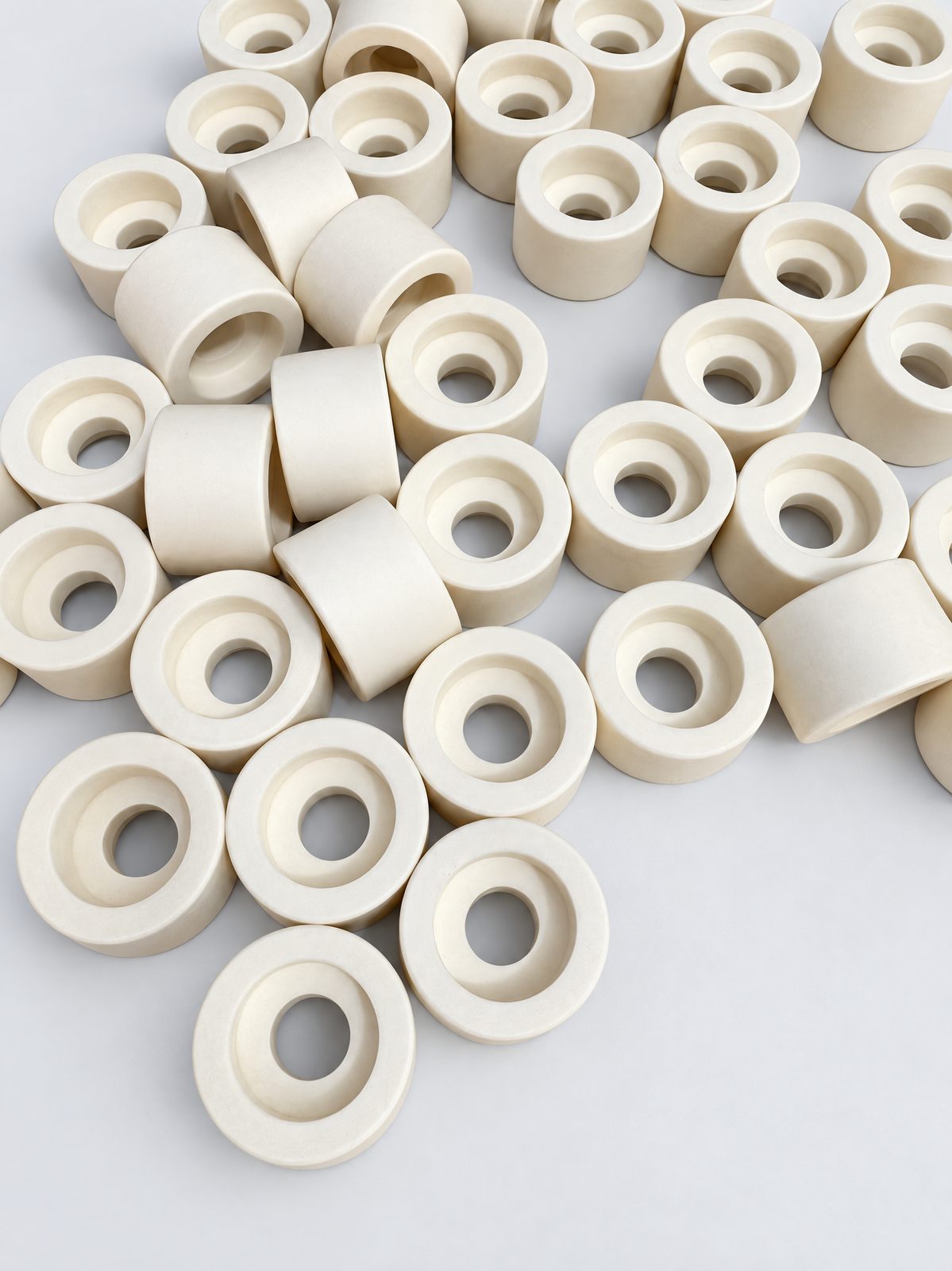
A high-purity alumina plate is a dense sintered aluminum oxide (Al2O3) sheet, substrate, or setter used where a flat part needs electrical insulation, wear resistance, and dimensional stability at extreme heat. Among commercial compositions from 94% to 99.5% Al2O3, Accuratus rates its 99.5% grade to 1,750 °C (3,180 °F) under no load at 35 W/(m K) thermal conductivity, while Kyocera's February 2025 DEGUSSIT AL23 datasheet lists a maximum air service temperature of 1,950 °C. Specifying the right purity, forming route, and diamond-ground faces up front prevents unnecessary machining cost and first-cycle furnace cracking.
Choosing a Purity Grade: 94%, 96%, 99%, 99.5% Al2O3, and C799
Buyers searching for an alumina plate high purity option or comparing customized 96, 99, and 99.5 alumina ceramic substrate, plate, and sheet designations are choosing how much glassy grain-boundary phase remains in the fired body. Lower-purity aluminas include oxide fluxes that lower firing cost and aid metallization, while higher-purity alpha-alumina grades cut silica and iron oxides to raise thermal conductivity, electrical resistivity, refractoriness, and plasma resistance.
Morgan Technical Ceramics groups industrial compositions into standard alumina at 85% to 95% Al2O3 for general wear parts and insulators, high-purity alumina at 96% to 99.5% Al2O3 for semiconductor equipment, analytical instruments, medical devices, and vacuum systems, and ultra-high-purity alumina for plasma environments and ultra-high vacuum chambers. Accuratus supplies commercial grades from a 94% metallizable white body and a 96% substrate grade up to 99.5% ivory alumina for high-temperature service. Precision Ceramics lists its CeramAlox 96 at 96% Al2O3, density 3.75 g/cm3, 25 °C thermal conductivity 25 W/mK, compressive strength 2,000 MPa, and no-load air temperature 1,600 °C.
European drawings frequently use ceramic class codes instead of percentages. Precision Ceramics lists Alumina C 799 for electrical and chemical service up to 1,700 °C in inert gas alongside Mullite C 610 (60% Al2O3 and 37% SiO2, rated to 1,500 °C). At GY Alumina, across our alumina materials and grades, our standard corundum grade is plain C799 alumina at 99.5% Al2O3, and crucibles are made in 99% and 99.5% Al2O3. Where a drawing names C 610, we supply 95% white alumina or our standard C799 alumina instead, as neither is mullite. An independent lab analyzes one of our alumina tubes every year, recording 99.55% Al2O3 in 2024, 99.57% in 2025, and 99.61% in 2026.
- 94% to 95% Al2O3: Selected when ceramic-to-metal brazing, fired metal films, or general wear protection outweigh peak thermal conductivity.
- 96% Al2O3: The workhorse thick-film electronic substrate and mechanical wear grade, balancing 25 W/mK conductivity with economical raw powder and grinding cost.
- 99% to 99.5% Al2O3 and C799: The main furnace setter, high-voltage insulator, and vacuum-fixture tier, minimizing silicate boundaries above 1,600 °C.
Mechanical, Thermal, and Electrical Properties by Maker and Grade
Density, bending strength, and breakdown voltage depend on both Al2O3 purity and the forming process used to consolidate the powder. In Kyocera Fineceramics Europe's DEGUSSIT AL23 (alpha-alumina above 99.5% purity, 10 um mean grain size, and 0 vol-% open porosity), bulk density spans 3.70 to 3.95 g/cm3, four-point flexural strength spans 300 to 350 MPa, and dielectric breakdown strength spans 20 to 30 kV/mm depending on the manufacturing route.
For electrical and electronic parts, ASTM D2442-75(2025), updated June 25, 2025, specifies standard test methods and property limits for fabricated alumina bodies and ceramic-to-metal seals regardless of geometry. When comparing plate datasheets, check whether flexural strength was measured in three-point or four-point bending and whether dielectric strength used AC or DC voltage on thin coupons, since thin substrates record higher kV/mm values than thick blocks.
| Property | Accuratus 94% Al2O3 | Accuratus 96% Al2O3 | Precision Ceramics CeramAlox 96 (96%) | Accuratus 99.5% Al2O3 | Kyocera DEGUSSIT AL23 (above 99.5%) |
|---|---|---|---|---|---|
| Bulk density | 3.69 g/cm3 (230.4 lb/ft3) | 3.72 g/cm3 (232.2 lb/ft3) | 3.75 g/cm3 | 3.89 g/cm3 (242.8 lb/ft3) | 3.70 to 3.95 g/cm3 |
| Open porosity | 0% | 0% | Not stated | 0% | 0 vol-% |
| Flexural strength | 330 MPa (47 x 10^3 lb/in2) | 345 MPa (50 x 10^3 lb/in2) | 200 to 300 MPa | 379 MPa (55 x 10^3 lb/in2) | 300 to 350 MPa |
| Compressive strength | 2,100 MPa (304.5 x 10^3 lb/in2) | 2,100 MPa (304.5 x 10^3 lb/in2) | 2,000 MPa | 2,600 MPa (377 x 10^3 lb/in2) | 2,500 MPa |
| Elastic modulus | 300 GPa (43.5 x 10^6 lb/in2) | 300 GPa (43.5 x 10^6 lb/in2) | 300 GPa | 375 GPa (54.4 x 10^6 lb/in2) | 380 GPa |
| Hardness | 1,175 kg/mm2 | 1,100 kg/mm2 | 12 GPa | 1,440 kg/mm2 | 17.1 GPa (HV 1.0) |
| Fracture toughness KIC | 3.5 MPa m1/2 | 3.5 MPa m1/2 | 4.5 MPa m1/2 | 4 MPa m1/2 | Not stated |
| Thermal conductivity (20 to 25 °C) | 18 W/(m K) (125 BTU in/(ft2 hr °F)) | 25 W/(m K) (174 BTU in/(ft2 hr °F)) | 25 W/mK | 35 W/(m K) (243 BTU in/(ft2 hr °F)) | 34.9 W/(m K) at 20 °C |
| Maximum no-load air temperature | 1,700 °C (3,090 °F) | 1,700 °C (3,090 °F) | 1,600 °C | 1,750 °C (3,180 °F) | 1,950 °C |
| Dielectric strength | 16.7 AC kV/mm (418 V/mil) | 14.6 AC kV/mm (365 V/mil) | 9 DC kV/mm | 16.9 AC kV/mm (420 V/mil) | 20 to 30 kV/mm |
| Dielectric constant at 1 MHz | 9.1 | 9.0 | 9.8 | 9.8 | Not stated |
| Volume resistivity (20 to 25 °C) | Above 10^14 ohm-cm | Above 10^14 ohm-cm | Above 10^14 ohm-cm | Above 10^14 ohm-cm | Not stated |
Thermal Conductivity and Resistivity Drops at High Temperature
Room-temperature catalog sheets hide steep high-temperature shifts that affect heated carrier plates and furnace electrode supports. In Kyocera's DEGUSSIT AL23 datasheet, thermal conductivity drops from 34.9 W/(m K) at 20 °C to 6.8 W/(m K) at 1,000 °C and 5.3 W/(m K) at 1,500 °C, meaning a plate transfers far less heat per unit thickness at sintering temperatures than at room temperature.
| Property and Maker Grade | Low-Temperature Point | Mid-Temperature Point | High-Temperature Point |
|---|---|---|---|
| Thermal conductivity, Kyocera DEGUSSIT AL23 | 34.9 W/(m K) at 20 °C | 6.8 W/(m K) at 1,000 °C | 5.3 W/(m K) at 1,500 °C |
| Volume resistivity, Precision Ceramics Alumina C 799 | 10^15 ohm-cm at 200 °C | 10^12 ohm-cm at 400 °C | 10^11 ohm-cm at 600 °C |
| Volume resistivity, Precision Ceramics Mullite C 610 | 10^11 ohm-cm at 200 °C | Not stated at 400 °C | 10^4 ohm-cm at 600 °C |
| Linear CTE, Precision Ceramics Alumina C 799 | 5.4 x 10^-6 /K (20 to 100 °C) | 7.7 x 10^-6 /K (20 to 600 °C) | 8.5 x 10^-6 /K (20 to 1,000 °C) |
Substrates, Setters, and High-Purity Alumina Gas Distribution Plates
In electronics, Kyocera Global divides flat alumina into power-module substrates compatible with direct copper bonding, large thick-film circuit substrates, polished thin-film substrates with tight flatness and thickness tolerances, glazed thermal printhead substrates with minimal surface voids, and monolithic heat-dissipation substrates. For radio and microwave circuits, Accuratus lists a 1 kHz dissipation factor of 0.0002 on 99.5% alumina versus 0.0011 on 96% alumina, and Precision Ceramics lists a 1 MHz dielectric loss of 0.0001 across its CeramAlox range.
In semiconductor and fluid-control systems, engineers specify a high-purity alumina ceramic gas distribution plate, chuck, baffle, or valve plate. Morgan Technical Ceramics produces dense, non-porous, vacuum-tight Hilox alumina valve plates for liquid and gas control systems, while Kyocera produces electrostatic chucks, vacuum chucks, domes, chambers, and anti-plasma plates. Trace chemistry governs part life in plasma: Precision Ceramics' compound table for Alumina C 799 lists minor oxides at 0.05% SiO2, 0.06% Fe2O3, 0.15% MgO, and 0.025% CaO, limiting grain-boundary attack and metallic wafer contamination.
For kilns and heavy wear, Kyocera and Almath Crucibles supply flat recrystallized alumina setters and firing pads that carry parts through calcination without sagging, while Precision Ceramics and Kyocera supply polishing plates, pad dressing plates, tap plates, valve seats, abrasive flow deflector plates, and ballistic armor.
Forming Routes, 20% Sintering Shrinkage, and Diamond Machining
Read more
Across the technical ceramics sector, Precision Ceramics and Morgan Technical Ceramics list dry or die pressing, isostatic pressing, slip casting, extrusion, and ceramic injection molding as primary forming methods. Complex pockets and hole patterns are easiest to mill or drill in the unfired green or biscuit state, before firing densifies the body. However, Precision Ceramics notes that sintering to full density causes the alumina body to shrink about 20%, making very tight tolerances impossible to hold prior to sintering.
For unground kiln furniture, Almath Crucibles stocks rectangular alumina substrate plates from 0.25 mm to 10 mm thick in footprints from 100 mm x 100 mm up to 300 mm x 300 mm x 1 mm (0.347 kg, rated to 1,750 °C) and 360 mm x 360 mm x 4 mm, noting handmade tolerances of about +/-10% on nominal sizes. Achieving tight flatness, parallelism, or hole positions requires post-sintering diamond grinding, lapping, polishing, or laser machining. For small batches that stay below 800 °C under stress (or 1,000 °C unstressed) with gentle thermal cycles and light wear, Precision Ceramics notes that machinable Macor glass-ceramic can lower machining costs, whereas hotter or abrasive duty requires sintered alumina.
Thermal Shock Limits, Expansion Clearance, and Gas Atmospheres
Read more
Rapid cooling cracks wide alumina plates when outer faces contract against a hot core and build surface tension. Measured by the Hasselmann quench-and-bend test, Morgan Technical Ceramics lists a thermal downshock resistance (critical delta T) of 170 °C to 300 °C for alumina, compared with 400 °C for silicon carbide, 400 °C to 500 °C for zirconia, and 900 °C for silicon nitride. Controlled furnace ramps and uniform support keep plate temperature gradients safely inside that 170 °C threshold.
Process atmosphere sets the upper service limit. Precision Ceramics lists operation up to 1,650 °C (2,900 °F) in oxidizing and reducing atmospheres and 2,000 °C (3,600 °F) in vacuum, while Accuratus states high-purity alumina is usable to 1,925 °C in oxidizing and reducing gas with vacuum weight loss of 10^-7 to 10^-6 g/(cm2 sec) between 1,700 °C and 2,000 °C. Accuratus notes that alumina resists all gases except wet fluorine and all common reagents except hydrofluoric acid and phosphoric acid, though high-temperature alkali metal vapors attack alumina, especially lower-purity grades.
Specification Checklist and Ordering Custom Parts from GY Alumina
Putting default metal-shop tolerances on every face of a ceramic drawing drives up diamond-grinding cost and lead time. Leave non-mating outer faces as-fired where your assembly permits, apply tight tolerances only to functional sealing or mounting surfaces, and check the items below before sending a drawing.
- Al2O3 purity grade: Specify the exact minimum percentage (such as 95%, 96%, or 99.5% Al2O3) or class code (such as C799).
- Nominal dimensions and tolerances: State length, width, diameter, and thickness in mm with explicit +/- limits on each feature.
- As-fired versus finished faces: Mark which surfaces stay sintered and which require flat grinding, lapping, or polishing.
- Holes, slots, and bore fits: Give hole diameters, clearances, and edge distances, using one-sided bore tolerances where pins or wires pass through.
- Temperature and cycle rates: List peak continuous temperature in °C, span load, and fastest heating or cooling ramps.
- Atmosphere and chemical contact: Note air, hydrogen, inert gas, vacuum, plasma, alkali vapors, or acid exposure.
- Batch and prototype quantities: Separate initial test pieces from production batch volumes.
What GY Alumina Manufactures to Drawing or Sample
GY Alumina is the export brand of a Tangshan ceramics factory with 100+ customers served across furnace, thermocouple, laboratory, and industrial companies. We form parts by slip casting, pressing, extrusion, and hot pressing in C799 alumina (99.5% Al2O3, sintered at about 1,760 °C) and 95% white alumina, plus crucibles in 99% and 99.5% Al2O3, with secondary cutting to length, end slots, side holes, perforated tubes, and closed ends with drilled holes.
Within our custom alumina components made to drawing or sample, we manufacture discs, rings, washers, bushings, square bars, balls, crucibles, boats, and custom shapes, alongside single-bore, multi-bore, perforated, and slotted tubes (extruded tubes up to OD 17 mm x ID 10 mm and slip-cast tubes up to OD 100 mm x ID 90 mm x 1,000 mm). We also stock solid alumina rods in eight diameters from 2 mm to 12 mm, about 2,400 mm long, with a +0.2 mm grinding allowance on the diameter. Our ISO 9001:2015 certificate covers the manufacturing of ceramic protective tubes for thermocouples.
If you have a ceramic disc, washer, ring, setter, or pressed or cast shape, send a drawing or sample for review so our team can confirm the forming route. Parts to drawing usually start at 100 pieces per item and take 25 to 30 days to produce, with 5 to 10 free samples sent for approval first (the buyer pays the courier), while standard stock sizes ship in about 3 days for small orders to about 7 days for bulk orders. Send your drawing, the grade and the quantity. We usually reply with a quote within two working days.
Questions buyers ask
- What is the difference between 96% and 99.5% alumina plates?
- On Accuratus's datasheets, stepping from 96% to 99.5% Al2O3 raises density from 3.72 g/cm3 to 3.89 g/cm3, boosts thermal conductivity from 25 W/(m K) to 35 W/(m K), lifts flexural strength from 345 MPa to 379 MPa, and increases no-load air temperature from 1,700 °C to 1,750 °C. Choose 96% for cost-sensitive substrates and wear liners, and 99.5% for hotter, cleaner furnace or vacuum duty.
- How hot can a high-purity alumina plate operate in air, reducing gas, or vacuum?
- Precision Ceramics lists no-load maximum air and inert temperatures of 1,600 °C for CeramAlox 96 and 1,750 °C for CeramAlox Ultra Pure, while Kyocera lists 1,950 °C in air for DEGUSSIT AL23. Accuratus states high-purity alumina is usable to 1,925 °C in oxidizing and reducing atmospheres, with vacuum weight loss of 10^-7 to 10^-6 g/(cm2 sec) from 1,700 °C to 2,000 °C.
- Can sintered alumina plates be machined with standard carbide tooling?
- No. Precision Ceramics notes that alumina can be milled or drilled in its unfired green or biscuit states before shrinking about 20% in each direction during sintering, whereas fully fired dense alumina can only be machined with diamond grinding methods.
- Which chemicals and gases attack high-purity alumina plates?
- According to Accuratus, dense alpha-alumina resists all gases except wet fluorine and all common reagents except hydrofluoric acid and phosphoric acid. At elevated temperatures, alkali metal vapors also attack alumina, particularly lower-purity grades with higher silicate content.
- What are GY Alumina's minimum order, sample policy, and lead time for custom parts?
- At GY Alumina, custom parts made to drawing or sample usually start at 100 pieces per item and take 25 to 30 days to produce. Before full production, 5 to 10 free samples are sent for approval first, with the buyer paying the courier.
Sources
- Accuratus: Aluminum Oxide (Al2O3) Ceramic Properties
- Kyocera Fineceramics Europe: DEGUSSIT AL23 Material Datasheet (February 2025)
- Precision Ceramics: Alumina Properties and Industrial Applications
- Precision Ceramics Europe: Alumina Tubes and Rods (Alumina C 799 and Mullite C 610)
- Morgan Technical Ceramics: High-Performance Alumina Ceramic Components
- Morgan Technical Ceramics: Hilox Durable Alumina Ceramic
- Morgan Technical Ceramics: Thermal Shock Resistance in Ceramics
- Kyocera Global: Alumina (Al2O3) Fine Ceramics
- Kyocera Fineceramics Europe: Alumina Materials and Products
- Almath Crucibles: Ceramic Substrates Catalog
- Almath Crucibles: SUB3003001 Alumina Plate 300 mm x 300 mm x 1 mm
- ASTM International: D2442 Standard Specification for Alumina Ceramics
- GY Alumina: Alumina and Corundum Grades Material Data
- GY Alumina: Alumina Ceramics Factory in Tangshan
- GY Alumina: Custom Alumina Parts Made to Drawing or Sample
- GY Alumina: Buyer FAQ on Minimum Order, Lead Time, and Samples
Last checked .