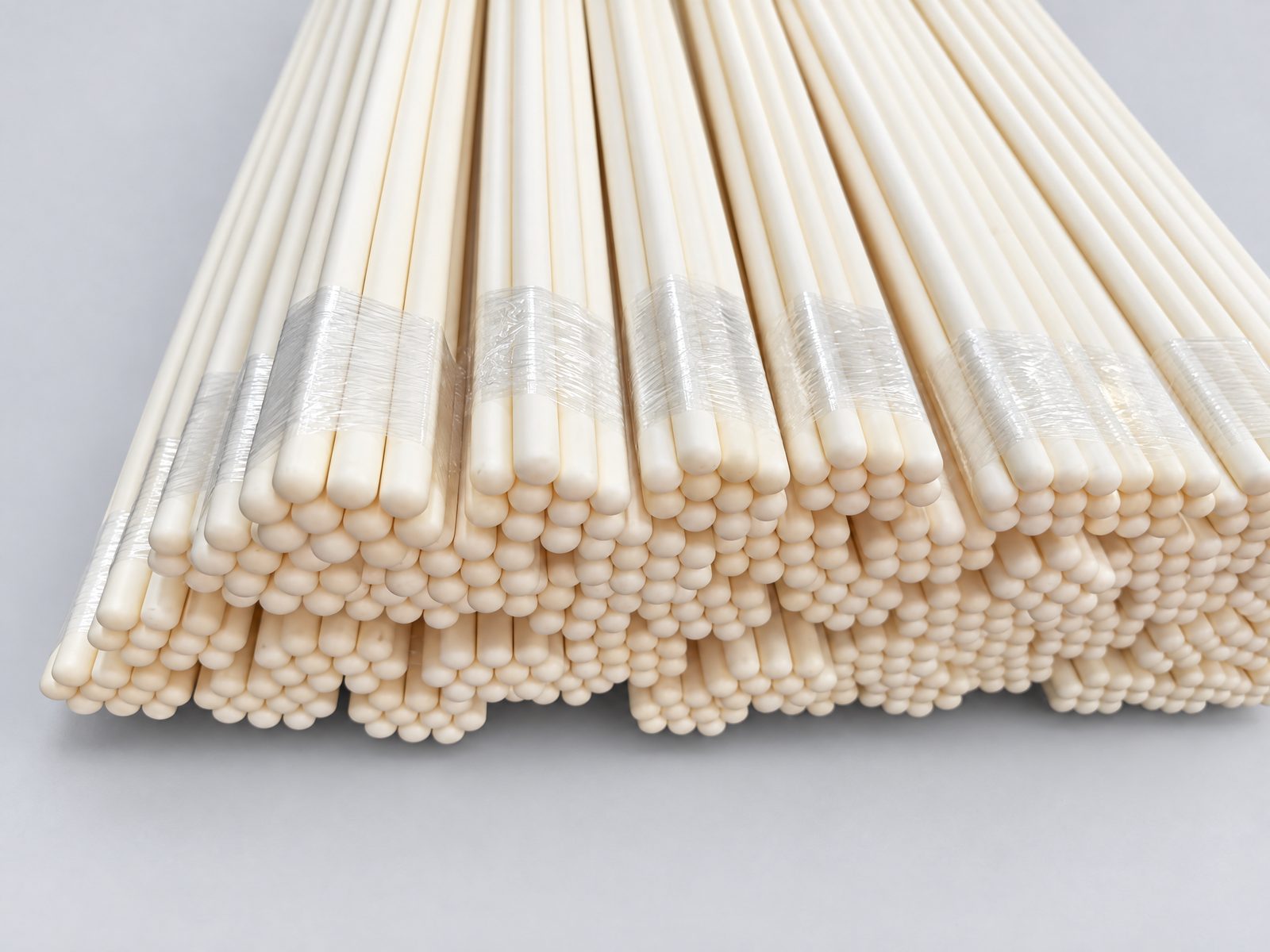
Alumina honeycomb is an engineered aluminum oxide (Al2O3, CAS 1344-28-1 per the NIST Chemistry WebBook) ceramic component built with parallel two-dimensional longitudinal hollow channels for catalyst substrates, high-temperature filters, combustion burner plates, and heat exchangers. Under ASTM C1674, ceramic honeycomb structures generally have 30 % or more porosity with channel cross-sectional dimensions on the order of 1 mm or greater, and are manufactured as blocks, plates, cylinders, rods, and rings. Unlike rolled metallic aluminum foil cores that deform ductilely at low temperatures, sintered alumina honeycombs remain linear-elastic to fracture and resist corrosive gas streams and thermal cycling.
Alumina honeycomb vs. metallic aluminum honeycomb
Buyers and engineers searching for alumina honeycomb encounter two completely different materials in industrial catalogs: sintered aluminum oxide ceramic monoliths and structural metallic aluminum foil cores. In the NIST Chemistry WebBook (Standard Reference Database 69), aluminum oxide is an inorganic oxide ceramic with chemical formula Al2O3, a molecular weight of 101.9613 g/mol, and CAS Registry Number 1344-28-1. Metallic aluminum honeycomb, by contrast, is fabricated from thin metallic sheets bonded into lightweight sandwich panels, such as the aluminum skin honeycomb building panels evaluated for hail impact in National Bureau of Standards Report 10193 (published January 1, 1970).
The mechanical behavior of the two cellular materials separates both their service environments and their test standards. Ceramic alumina honeycombs are rigid, refractory oxides that remain linear-elastic right up to tensile fracture. Metallic and polymer cellular structures deform in an elastic-ductile or elastomeric manner through cell-wall bending and plastic buckling, which places them outside the scope of ceramic cellular flexure standards.
Because procurement systems occasionally shorten aluminum oxide to alum. honeycomb, purchase orders and engineering drawings should state both the chemical formula Al2O3 and CAS 1344-28-1 alongside the required ceramic phase and porosity.
| Attribute | Alumina Ceramic Honeycomb | Metallic Aluminum Honeycomb | Drawing Specification Check |
|---|---|---|---|
| Chemical identity | Aluminum oxide ceramic (Al2O3, CAS 1344-28-1, molecular weight 101.9613 g/mol) per NIST Chemistry WebBook | Metallic aluminum sheet or foil core bonded between skins | State Al2O3 and CAS 1344-28-1 explicitly on the title block |
| Mechanical failure mode | Linear-elastic to brittle tensile fracture in cell walls | Elastic-ductile yielding, folding, and core buckling | Apply ASTM C1674 only to linear-elastic ceramic monoliths |
| Primary industrial duty | Catalytic conversion supports, high-temperature filters, burner plates, heat exchange | Lightweight building panels, partitions, and structural sandwich cores | Specify operating atmosphere, steam exposure, and thermal cycle duty |
Alumina vs. cordierite, mullite, and silicon carbide honeycombs
ASTM C1674 groups advanced ceramic honeycombs across nine recognized compositions: alumina, cordierite, zirconia, spinel, mullite, silicon carbide, silicon nitride, graphite, and carbon. Selecting the right composition starts with balancing chemical inertness and refractoriness against cyclic thermal shock resistance.
In commercial heat-recovery and regenerative oxidizer markets, suppliers frequently label aluminosilicate blends containing mullite or cordierite as dense alumina honeycomb. Genuine high-alumina ceramic honeycombs rely primarily on crystalline Al2O3 to resist alkali attack, molten metal slag, steam, and high-temperature chemical corrosion. Cordierite and mullite formulations incorporate silica and magnesia or aluminosilicate phases to lower thermal expansion during rapid heating and cooling cycles, trading peak temperature capability and chemical purity for higher resistance to thermal gradient cracking. Silicon carbide honeycombs, which ASTM C1674 notes alongside cordierite as widely used in small-cell industrial structures, provide high thermal conductivity for particulate traps and radiant burners.
When a honeycomb monolith acts as a fixed-bed catalyst substrate, surface chemistry matters as much as bulk structural composition. Dense sintered alpha-alumina walls provide mechanical rigidity, whereas high-surface-area catalytic washcoats supply active dispersion sites for precious metals or oxide catalysts. Within ASTM International, technical responsibility splits across ASTM Committee C28 on Advanced Ceramics, Committee C08 on Refractories, and Committee D32 on Catalysts, so buyers procuring catalyzed monoliths should separate bare substrate mechanical requirements from washcoat adhesion and activity specifications.
Cellular channel geometry, porosity, and monolith forms
Engineered ceramic honeycombs combine macroscopic open channels with microscopic pores inside the ceramic walls. Under ASTM C1674, ceramic honeycomb components feature two-dimensional longitudinal hollow channels, generally contain 30 % or more porosity, and have channel cross-sectional openings on the order of 1 mm or greater. Manufacturers supply these cellular architectures in five primary outer forms: blocks, plates, cylinders, rods, and rings.
Total component porosity comes from two distinct geometric levels that engineers should specify separately on a print. First is the open frontal area created by the parallel hollow channels, which is governed by cell pitch (center-to-center spacing between adjacent channels) and cell wall thickness. Second is the internal wall porosity within the sintered ceramic webs themselves, defined by pore volume percent, pore size, pore shape, and pore interconnectivity. A molten-metal filter or catalytic washcoat carrier often needs controlled microporosity inside the ceramic walls to trap inclusions or anchor a slurry coating, whereas a heat-exchange block may favor denser walls to increase volumetric heat storage and abrasion resistance.
Channel cross-sections are not restricted to hexagons despite the honeycomb name. ASTM C1674 identifies square, rectangular, circular, hexagonal, and triangular channel geometries. Square channels are common in extruded industrial blocks and cylinders because orthogonal webs create uniform wall thickness and allow closed-form moment-of-inertia stress calculations. Hexagonal and circular channels distribute hoop stresses smoothly and reduce sharp corner fillets where catalytic washcoat slurries can pool and thicken, while triangular or rectangular cells introduce directional stiffness anisotropy that must be aligned carefully with mounting loads.
Gas flow, heat transfer, and thermal shock in cellular channels
Splitting a large duct or reactor cross-section into hundreds of parallel millimeter-scale channels changes fluid mechanics and heat transfer. As demonstrated in NIST fire-research experiments using a horizontal parallel-plate narrow-channel apparatus measuring 3 mm in channel height, 110 mm in width, and 375 mm in length, gas flow inside millimeter-scale passages remains laminar and two-dimensional except at very high velocities where side boundaries take effect, and buoyancy forces become negligible in horizontal channels because of the small channel height. In that laminar regime, gas velocity and narrow channel spacing directly control reactant delivery, solid-to-gas heat transfer, and whether condensable vapors or soot particles deposit along the channel walls.
Choosing cell pitch and wall thickness requires balancing pressure drop against geometric surface area. Finer cell pitches, such as the roughly 2 mm pitch common in small-cell substrates, pack more channel wall area into a fixed reactor volume and shorten the radial diffusion distance between the gas core and a catalyzed wall. Larger channel openings above 1 mm reduce flow resistance and resist plugging in dusty flue gas, ash-laden exhaust, or foundry filtration streams.
In high-temperature service, ceramic honeycombs rarely fail from static mechanical weight alone. As noted in ASTM C1674, honeycomb ceramics commonly fail in tension caused by thermal gradient stresses. When a hot gas pulse enters a cooler monolith block, or cold purge air strikes a heated bed, uneven thermal expansion across the block cross-section and along the axial flow path bends the thin cell walls in tension. Extended exposure to high temperatures and corrosive atmospheres including steam can also alter wall microstructure over time, which is why qualification programs pair thermal shock testing under ASTM C1525 with before-and-after flexural testing of environmentally conditioned specimen sets.
ASTM C1674 flexural strength testing and specimen sizing
ASTM C1674 (active edition ASTM C1674-23, last updated July 14, 2023, developed by Subcommittee C28.04 in Volume 15.01 of the Annual Book of ASTM Standards) is the standard test method for measuring ambient-temperature flexural strength of advanced ceramics with honeycomb cellular channels. Flexure testing is preferred over compression crushing tests because crushing does not measure the tensile fracture limits that govern thermal gradient cracking, while direct uniaxial tensile tests suffer from severe gripping and alignment problems on thin-walled porous cells.
The standard establishes user-defined Test Methods A1 and A2 alongside fixed-geometry Test Method B. Four-point-quarter-point loading (Test Method A1 and Test Method B) is strongly preferred over three-point loading (Test Method A2) because three-point bending exposes only a narrow line of cell walls to peak tensile stress, yielding artificially higher strength numbers due to statistical flaw distribution.
From the breaking force and specimen dimensions, ASTM C1674 defines three distinct strength calculations: Nominal Beam Strength (S_NB), which treats the bar as a solid continuum, Wall Fracture Strength (S_WF), which uses the true geometric moment of inertia of square-channel webs to find outer-fiber failure stress, and Honeycomb Structure Strength (S_HS), a geometry-independent continuum value derived from S_WF for comparing honeycombs of different cell sizes. Because continuum beam equations ignore open channels, S_NB overestimates strength whenever the linear cell count (the integer number of cells across the shortest cross-sectional dimension of the bar) is too low.
A practical specimen-sizing check shows why cell count matters on real prints. Test Method B specifies a rectangular bar 13 mm by 25 mm by above 116 mm tested over a 90 mm outer support span for small-cell structures with a cell pitch around 2 mm. By our calculation from ASTM C1674, quarter-point loading on that 90 mm span places the inner rollers 22.5 mm from each outer support across a 45 mm central span, while a 2 mm cell pitch fits 6.5 pitches (6 complete cells) across the 13 mm thickness and 12.5 pitches across the 25 mm width. Because 7 complete cells sits inside the 5 to 15 cell band, relying on S_NB alone on that 2 mm pitch bar can overestimate strength by 10 % to 20 %, whereas reaching the preferred 15-cell minimum at a 2 mm pitch requires a Test Method A1 specimen with a shortest cross-sectional dimension of at least 30 mm.
| Configuration or Cell Count Band | Loading or Overestimate Range | Dimensions or Calculation Rule | Engineering Guidance |
|---|---|---|---|
| Test Method A1 | 4-point-1/4 point flexure | User-defined bar geometry and user-defined outer span | Strongly recommended for custom alumina blocks and coarse cell pitches |
| Test Method A2 | 3-point flexure | User-defined bar geometry and user-defined outer span | Used only when specimens cannot fit 4-point fixtures, reports higher apparent strength |
| Test Method B | 4-point-1/4 point flexure | 13 mm by 25 mm by above 116 mm bar on a 90 mm outer span | Standard baseline size for small-cell honeycombs (cell pitch around 2 mm) |
| Linear cell count 15 or greater | S_NB within 10 % of S_WF | S_NB and S_HS are roughly equivalent | Preferred bar sizing to minimize cell-count bias in quality control |
| Linear cell count 5 to 15 | 10 % to 20 % S_NB overvalue | Apply S_WF and S_HS equations (defined for 2 to 15 cells) for square cells | Use S_NB with caution and verify whether supplier reported S_NB or S_HS |
| Typical cellular check | 4-point-1/4 point preferred | Check integer cell count across shortest bar dimension | Avoid continuum S_NB reporting on coarse-cell bars |
Elastic modulus, Weibull statistics, and quality control standards
Read more
Measuring flexural strength is only one part of qualifying a porous alumina monolith. ASTM C1674 notes that bar deflection during a bending test is not the preferred way to measure Young's modulus on cellular ceramics. Dynamic non-destructive methods, specifically sonic resonance under ASTM C1198 or impulse excitation under ASTM C1259, produce far more repeatable elastic modulus data without local cell-wall crushing at the loading rollers.
Because brittle porous ceramics fail from distributed microstructural pores and processing flaws, strength results follow a statistical scatter rather than a single deterministic yield value. ASTM Committee C28 (formed in 1986, with 77 members overseeing 55 standards in Volume 15.01) pairs cellular flexure testing with Weibull statistical analysis under ASTM C1239 and Weibull size scaling under ASTM C1683. For monolithic dense reference bars, ambient flexural strength falls under ASTM C1161, while non-destructive inspection methods are covered in ASTM C1175. ASTM C1674 also observes that post-test fractographic flaw tracing is rarely practical on porous honeycomb walls because locating a single critical origin inside a cellular web is uncertain.
When porous alumina filters or cellular ceramic membranes are engineered for specialized medical blood-contacting filtration devices rather than industrial gas treatment, mechanical standards are paired with biological safety testing. In that sector, ISO 10993-4:2017 (Edition 3, published April 2017, confirmed in 2023, with Amendment 1 ISO 10993-4:2017/Amd 1:2025) establishes the structured selection of tests for evaluating device interactions with blood.
Extrusion, sintering, and additive manufacturing of alumina channels
Read more
Industrial ceramic honeycombs with straight two-dimensional channels are traditionally manufactured by ram or screw extrusion of plasticized alumina ceramic paste through slotted precision honeycomb dies, followed by controlled drying, binder burn-out, high-temperature sintering, and optional post-sintering heat treatments or catalytic washcoating. ASTM C1674 highlights each of those fabrication stages because minor shifts in extrusion die wear, drying humidity, organic binder removal rate, or kiln temperature uniformity directly alter wall porosity morphology and outer-fiber fracture strength.
Drying and binder burn-out are critical bottlenecks for high-purity alumina honeycombs. Thin internal webs dry at a different rate than outer skin walls, creating shrinkage stresses in the green body before ceramic bonds form during sintering. Manufacturers compare baseline specimen lots against process-change lots in four-point bending to verify that faster firing schedules or altered pore-former additions do not degrade wall fracture strength.
For complex reactor inserts, non-uniform channel pitches, or low-volume prototypes where custom extrusion tooling is impractical, ceramic additive manufacturing provides a die-free route. Research published by the NIST Material Measurement Laboratory's Materials Structure and Data Group documents industry measurement needs for ceramics additive manufacturing (2020), standards and data requirements for industrializing ceramic direct ink writing (2022), and an interlaboratory study of flexural strength in additively manufactured alumina (2025). Direct ink writing extrudes ceramic paste filament-by-filament into cellular lattices, allowing tailored porosity gradients while still requiring careful green drying and sintering control.
Industrial applications and buyer specification checklist
Across energy, chemical, metallurgical, and combustion equipment, ASTM C1674 and ASTM Committee C28 identify core industrial roles for ceramic honeycombs: catalytic conversion supports and catalyst substrates, high-temperature particulate and molten-metal filters, radiant and premixed combustion burner plates, heat exchangers and thermal regenerators, fuel cell and sensor components, and mechanical energy absorption or damping structures.
Before issuing a request for quotation on a cellular or multi-channel alumina component, put the following seven items on your engineering drawing so every supplier quotes the exact same architecture and test basis.
- Chemical composition and grade: state Al2O3 (CAS 1344-28-1) and minimum alumina purity so mullite or cordierite blends are not substituted without approval.
- Outer monolith geometry and tolerances: specify block, plate, cylinder, rod, or ring dimensions along with flatness and perpendicularity on sealing faces.
- Channel shape, pitch, and wall thickness: define square, hexagonal, circular, rectangular, or triangular holes together with center-to-center pitch in mm and nominal web thickness in mm.
- Open area and wall microporosity: separate macroscopic open channel fraction from sintered ceramic wall porosity (30 % or more total porosity per ASTM C1674 for porous honeycombs, or dense walls where gas-tight separation is required).
- Mechanical test basis: specify ASTM C1674-23 Method A1 or Method B, state the specimen orientation, and require the lab report to distinguish Nominal Beam Strength (S_NB) from Wall Fracture Strength (S_WF) and Honeycomb Structure Strength (S_HS).
- Thermal and environmental duty: list peak temperature, heating and cooling ramp rates (or ASTM C1525 thermal shock delta-T), and exposure to steam, slag, or corrosive gases.
- Surface finish or coating condition: clarify whether monoliths are supplied bare as-sintered or calcination-ready for a catalytic washcoat, and test coated check bars if washcoating alters wall stress.
| Component Architecture | Channel and Wall Profile | Typical Service Role | Sourcing Path |
|---|---|---|---|
| Extruded thin-wall honeycomb monolith | High count of parallel cells (1 mm or greater opening) with 30 % or more porosity | Catalyst washcoat carriers, burner plates, high-temperature filters, heat recovery beds | Specify cell pitch, wall thickness, Al2O3 purity, and ASTM C1674-23 test method |
| Multi-bore alumina tube or capillary | Thick dense C799 alumina wall with single, twin, or multiple axial bores | Thermocouple wire electrical insulation, gas sampling, analytical furnace feedthroughs | Manufactured by GY Alumina to standard sizes or custom buyer drawings |
| Perforated or slotted alumina tube | Slip-cast or extruded C799 alumina tube with machined side holes or end slots | Gas sparging, furnace radiant protection, fluid distribution, refractory baffling | Manufactured by GY Alumina with custom hole patterns and closed or open ends |
Sourcing custom C799 alumina tubes and multi-bore parts from GY Alumina
While thin-wall extruded honeycomb monolith blocks for regenerative oxidizers and automotive-style catalyst beds are produced on dedicated cellular monolith extrusion lines, many laboratory, thermocouple, and industrial furnace assemblies actually require dense, thick-walled multi-channel or perforated alumina components rather than porous cellular blocks.
GY Alumina manufactures stock and custom C799 alumina ceramic parts, including single-, twin-, and multi-bore tubes and capillaries, perforated and slotted tubes, round, elliptical, and square furnace and thermocouple protection tubes (open at both ends or closed at one end), solid alumina rods, square bars, balls, rings, washers, bushings, discs, crucibles, and boats to your drawing or sample. Send your drawing, the grade, and the quantity, and we usually reply with a quote within two working days.
Questions buyers ask
- What is the difference between alumina honeycomb and aluminum honeycomb?
- Alumina honeycomb is a sintered aluminum oxide ceramic (Al2O3, CAS 1344-28-1 per the NIST Chemistry WebBook) that behaves linear-elastically and withstands corrosive, high-temperature industrial environments. Aluminum honeycomb is a metallic foil core used in lightweight structural sandwich panels (such as those tested in NBS Report 10193) that fails by ductile folding and buckling at low temperatures.
- What porosity and channel dimensions define ceramic honeycombs in ASTM C1674?
- Under ASTM C1674, engineered ceramic honeycomb components feature two-dimensional longitudinal hollow channels, generally have 30 % or more porosity, and have channel cross-sectional dimensions on the order of 1 mm or greater. They are produced as blocks, plates, cylinders, rods, and rings.
- Why do some suppliers sell cordierite or mullite blocks as alumina honeycomb?
- Many heat-recovery blocks use aluminosilicate blends (cordierite or mullite) to lower thermal expansion in cyclic regenerators while marketing the product under broad alumina trade names. To receive true high-alumina ceramic rather than a silicate blend, specify Al2O3 chemical purity and CAS 1344-28-1 directly on your purchase specification.
- Why does ASTM C1674 measure flexural strength instead of compressive crush strength?
- Ceramic honeycombs in high-temperature service commonly crack in tension driven by thermal gradient stresses rather than simple compressive crushing. Because gripping thin porous cell walls in a direct uniaxial tensile test causes alignment and crushing errors, four-point flexure testing under ASTM C1674 is the preferred method for evaluating nominal tensile fracture resistance.
- How many cells across the specimen thickness are needed for ASTM C1674 testing?
- ASTM C1674 recommends a linear cell count of 15 or greater across the shortest cross-sectional dimension so that Nominal Beam Strength stays within 10 % of Wall Fracture Strength. Between 5 and 15 cells, continuum beam equations can overestimate strength by 10 % to 20 %, and below 5 cells the overestimate reaches 20 % to 100 %, making Honeycomb Structure Strength the recommended metric.
- What multi-channel alumina components does GY Alumina manufacture to drawing?
- Rather than thin-wall porous honeycomb monolith blocks, GY Alumina manufactures C799 alumina single-, twin-, and multi-bore tubes and capillaries, perforated and slotted tubes, furnace and thermocouple protection tubes, solid rods, rings, discs, crucibles, and boats to buyer drawings or samples.
Sources
- ASTM C1674 Standard Test Method for Flexural Strength of Advanced Ceramics with Engineered Porosity (Honeycomb Cellular Channels) at Ambient Temperatures
- ASTM Committee C28 on Advanced Ceramics
- ASTM Committee C28 Advanced Ceramic Standards Chart
- ASTM International Technical Committees by Designation
- NIST Chemistry WebBook (SRD 69): Aluminum Oxide
- NIST (NBS Report 10193): Hail Resistance Tests of Aluminum Skin Honeycomb Panels
- NIST Fire Research: Testing of Gaseous Fire Suppressants in Narrow Channel Apparatus
- NIST Materials Structure and Data Group: Recent Group Publications
- ISO 10993-4:2017 Biological Evaluation of Medical Devices Part 4: Selection of Tests for Interactions with Blood
Last checked .