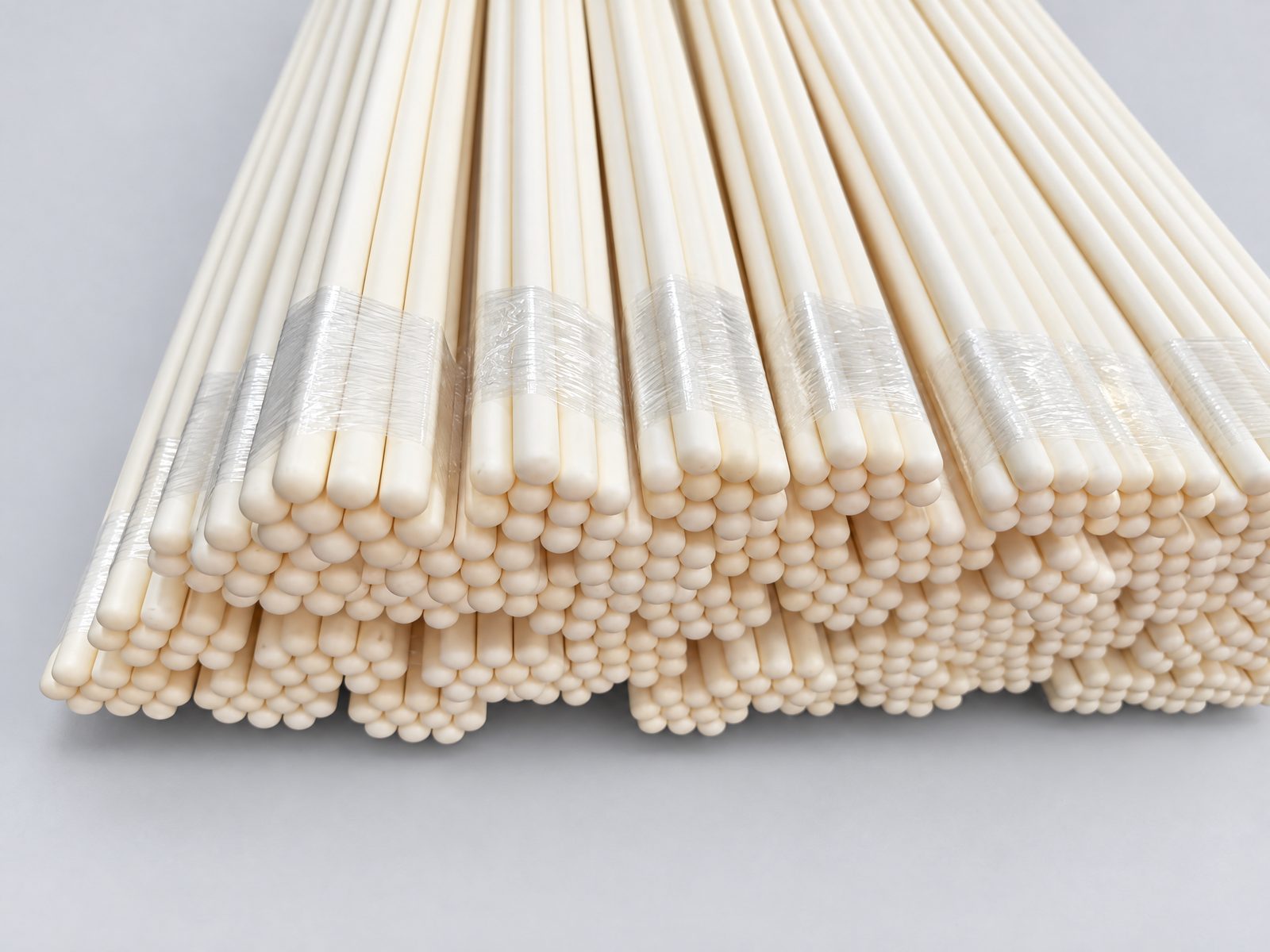
Alumina epoxy refers either to an aluminum oxide-filled polymer composite for electrically insulating heat transfer and wear protection, or to epoxy-bonded sintered alumina ceramic hardware. In NASA Contractor Report 145227, adding alumina filler to diamine-cured epoxy adhesives produced much lower bond strength than unfilled epoxy formulations.
Three material systems sold as alumina epoxy
Supplier catalogs group three separate engineering material classes under the name alumina epoxy. Ordering the wrong form causes bond-line peel failures, clogged dispensing valves, or premature thermal breakdown in service.
The first class is a thermally conductive, electrically insulating liquid potting resin or paste adhesive. Formulators disperse micrometer or nanometer aluminum oxide powders into reactive epoxy so heat moves from coils, sensors, or power electronics into a metal housing without creating an electrical short. The second class is a high-build industrial wear putty, where coarse sintered aluminum oxide beads or angular grit pack a thixotropic paste troweled inside chutes, hoppers, scrubbers, and slurry pipes, or applied as backing mortar behind solid ceramic wear tiles.
The third class covers structural alumina fiber-reinforced epoxy laminates and epoxy-bonded monolithic alumina assemblies. Cryogenic, aerospace, and instrument designs either cure continuous alumina fibers inside an epoxy matrix to limit low-temperature heat leak, or use unfilled structural epoxy to bond fabricated sintered alumina insulators, tubes, and rings onto metal mounts.
- Electronic potting and thermal adhesives: Fine aluminum oxide powder dispersed in pourable or paste epoxy to bridge heat sinks and housings while maintaining electrical isolation.
- Industrial wear putties and tile mortars: Heavy paste epoxies loaded with coarse ceramic alumina beads or grit to resist sliding abrasion on steel structures.
- Epoxy-bonded solid alumina and fiber laminates: Dense sintered aluminum oxide parts joined with structural epoxy, or continuous alumina fibers cured inside an epoxy laminate.
| Material System | Electrical and Thermal Role | Observed Mechanical and Bond Behavior | Primary Reference |
|---|---|---|---|
| Alumina-filled epoxy paste or casting | Electrically insulating heat-transfer medium | Produced much lower adhesive bond strength than unfilled diamine-cured epoxy | NASA Contractor Report 145227 |
| Aluminum-filled epoxy adhesive | Contains metallic aluminum particulate filler | Found not beneficial to adhesive strength in aromatic diamine-cured epoxy | 1977 NASA adhesive study |
| Alumina fiber-reinforced epoxy laminate | Cryogenic thermal control and electrical insulation | Structural composite evaluated for low-temperature thermal conductivity | NIST Interagency Report 89-3914 |
| Carbon and pitch fiber epoxy hybrid | Conductive graphitic reinforcement for heat spreading | Raised tensile modulus and through-thickness conductivity while lowering tensile strength | 2024 NASA Glenn composite study |
| Solid sintered alumina joined with epoxy | Rigid electrical and electronic ceramic hardware | Alumina core radial cracking remained relatively independent of epoxy bond thickness | ASTM D2442-75(2025) and NIST |
Epoxy resin chemistry, hardeners, and matrix toughening
Every alumina-filled epoxy starts with an uncrosslinked base resin that cannot cure on its own. Under ASTM D1763-00(2021), Standard Specification for Epoxy Resins (updated July 5, 2021), totally reactive liquid and solid epoxy resins containing no hardeners are divided into 6 resin types by chemical nature and inspected by viscosity, Mettler softening point, and color. Base resins under this specification serve in castings, coatings, tooling, potting, adhesives, and reinforced composites, and also act as stabilizers or cross-linking agents with other reactive products.
Adding a hardener in the proper stoichiometric ratio polymerizes the resin into an infusible thermoset network whose moisture durability and heat resistance depend on curing agent chemistry. In a May 1, 1977 NASA investigation of aromatic diamine curing agents based on diphenyl sulfone, benzophenone, and methylene dianiline isomers, an unfilled m,m'-methylene dianiline epoxy adhesive delivered superior moisture resistance relative to a p,p'-methylene dianiline formulation, while meta versus para orientation produced no adhesive strength difference in the diphenyl sulfone and benzophenone series.
Pure crosslinked epoxy is rigid and prone to brittle cracking under shock loads unless toughened. All 5 systems with the highest impact damage tolerance used bisphenol A as the base resin combined with modifiers: 2 used elastomeric additives, 2 used thermoplastic additives, and 1 used a vinyl modifier. Formulators further tune uncured flow and cured stiffness by adding fillers, reinforcements, extenders, plasticizers, and thixotropic agents.
Why alumina filler lowers bond strength while changing stiffness
Adding hard ceramic aluminum oxide powder to an epoxy adhesive does not make a bonded joint stronger in tension or lap shear. Testing in NASA Contractor Report 145227 evaluated both aluminum and alumina particulate fillers in an m,m'-methylene dianiline-cured epoxy adhesive and reported that neither filler improved bond strength, with alumina-filled adhesives showing much lower strength than unfilled epoxy. Solid ceramic grains occupy surface area at the adherend interface that would otherwise wet with reactive polymer, raise paste viscosity so trapped air stays in the joint, and concentrate peel and shear stresses around rigid inclusions.
The January 2024 NASA Glenn composite report notes the same trade-off in polymer matrix laminates, where modifying matrix resin to increase out-of-plane thermal conductivity yields moderate thermal gains and often degrades mechanical performance. Enough ductile polymer volume must remain between solid reinforcements to absorb strain without cracking. Test results from the NASA Langley impact evaluation indicated that a resin volume fraction of 40 percent or greater may be required to permit plastic flow between fibers for damage tolerance. In that NASA Glenn study, co-braided RTM6 epoxy laminates were molded at a 57 percent average fiber volume fraction, and the toughened TC275-1 epoxy prepreg carried a 38 wt% resin content.
Particle size distribution sets how much aluminum oxide packs into liquid resin before viscosity turns the mix into an unworkable dry paste. Blending fine nanometer grains with larger micrometer grains lets small particles fill interstitial voids. In a September 1, 2001 NASA Glenn Research Center study (Technical Memorandum 2001-210606) on mixed nanometer and micrometer alumina powders consolidated in argon at 1500 °C and 1600 °C, conventional micrometer-only powders failed to consolidate, whereas 100 percent nanometer alumina and bimodal mixtures reached below 99 percent density and generated high-temperature creep strains below 0.65 percent from cavitation-linked voids. A February 18, 2008 NIST paper in Polymer Volume 49, Issue 4 likewise investigated thermal, mechanical, and fracture behavior directly in alumina/epoxy composites. Fine bimodal powders keep potting compounds pourable around tight leads, whereas coarse millimeter-scale beads belong in troweled wear linings.
Measuring thermal impedance and apparent conductivity
Comparing thermal conductivity figures across epoxy datasheets misleads buyers unless suppliers separate interfacial contact resistance from bulk conduction under the same method. ASTM D5470-17R24 (reapproved 2024), Standard Test Method for Thermal Transmission Properties of Thermally Conductive Electrical Insulation Materials, measures steady-state thermal impedance across electrical insulating materials from liquid pastes to rigid cured solids. Because alumina-filled epoxies are heterogeneous mixtures of ceramic and polymer rather than uniform single-phase solids, the standard reports apparent thermal conductivity.
The test clamps a thin specimen between parallel heated and cooled meter bars under idealized one-dimensional heat flow at a specified average test temperature. Apparent thermal conductivity can be calculated from a single thickness and its measured impedance only when interfacial thermal resistance stays nominally below 1 percent of specimen resistance. On rigid Type III cured epoxy slabs where surface roughness traps air, laboratories reduce contact resistance with thermal grease or oil, or exclude it by testing multiple thicknesses and plotting thermal impedance against thickness. The zero-thickness intercept equals the sum of the two surface contact resistances, and the inverse of the straight-line slope gives apparent thermal conductivity.
For Dewar supports and spacecraft struts at cryogenic temperatures, NIST Interagency Report 89-3914 (published January 1, 1989) characterizes low-temperature thermal conductivity in continuous alumina fiber/epoxy and alumina fiber/PEEK composites.
| Specimen Type | Deformation Under Clamping Stress | Representative Insulating Materials |
|---|---|---|
| Type I | Viscous liquids with unlimited deformation under stress and no elastic recovery | Thermal greases, uncured pastes, liquid compounds, and phase-change materials |
| Type II | Viscoelastic solids where internal stresses balance applied stress to limit deflection | Cured thermal gels, soft elastomers, and hard rubbers |
| Type III | Elastic solids exhibiting negligible thickness deflection under test pressure | Rigid cured epoxies and plastics, dense ceramics, and metals |
Worked case: evaluating an electrically isolated thermal joint
Suppose you must bond a heat-generating sensor assembly onto an anodized aluminum housing while maintaining electrical isolation, and a thin glass or ceramic cover is epoxy-joined onto an alumina carrier under clamping load.
Total heat-path resistance equals bulk bond-line impedance (thickness divided by apparent thermal conductivity) plus the two surface contact resistances. Because single-point conductivity math holds only when interfacial resistance stays nominally below 1 percent of specimen resistance, and shop-floor housings rarely match idealized parallel meter bars, an overly stiff paste that bridges machined grooves traps insulating air gaps that spike joint temperature regardless of bulk alumina content.
Bond-line thickness also governs cracking in brittle layered hardware. A February 14, 2008 NIST study in the Journal of Dental Research Volume 87 investigated critical fracture loads in layered structures where glass veneers were epoxy-joined onto alumina or zirconia ceramic cores over a polymer base. Subsurface radial cracking in the alumina core stayed relatively independent of epoxy adhesive thickness, whereas radial cracking in the brittle top veneer depended directly on adhesive thickness. Zirconia cores proved much less susceptible to fracture than alumina due to higher strength and lower modulus, while critical loads for veneer cracking did not differ significantly between alumina and zirconia cores.
- Step 1, prioritize wetting over peak filler fraction: Select a viscosity grade that wets machined grooves so interfacial air pockets do not dominate joint impedance.
- Step 2, hold thin bond lines on heat paths: Keep thermally conductive epoxy layers as thin as substrate flatness and voltage isolation permit to cut bulk impedance and limit flexure in thin brittle overlayers.
- Step 3, request multi-thickness Type III plots: Confirm whether supplier conductivity figures on rigid cured slabs excluded contact resistance via multi-thickness impedance plotting.
- Step 4, separate mechanical peel from thermal fill: Carry high peel or tensile shear loads with clips, fasteners, or an unfilled structural adhesive border, using the alumina-filled compound for heat transfer.
Shop checklist and ASTM qualification standards
Read more
Dense aluminum oxide particles settle toward the bottom of shipping pails during storage, and stirring thick pastes whips insulating air bubbles into the mix. Scooping settled resin without re-homogenizing shifts both filler loading and reactive stoichiometry, leaving soft uncured spots or resin-starved brittle zones. Structural epoxy panel inspection in the 2024 NASA Glenn study paired optical cross-section microscopy with 5 MHz ultrasonic C-scan transmission across 6-ply, 30.5 cm by 30.5 cm laminates to verify consolidation, fiber wet-out, and low void content.
Run the shop checklist below before potting or bonding production parts, and specify the active ASTM test or material standard in the table that matches your assembly geometry.
- Re-mix settled resin containers first: Stir the alumina-filled resin component from the bottom of the pail until color and paste consistency are uniform before weighing hardener.
- Meter exact stoichiometric ratios: Weigh or meter resin and hardener in the exact specified ratio so epoxide groups crosslink into an infusible network.
- Adjust viscosity without solvents: Never thin reactive potting epoxy with non-reactive solvents, which create cure voids. Warm unmixed resin slightly within supplier limits if needed, noting shorter pot life.
- Vacuum degas potting mixes: Pull vacuum on mixed liquid compounds until trapped air foams rise, break, and subside before pouring around fine windings or pins.
- Protect dispensing gear from ceramic wear: Hard alumina grains rapidly abrade steel gear pumps, check valves, and fine metal needles. Use abrasion-resistant wetted parts, wide-bore plastic nozzles, or pneumatic cartridges.
- Clean and profile bonding faces: Degrease and abrade smooth metal or ceramic adherends so viscous paste makes intimate contact.
| Active Designation | Standard Scope | Target Material Form | Standard Unit System |
|---|---|---|---|
| ASTM D1763-00(2021), Standard Specification for Epoxy Resins | Viscosity, Mettler softening point, and color across 6 unhardened reactive resin types | Liquid and solid base epoxy resins before hardener or filler addition | SI units |
| ASTM D5470-17R24, Thermal Transmission of Conductive Electrical Insulation | Steady-state thermal impedance and apparent thermal conductivity | Type I viscous liquids, Type II viscoelastic solids, and Type III rigid insulating solids | SI units |
| ASTM D5868-01R23 (reapproved 2023), Lap Shear Adhesion for FRP Bonding | Single-lap shear apparent adhesion strength and surface treatment comparison | Adhesives joining random or oriented fiber-reinforced plastics to themselves and to metals | Inch-pound units standard |
| ASTM D3039/D3039M-17R25 (reapproved 2025), Tensile Properties of Polymer Matrix Composites | 5 in-plane tensile properties (strength, strain, chord modulus, Poisson's ratio, transition strain), reporting void content and fiber volume percent | Balanced, symmetric continuous or discontinuous high-modulus fiber-reinforced laminates | SI or inch-pound units used independently |
| ASTM D2442-75(2025) (updated June 25, 2025), Alumina Ceramics for Electrical Applications | Electrical, mechanical, thermal, and general property limits and test methods regardless of geometry | Fabricated sintered alumina parts for electronic devices and ceramic-to-metal seals | SI units standard |
When to specify solid sintered alumina instead of alumina epoxy
GY Alumina manufactures dense sintered C799 alumina and white alumina ceramic parts rather than liquid epoxy resins, potting compounds, or wear putties. Even heavily loaded alumina-epoxy castings rely on an organic polymer matrix that softens under furnace heat and degrades in molten media or aggressive atmospheres. Under continuous particle impact, polymer-bound castings also wear faster than monolithic sintered corundum.
Replace cast alumina-epoxy parts with solid sintered alumina components when your operating zone exceeds epoxy temperature limits. Solid sintered alumina also holds rigid dimensions and electrical insulation inside kilns, heaters, thermocouple sheaths, and corrosive fluid paths. You can also pair both materials in one assembly. A sintered C799 alumina protection tube, multi-bore insulator, or bushing handles the hot or abrasive working zone, while structural epoxy seals the cool termination end into a metal flange or housing.
We form custom and standard parts by slip casting, pressing, extrusion, and hot pressing. Secondary operations include cutting to length, end slots, side holes, perforated tubes, and closed ends with drilled holes. Custom tubes made to your drawing or sample include round, elliptical, and square profiles, open at both ends or closed at one end. We also make single-bore, twin-bore, and multi-bore tubes and capillaries, plus threaded, ribbed, perforated, and slotted tubes. Solid shapes and labware include solid rods, square bars, balls, rings, washers, bushings, discs, crucibles, and boats. Send your drawing and the grade for review.
Questions buyers ask
- Does adding alumina powder make an epoxy adhesive joint stronger?
- No. In NASA Contractor Report 145227, adding alumina filler to an m,m'-methylene dianiline-cured epoxy adhesive produced much lower adhesive strength than the unfilled epoxy formulation. Formulators add alumina for thermal transfer, electrical insulation, stiffness, or sliding wear resistance rather than lap-shear bond strength.
- How is the thermal conductivity of alumina-filled epoxy measured?
- Laboratories use ASTM D5470-17R24 to measure steady-state thermal impedance and calculate apparent thermal conductivity across thin electrical insulating specimens. Plotting thermal impedance across multiple specimen thicknesses isolates surface contact resistance at the zero-thickness intercept and gives apparent thermal conductivity from the inverse slope.
- Is alumina epoxy electrically conductive or electrically insulating?
- Alumina-filled epoxy is electrically insulating because aluminum oxide ceramic resists electrical current, unlike silver-filled, aluminum-filled, or carbon-fiber epoxy systems. That combination lets potting compounds and thermal pastes conduct heat away from live electronics without shorting circuits.
- Does bond-line thickness affect cracking when epoxy joins ceramic layers?
- It depends on which ceramic layer you examine. A 2008 NIST study of glass veneers epoxy-joined onto alumina cores over a polymer base found that alumina core radial cracking stayed relatively independent of epoxy adhesive thickness, whereas cracking in the brittle top veneer depended directly on adhesive thickness.
- When should I switch from an alumina-filled epoxy wear putty to solid sintered alumina?
- Use alumina-filled epoxy paste to pot electronics or trowel protective linings at ambient to moderate temperatures where organic polymers remain stable. Switch to solid sintered C799 alumina tubes, bushings, rings, or insulators whenever your part faces furnace heat, molten samples, high-voltage standoffs, or severe erosion.
Sources
- NASA Contractor Report 145227: Effects of Novel Diamine Curing Agents and Fillers on Epoxy Adhesives
- NASA Technical Memorandum 20230017100: Thermal Conductivity and Mechanical Properties of Epoxy Composites
- NASA Langley Research Center: Effect of Resin on Impact Damage Tolerance of Graphite/Epoxy Laminates
- NASA Technical Memorandum 2001-210606: Polycrystalline Alumina from Mixed Nanometer and Micrometer Powders
- NIST: Veneer Versus Core Failure in Adhesively Bonded All-Ceramic Crown Layers
- NIST: Investigation of the Thermal, Mechanical, and Fracture Properties of Alumina/Epoxy Composites
- NIST Interagency Report 89-3914: Low-Temperature Thermal Conductivity of Alumina Fiber/Epoxy Composites
- ASTM D1763-00(2021) Standard Specification for Epoxy Resins
- ASTM D5470 Standard Test Method for Thermal Transmission Properties of Thermally Conductive Electrical Insulation Materials
- ASTM D5868 Standard Test Method for Lap Shear Adhesion for Fiber Reinforced Plastic Bonding
- ASTM D3039/D3039M Standard Test Method for Tensile Properties of Polymer Matrix Composite Materials
- ASTM D2442-75(2025) Standard Specification for Alumina Ceramics for Electrical and Electronic Applications
Last checked .