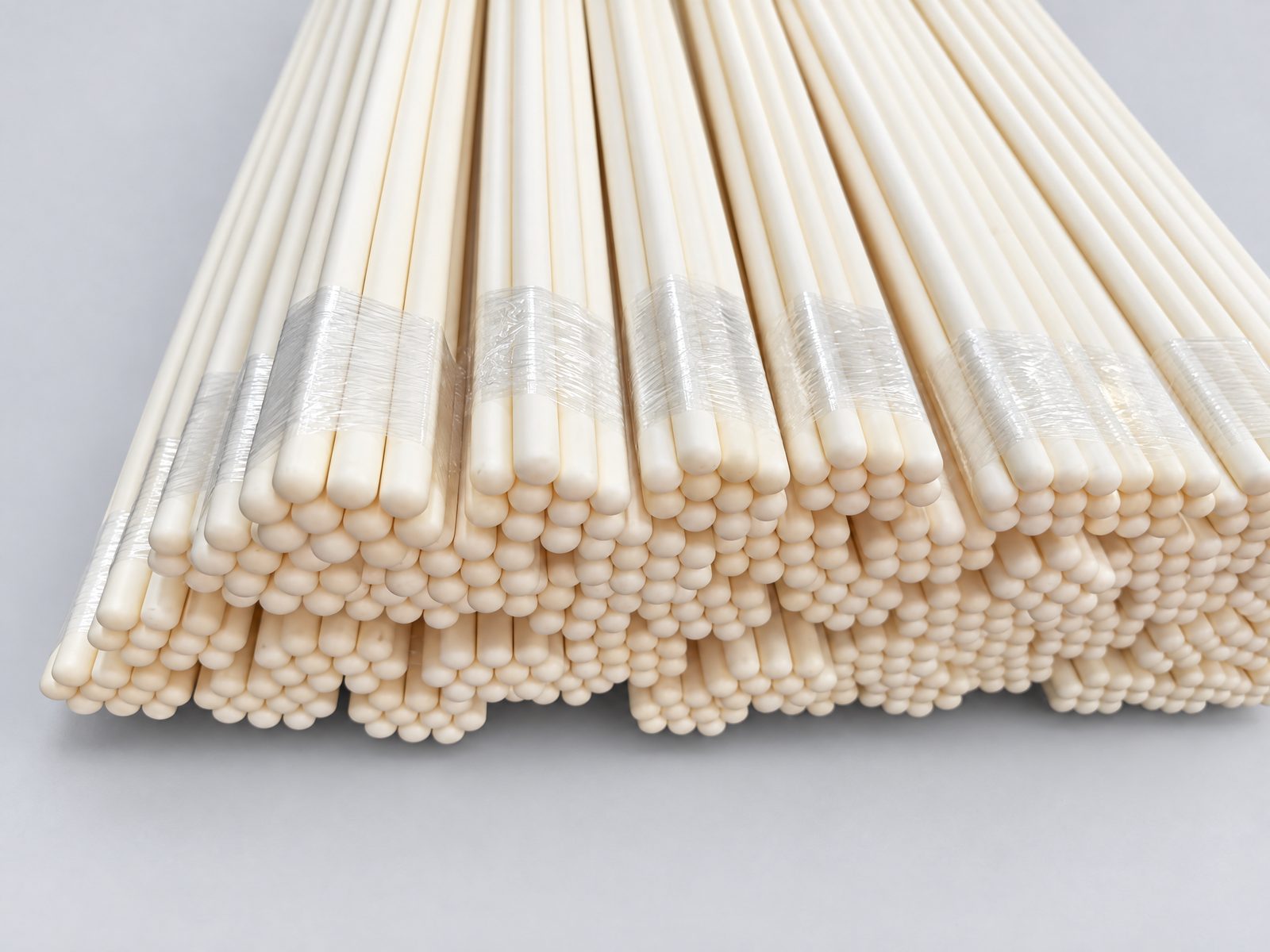
Alumina casting shapes aluminum oxide (Al2O3) powders from room-temperature liquid suspensions into complex green bodies that are later densified by firing, rather than melting and pouring like metal. Because alpha-alumina melts at 2050 °C according to NIST Standard Reference Database 150, technical ceramic parts are cast as aqueous slips or coagulated slurries and sintered near 1700 °C, while furnace linings use either hydraulic refractory castables or electric-arc fused cast blocks.
Three Meanings of Alumina Casting and How It Differs from Aluminum
Engineers and buyers use the phrase alumina casting, or casting alumina, for three distinct industrial products. Confirming which material system sits on your print prevents costly RFQ mistakes before tooling begins.
First, in technical ceramics, alumina casting means forming high-purity Al2O3 components such as closed-end protection tubes, crucibles, boats, and complex insulators from fine ceramic powder dispersed in liquid. Common wet-forming routes include slip casting in porous plaster molds, spontaneous coagulation casting, pressure filtration, tape casting, freeze casting, and magnetically assisted slip casting.
Second, in heavy industrial furnaces, alumina casting refers to monolithic castable refractories and fused cast blocks. Refractory castables are dry oxide aggregates and hydraulic or colloidal binders mixed with water and vibration-cast into formwork like concrete, whereas fused cast alumina-zirconia-silica (AZS) blocks are melted in an electric arc furnace and poured into molds for glass-melting tanks.
Third, purchase orders sometimes confuse alumina (Al2O3 ceramic oxide) with metallic aluminum alloys. Metallic aluminum sand, die, permanent-mold, investment, and semi-solid castings fall under ASTM International Subcommittee B07.01, which maintains 11 active specifications including ASTM B26/B26M-25, ASTM B85/B85M-25, ASTM B108/B108M-25, ASTM B618/B618M-25, and ASTM B969/B969M-25. None of those light-metal foundry specifications apply to sintered aluminum oxide ceramics, although metal foundries do use sintered alumina crucibles and refractory components to contain molten metal.
| Process Family | Starting Feedstock | Consolidation Mechanism | Typical Thermal Step | Apparent Porosity or Density | Primary End Use |
|---|---|---|---|---|---|
| Slip casting (technical Al2O3) | Fine Al2O3 powder, water, dispersants | Capillary suction into porous gypsum mold | Solid-state sintering at about 1700 °C | 98% or higher of theoretical density | Crucibles, closed-end tubes, custom hollow ware |
| Spontaneous coagulation casting | 180 nm Al2O3 suspension | Colloidal coagulation into 58% dense green body | Full-density sintering at 1,250 °C | Full density (51.6% in-line transmittance) | Submicron optical and high-strength ceramics |
| Pressure filtration casting | 180 nm Al2O3 suspension | Pressurized dewatering into 65% dense green body | Full-density sintering at 1,210 °C | Full density (55.4% in-line transmittance) | Fine-grained structural and transparent alumina |
| Refractory castables | Dry oxide aggregates, calcium aluminate or colloidal binder, water | Hydraulic or colloidal setting in formwork | Curing and multi-step drying up to 1,000 °C | Controlled open pore network | Steel, non-ferrous, and boiler furnace linings |
| Fused cast AZS blocks | 43 to 50 wt.% Al2O3, 33 to 42 wt.% ZrO2, 13 to 20 wt.% SiO2 | Electric arc melting and mold solidification | Molten pour and controlled annealing | 0 to 2% apparent porosity | Molten glass contact sidewalls and tank blocks |
| Metallic aluminum casting (not Al2O3) | Molten metallic Al alloy ingot (ASTM B07.01) | Liquid metal solidification in sand or metal dies | Alloy melt pour and ASTM B917/B917M-25 heat treatment | Dense metallic alloy | Structural metal housings and mechanical castings |
How Slip Casting Shapes Alumina Ceramic Parts
Because ceramics combine high melting points with extreme hardness, melting or cutting raw blocks into intricate hollow geometries is impractical. As outlined in the Ceramic and Glass Industry Foundation slip casting guide, slip casting builds hollow and contoured shapes at room temperature without heat during the forming step.
Processing starts with preparing the slip, a fluid suspension made by mixing fine ceramic powder into water alongside dispersing chemicals. Unlike salt or sugar, alumina powder does not dissolve in water. Dispersants keep individual solid particles separated so they flow smoothly into narrow mold cavities without clumping or settling prematurely.
The slip is poured into a porous plaster mold made of gypsum (CaSO4·2H2O). Capillary action pulls water out of the suspension and into the microscopic pores of the plaster wall, compacting a solid layer of ceramic particles from the mold wall inward. In drain casting (used for tubes, crucibles, and hollow vessels), the operator pours out the excess liquid slip once the compacted wall reaches target thickness. In solid casting, slip is topped up until the entire cavity solidifies.
Plaster mold consistency controls water absorption rate and wall build-up. In the Ceramic and Glass Industry Foundation protocol, molds are mixed at a 3:4 water-to-plaster weight ratio, such as 30 g of water to 40 g of plaster of paris (a 4:3 gypsum-to-water ratio). About 3.4 kg (7.5 lb) of plaster of paris mixed at that ratio forms an approximate 152.4 mm x 152.4 mm x 152.4 mm (6 in x 6 in x 6 in) mold block, or 6 or more small cavities for patterns below a 25.4 mm (1 in) cube.
- Mold curing and conditioning: Newly poured gypsum molds harden at room temperature for 30 to 45 minutes before pattern removal, then dry for 2 to 3 days before casting begins.
- Wall build-up by dwell time: Longer residence time in the cavity builds thicker ceramic walls. In instructional porcelain trials, 10 to 15 minutes of dwell builds a 5 to 10 mm wall before excess slip is drained.
- In-mold shrinkage and release: Partial drying for 30 to 60 minutes allows the cast layer to firm up and detach cleanly from the gypsum wall, assisted by gentle low-pressure air if needed.
- Final green drying: Demolded parts dry overnight or longer until residual moisture leaves the pore network, producing a fragile dry powder compact called a green body.
Coagulation, Pressure Filtration, Freeze, and Magnetic Casting
Conventional gypsum slip casting works reliably for hollow tubes and vessels, yet tight corners, thick cross-sections, and submicron optical microstructures often call for specialized colloidal casting routes. Recent studies reported by The American Ceramic Society highlight how green-body packing density governs firing behavior and final strength.
Strong covalent bonding in Al2O3 resists atomic diffusion, requiring high firing temperatures that can trigger unwanted grain coarsening. In a June 2026 Ceramic Tech Today report on submicron transparent alumina made from 180 nm starting particles, researchers compared spontaneous coagulation casting against pressure filtration. Both methods produced agglomerate-free green bodies with small, narrow pore-size distributions that delayed grain growth until late in densification.
By our calculation from that June 2026 American Ceramic Society dataset, raising green density by 7 percentage points from 58% (spontaneous coagulation casting) to 65% (pressure filtration) cut total pore volume in the unfired green body from 42% down to 35% and lowered the full-densification firing temperature by 40 °C, from 1,250 °C down to 1,210 °C.
For directional or layered architectures, a December 2025 American Ceramic Society Bulletin review details three additional slurry-casting methods. Magnetically assisted slip casting (MASC) applies a magnetic field while casting slurries at 50 wt.% solid loading to align coated alumina microplatelets. Alumina-copper composites formed by MASC are densified by hot pressing at 1,150 °C for 60 minutes at about 60 MPa, while iron-coated alumina platelet castings (reduced in 5 vol.% hydrogen-nitrogen) densify under pressure at 1,450 °C. Freeze casting freezes an aqueous alumina suspension along a unidirectional or bidirectional thermal gradient and sublimates the lamellar ice crystals to leave an aligned porous scaffold. Tape casting spreads ceramic slurry into thin sheets that can be cut and laminated prior to firing.
| Casting Method | Green Relative Density | Computed Green Pore Volume | Full-Density Sintering Temp | Fired Average Grain Size | Flexural Strength |
|---|---|---|---|---|---|
| Spontaneous coagulation casting | 58% | 42% | 1,250 °C | 0.54 µm | 696 MPa |
| Pressure filtration | 65% | 35% | 1,210 °C | 0.46 µm | 829 MPa |
Drying, Sintering at 1700 °C, and Mold Shrinkage Scaling
An unfired alumina green body consists of tightly packed powder held together only by weak interparticle forces and minor organic processing aids. It is fragile enough to crumble if handled roughly or removed from the mold while damp, yet rigid enough to transfer onto kiln furniture once thoroughly dried.
According to NIST Standard Reference Database 150, polycrystalline high-purity alpha-alumina (99.5% Al2O3 or higher) is typically consolidated by solid-state sintering at about 1700 °C or by hot pressing, reaching 98% of theoretical density or higher. Formulators add a small amount of MgO as a sintering aid to pin grain boundaries and hold nominal fired grain size near 5 µm. Rapid pressure-assisted alternatives such as spark plasma sintering consolidate coated alumina platelet slip castings at 1,100 °C or 1,200 °C.
Toolmakers oversize every plaster cavity and core pin so the part shrinks onto nominal print dimensions during sintering. For uniform, isotropic particle packing with zero mass change in the ceramic oxide, target mold cavity length equals desired sintered length divided by (1 minus the fractional linear firing shrinkage), where fractional linear shrinkage is governed by the cube root of the ratio of green bulk density to final sintered density.
Any density gradient locked into the green wall during casting turns into differential shrinkage inside the kiln. If slip solids settle toward the bottom of a tall vertical mold or dewater unevenly around an abrupt step change, the less dense zone shrinks more than the denser zone, causing ovality, camber, or hairline firing cracks.
Sintered Alpha-Alumina Properties from 20 °C to 1500 °C
Once sintered to near-full density, cast alpha-alumina exhibits the corundum crystal structure (hexagonal cell with 6 formula units) and a melting point of 2050(4) °C (meaning 2050 +/- 4 °C). Designers selecting cast alumina for furnace tubes, crucibles, wear sleeves, or structural insulators must account for how modulus, strength, hardness, and thermal conductivity shift with operating temperature.
The table below compiles validated property values from NIST Standard Reference Database 150 (data content updated 2002) for sintered alpha-alumina of 99.5% or higher purity, 98% or higher relative density, and 5 µm nominal grain size. Numbers in parentheses indicate standard uncertainty in the last digit.
That 15 GPa room-temperature hardness explains why fired alumina resists ordinary metalworking cutters. Whenever a part geometry allows features such as closed ends, steps, ribs, or tapered cavities to be formed directly in the casting mold or shaped before final densification, buyers avoid slow post-sintering stock removal.
| Property | 20 °C | 500 °C | 1000 °C | 1200 °C | 1400 °C | 1500 °C |
|---|---|---|---|---|---|---|
| Density (g/cm3) | 3.984(2) | 3.943 | 3.891 | 3.868 | 3.845 | 3.834 |
| Elastic modulus (GPa) | 416(30) | 390 | 364 | 354 | 343 | 338 |
| Compressive strength (GPa) | 3.0(5) | 1.6 | 0.7 | 0.4 | 0.3 | 0.28 |
| Flexural strength (MPa) | 380(50) | 375 | 345 | 300 | 210 | 130 |
| Tensile strength (MPa) | 267(30) | 267 | 243 | 140 | 22 | 13 |
| Fracture toughness, 300 µm crack (MPa m1/2) | 3.5(5) | 3.0 | 2.7 | 2.6 | 2.5 | 2.5 |
| Vickers hardness, 1 kg (GPa) | 15(2) | 8.5 | 4.6 | 3.7 | 2.9 | 2.5 |
| Thermal conductivity (W/m·K) | 33(2) | 11.4 | 7.22 | 6.67 | 6.34 | 6.23 |
| Thermal expansion from 0 °C (10-6 K-1) | 4.6(2) | 7.1 | 8.1 | 8.3 | 8.5 | 8.6 |
| Specific heat (J/kg·K) | 755(15) | 1165 | 1255 | 1285 | 1315 | 1330 |
Refractory Alumina Castables vs. Fused Cast Blocks
Read more
Monolithic refractory castables solve a completely different engineering problem than sintered technical ceramic tubes or crucibles. Instead of shrinking a fine powder compact in a kiln, installers blend graded refractory aggregates and fine oxides with water on site and vibration-cast the mix into steel formwork to line ladles, troughs, and boilers.
As reported by The American Ceramic Society, calcium aluminate cement is the primary hydraulic binder in refractory castables, supplemented in low-cement or cement-free designs by hydratable alumina, silica and alumina colloids, or phosphate binders. Where basic slag resistance demands magnesia additions, uncalcined MgO hydration into Mg(OH)2 creates apparent volumetric expansion, and subsequent dehydration between 380 °C and 650 °C releases steam that can crack or explosively spall dense linings. In laboratory vibration-cast trials, adding 3 mass% of Mg(OH)2 precursor pre-calcined at 600 °C to calcium aluminate cement and drying at 1,000 °C matched the compressive strength of MgO-free control castables without destructive expansion.
Open porosity remains the main vulnerability of aluminosilicate and mullite (3Al2O3·2SiO2) castables exposed to alkali vapors and molten slags. While ASTM C987 provides a visual pass/fail crucible cup test against alkali vapors alone, sealed-crucible tests using 20 g of anhydrous sodium carbonate show that minimizing accessible pore volume restricts sodium aluminosilicate corrosion.
Where molten glass contact up to 1,600 °C demands near-zero open porosity, manufacturers switch to fused casting. According to a March 2026 American Ceramic Society Bulletin review, fused cast AZS refractories (43 to 50 wt.% alumina, 33 to 42 wt.% zirconia, and 13 to 20 wt.% silica) are melted in an electric arc furnace and poured directly into molds to anneal and solidify. Fused casting cuts apparent porosity to 0 to 2%, compared with 10 to 19% for sintered dense zircon refractories, though operators still manage zirconia's monoclinic-to-tetragonal volume change near 1,157 °C and accelerated wear in high-calcium glasses above 20 wt.% CaO or static glass melts at 1,440 to 1,500 °C.
Casting Defects, Troubleshooting, and Buyer Checklist
Read more
Most dimensional and structural failures in cast alumina trace back to mold moisture imbalance, particle agglomeration, or rushed drying schedules long before peak sintering temperature is reached. Reviewing common failure modes helps engineering and quality teams set realistic wall ratios and inspection gates.
Use the diagnostic points and pre-RFQ checklist below to align part geometry with the right forming route before releasing drawings for production.
- Uneven wall thickness at sharp corners: Capillary drainage concentrates differently at tight internal and external radii than along flat walls. Generous corner fillets keep cast wall thickness uniform.
- Slow or stalled wall build-up: Plaster molds that remain damp from a prior cycle or were mixed off the 3:4 water-to-plaster weight ratio lose capillary suction. Full drying of reusable gypsum molds between pours restores uniform dewatering.
- Crumbling or cracked green bodies: Demolding too early or rushing moisture removal fractures fragile powder compacts. Extending in-mold set time and ambient drying prevents premature handling damage.
- Mold release sticking: Weak separation from the cavity wall tears green surfaces. Allowing proper drying shrinkage away from the mold wall and applying gentle low-pressure air aids clean release.
- Excessive fired grain growth and low strength: Agglomerated slips leave wide pore-size distributions that require higher firing temperatures. Dispersed submicron powders and MgO grain-growth control preserve fine fired grain structure.
- Checklist item 1. Confirm material intent: State Al2O3 ceramic purity (such as C799 alumina) clearly so shops never confuse the part with ASTM B07.01 metallic aluminum castings or monolithic refractory concrete.
- Checklist item 2. Match forming method to geometry: As noted by The American Ceramic Society for commercial crucibles (which suppliers such as Goodfellow list from 0.03 mL to multi-liter capacities), factories select slip casting, pressing, or injection molding based on part size, tolerance, and order volume.
- Checklist item 3. Mark functional fits: Call out critical inside diameters, outside diameters, closed-end profiles, slots, and through-holes on your 2D drawing so shrinkage allowances and secondary operations are planned together.
Ordering Slip-Cast and Custom Alumina Parts from GY Alumina
GY Alumina manufactures technical alumina and corundum ceramic components at our factory in Tangshan, serving 100+ customers across furnace, thermocouple, laboratory, and industrial equipment sectors. Rather than forcing every part into one tooling method, our team uses slip casting, pressing, extrusion, and hot pressing so each diameter, wall thickness, and batch size goes onto the right line.
Slip casting is our primary route for larger-diameter tubes, closed-end protection sheaths, crucibles, boats, and custom hollow shapes to your drawing or sample, while smaller multi-bore insulators, capillaries, and slender tubes run by extrusion and compact rings, washers, bushings, and discs run by pressing. Our standard corundum grade is C799 alumina, and where a customer drawing calls out IEC 60672 C 610 (a mullite class), we supply white alumina or our standard C799 alumina instead. Secondary operations in our shop include cutting to length, end slots, side holes, perforated tubes, and closed ends with drilled holes, alongside stock solid alumina rods that carry a diameter grinding allowance.
For custom parts made to drawing or sample, we send free approval samples before full production begins (the buyer covers courier freight), while standard stock items ship directly from warehouse inventory. Confirm critical bore clearances against your mating thermocouple wire, heater element, or fixture before ordering. Send your drawing, the grade and the quantity. We usually reply with a quote within two working days.
Questions buyers ask
- Why is alumina slip cast as a slurry instead of melted and poured like aluminum metal?
- Pure sintered alpha-alumina melts at 2050(4) °C according to NIST Standard Reference Database 150, and its extreme room-temperature hardness (15 GPa Vickers) makes machining solid blocks difficult. Suspending fine alumina powder in water at room temperature, casting it in a porous plaster mold, and solid-state sintering near 1700 °C shapes complex hollow parts far more practically than melting.
- What is an alumina ceramic green body?
- According to the Ceramic and Glass Industry Foundation, a green body is the dried, unfired ceramic part removed from the casting mold after water is wicked away by capillary action. It consists of tightly packed alumina powder particles that are fragile to handle until high-temperature sintering transforms them into a dense polycrystalline part.
- How does green body density affect alumina sintering temperature?
- Higher particle packing density in the unfired green body shrinks pore sizes and allows full densification at lower kiln temperatures with less grain coarsening. In a June 2026 study reported by The American Ceramic Society using 180 nm alumina powder, increasing green density from 58% (spontaneous coagulation casting) to 65% (pressure filtration) reduced full-density sintering temperature from 1,250 °C to 1,210 °C and raised flexural strength from 696 MPa to 829 MPa.
- How do fused cast alumina refractories differ from slip-cast alumina ceramics?
- According to the American Ceramic Society Bulletin, fused cast refractories such as AZS blocks (43 to 50 wt.% alumina) are made by melting raw oxides in an electric arc furnace and pouring the melt into molds to solidify with 0 to 2% apparent porosity for molten glass tanks. Slip-cast alumina parts are formed at room temperature from aqueous high-purity powder suspensions and densified by solid-state sintering without melting.
- Is alumina casting the same as ASTM aluminum casting?
- No, alumina casting produces aluminum oxide (Al2O3) ceramic or refractory parts, whereas aluminum casting pours molten metallic aluminum alloys. Metallic aluminum sand, die, permanent-mold, investment, and squeeze castings are governed by ASTM International Subcommittee B07.01 standards such as ASTM B26/B26M-25, ASTM B85/B85M-25, and ASTM B969/B969M-25.
Sources
- NIST Standard Reference Database 150: Sintered Alumina Property Data Summary
- Ceramic and Glass Industry Foundation: Ceramic Processing Slip Casting Lesson
- The American Ceramic Society: Fabricating Transparent Ceramics
- American Ceramic Society Bulletin: Fabrication Approaches to Nacre-Like Ceramic-Metal Composites
- American Ceramic Society Bulletin: Corrosion of Zirconium-Based Refractories by Molten Glass
- The American Ceramic Society: Improving MgO-Containing Castable Refractories Without Excessive Expansion
- The American Ceramic Society: New Test Method for Aluminosilicate Refractories
- The American Ceramic Society: Ceramics and Glass Business News of the Week
- ASTM International Subcommittee B07.01 on Aluminum Alloy Ingots and Castings
Last checked .