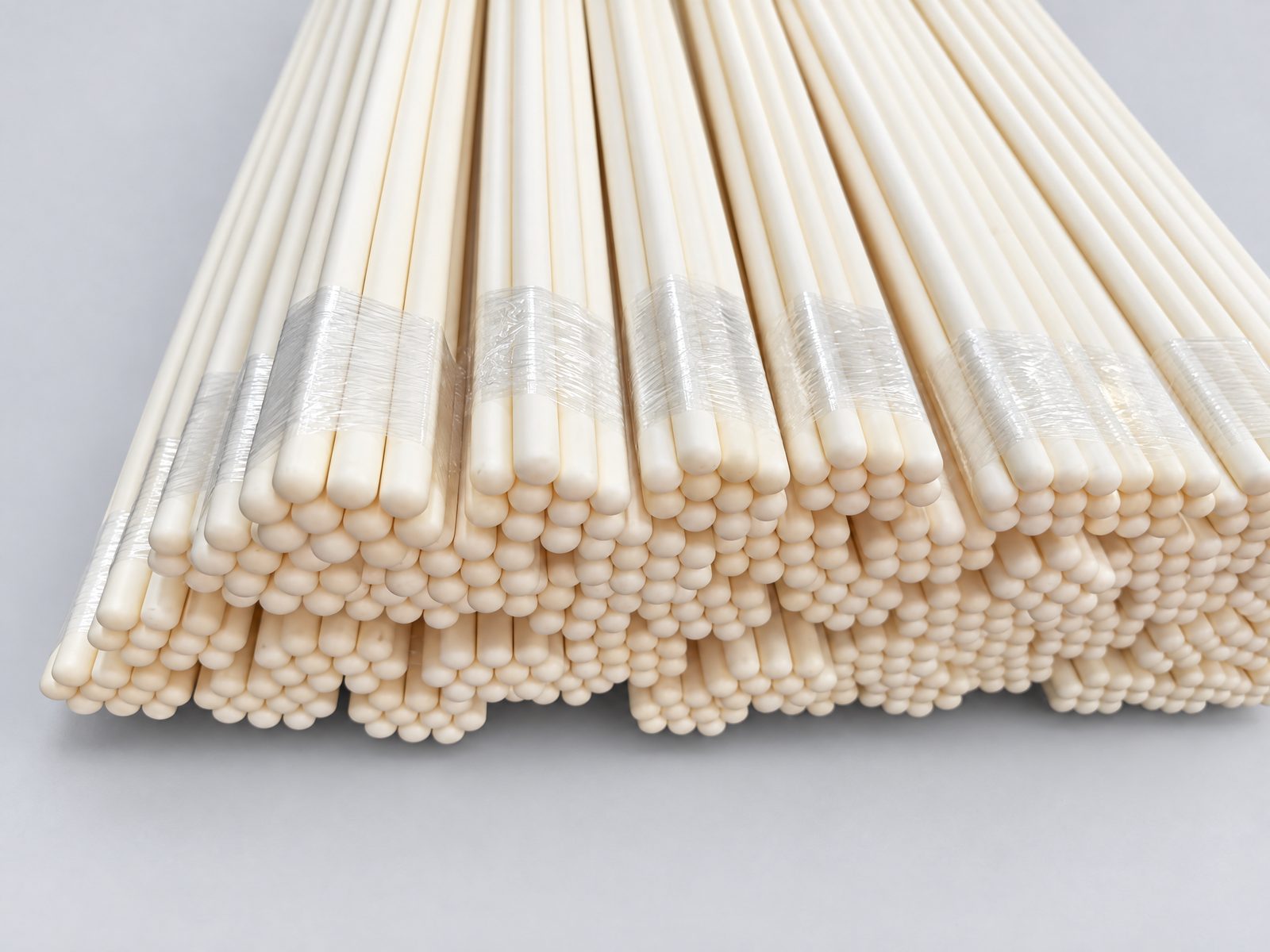
Alumina balls, also called aluminum oxide balls or alumina ceramic balls, are spherical technical ceramics sintered from polycrystalline aluminum oxide (Al2O3) for check valves, bearings, grinding mills, and high-temperature support beds. According to NIST Standard Reference Database 150, sintered high-purity alpha-alumina (99.5 % Al2O3 or higher) fired at about 1700 °C has a density of 3.984 g/cm3 at 20 °C, a Vickers hardness of 15 GPa, a compressive strength of 3.0 GPa, and a melting point of 2050 °C. Buyers separate dense sintered spheres built for mechanical load and wear from porous calcined spheres built for gas or water adsorption, then match purity and finish to the duty.
Types of alumina balls and print terminology
Engineering prints and supplier catalogs use several names for the same part. US drawings write alumina ball, aluminum oxide ball, alumina ceramic ball, or ceramic alumina ball (and their plurals, including aluminum oxide ceramic balls), while UK and international drawings often write aluminium oxide ball or aluminium oxide balls, matching the aluminium oxide spelling in ISO standards.
Before requesting a quote, separate two distinct industrial products that share the alumina name. Dense sintered ceramic alumina balls are solid polycrystalline alpha-alumina (corundum) bodies fired until open porosity closes so they carry mechanical loads, resist wear, insulate electrical assemblies, and support hot reactor beds without adsorbing fluids.
Porous activated alumina spheres are unvitrified adsorbents made to maximize internal pore area for drying compressed gases or filtering water. Putting a porous desiccant sphere into a ball mill, valve, or heavy catalyst bed causes rapid crushing and dust, whereas putting a dense sintered ball into a dryer tower gives zero moisture pickup.
| Category | Ceramic structure | Primary industrial role | Relevant verification method |
|---|---|---|---|
| Precision bearing, valve, and tribometer balls | Dense polycrystalline alpha-alumina, lapped spherical finish | Check valves, metering pumps, bearings, wear test pins, and joint prostheses | ASTM G99, ASTM G133, and ISO 6474-1 |
| Grinding media balls | Dense sintered alumina up to 99.5 % Al2O3 corundum | Wet and dry ball milling of ceramic slips, glazes, minerals, and battery powders | ASTM C373 bulk density and apparent porosity |
| Inert thermal and bed support balls | Dense sintered alumina for thermal shock and crush survival | Catalyst bed retention, heat-transfer media, and electron-device standoffs | ASTM C1525 water quench and ASTM D2442 |
| Porous desiccant and adsorbent spheres | Open-pore non-sintered aluminum oxide | Air and gas dehydration, liquid drying, and water filtration | Adsorption capacity testing (non-structural media) |
Purity grades, raw powder classes, and glassy phases
Chemical composition and starting powder grade control how an aluminum oxide ball handles impact stress, corrosive fluids, and furnace heat. High-purity corundum spheres contain 99.5 % Al2O3 or higher and are sintered at about 1700 °C or hot pressed to at least 98 % of theoretical density, often with a small magnesium oxide (MgO) addition to hold a nominal grain size of 5 µm.
At the raw-material stage, ASTM F7-95(2016) classifies aluminum oxide powder used in electronic device ceramics and insulating coatings into two particle-size classes, two chemical grades (Grades 1 and 2), and two acidity ranges: Class A (No. 500 nominal mesh, 24.3 µm nominal average particle size) and Class B (No. 900 nominal mesh, 1.7 µm nominal average particle size), with acid pH 4.5 to 6.5 and neutral pH 6.5 to 7.5 tested alongside water-soluble content.
Silicate glass phases alter mechanical strength and chemical stability in fired bodies. A 1999 NIST mechanical characterization study tested 3 ceramic core types (high-purity, high-density alumina, glass-infiltrated sintered alumina, and leucite-reinforced glass) using piston-on-3-ball biaxial flexure and short-bar chevron-notch fracture toughness. Both aluminas beat leucite-reinforced glass with similar Weibull modulus variability: high-purity, high-density alumina reached higher biaxial flexural strength, whereas glass-infiltrated sintered alumina showed higher fracture toughness at lower flexural strength.
In hot steam reformers or high-purity powder mills, glassy grain-boundary phases soften faster at elevated temperatures and can leach silica into steam or shed silicate debris into slurries. Where silicate pickup or creep is unacceptable, specify 99.5 % Al2O3 corundum and check body maturation using ASTM C373 water absorption, bulk density, apparent porosity, and apparent specific gravity tests.
Physical, mechanical, and thermal properties from 20 to 1500 °C
Sizing a ball from room-temperature catalog data creates risk when the assembly runs hot. Validated values from 20 °C to 1500 °C cover polycrystalline sintered alpha-alumina at 99.5 % Al2O3 or higher, at least 98 % of theoretical density, 5 µm nominal grain size, hexagonal corundum structure with 6 formula units per hexagonal cell, and a melting point of 2050 °C (standard uncertainty 4 °C).
In NIST Standard Reference Database 150, Vickers hardness (1 kg load) at 20 °C (15 GPa) is 6 times its value at 1500 °C (2.5 GPa), dropping by 6.5 GPa already at 500 °C (8.5 GPa). Over the 20 °C to 1500 °C span in the same table, mean flexural strength falls by 250 MPa (380 MPa to 130 MPa), Weibull characteristic strength drops from 395 MPa to 125 MPa, and density drops by 0.150 g/cm3 (3.984 g/cm3 to 3.834 g/cm3).
Above 1000 °C, sustained loads also drive creep. In the NIST sintered alumina dataset, flexural creep across 100 MPa to 200 MPa and 1200 °C to 1800 °C shows an activation energy of 325 kJ/mol (standard uncertainty 25 kJ/mol) and a stress exponent of 1.08 (standard uncertainty 0.05). At 150 MPa, creep rate rises from 0 x 10^-9 s^-1 at 20 °C and 500 °C to 4 x 10^-9 s^-1 at 1000 °C, 280 x 10^-9 s^-1 at 1200 °C, 6600 x 10^-9 s^-1 at 1400 °C, and 24600 x 10^-9 s^-1 at 1500 °C.
| Property and unit | 20 °C | 500 °C | 1000 °C | 1200 °C | 1400 °C | 1500 °C |
|---|---|---|---|---|---|---|
| Density (g/cm3) | 3.984 | 3.943 | 3.891 | 3.868 | 3.845 | 3.834 |
| Elastic modulus (GPa) | 416 | 390 | 364 | 354 | 343 | 338 |
| Shear modulus (GPa) | 169 | 158 | 146 | 142 | 137 | 135 |
| Bulk modulus (GPa) | 257 | 247 | 237 | 233 | 229 | 227 |
| Poisson's ratio | 0.231 | 0.237 | 0.244 | 0.247 | 0.250 | 0.252 |
| Compressive strength (GPa) | 3.0 | 1.6 | 0.7 | 0.4 | 0.3 | 0.28 |
| Flexural strength (MPa) | 380 | 375 | 345 | 300 | 210 | 130 |
| Weibull modulus | 11 | 11 | 11 | 11 | 11 | 11 |
| Tensile strength (MPa) | 267 | 267 | 243 | 140 | 22 | 13 |
| Hardness, Vickers 1 kg (GPa) | 15 | 8.5 | 4.6 | 3.7 | 2.9 | 2.5 |
| Fracture toughness, 300 µm crack (MPa·m1/2) | 3.5 | 3.0 | 2.7 | 2.6 | 2.5 | 2.5 |
| Thermal conductivity (W/m·K) | 33 | 11.4 | 7.22 | 6.67 | 6.34 | 6.23 |
| Specific heat (J/kg·K) | 755 | 1165 | 1255 | 1285 | 1315 | 1330 |
| Thermal expansion from 0 °C (10^-6 K^-1) | 4.6 | 7.1 | 8.1 | 8.3 | 8.5 | 8.6 |
Wear, friction, and contact damage in wet and dry service
As ASTM G99 notes, sliding wear depends on load, machine stiffness, speed, distance, contact geometry, debris removal, and environment rather than material hardness alone. Three NIST experimental findings help buyers prevent premature wear in alumina valves, bearings, and mills.
First, dry alumina-on-alumina sliding hits a severe mid-temperature wear plateau. In the NIST sintered alumina dataset at 2 GPa contact stress, the friction coefficient is 0.40 (standard uncertainty 0.05) and the base-10 log wear coefficient is -6 (standard uncertainty 1) at 20 °C. Both friction and wear jump sharply at 200 °C (standard uncertainty 5 °C) to a nearly constant mid-temperature plateau, reaching a friction coefficient of 0.8 and a base-10 log wear coefficient of -4 (a 100-fold rise in wear coefficient) at 500 °C. From 600 °C to 900 °C both fall roughly linearly, returning to 0.4 and -6 at 1000 °C.
Second, wet wear shifts with track geometry and debris retention. A 2017 NIST pin-on-disk study slid high-purity alumina balls against glass-ceramic disks in distilled water at constant load, speed, and sliding distance. Increasing wear track diameter from 4 mm to 12 mm sharply raised wear volume and friction because compacted debris covered nearly all of the 4 mm track as a protective interfacial layer, whereas coverage fell on the longer 12 mm circumference.
Third, contact load and moisture govern chipping. A 2017 NIST scratch-strength study dragged a tungsten carbide spherical-tipped conospherical indenter at about 0.5 mm/s across 5 mm tracks on 32 mm by 32 mm, 0.65 mm thick polycrystalline alumina plates under 0.1 N to 10 N normal loads. Subsurface plastic zones wedge open median cracks: strength followed the ideal P^-3/4 relation near 3 N, lateral cracks and chipping broke out above 3 N, and reduced grain bridging lowered toughness below 3 N. Atmospheric moisture further reduces toughness and worsens lateral cracking during humid or wet collisions.
Forming routes, ball mill sizing, and reactor bed layering
Read more
Dense alumina spheres are compacted from aluminum oxide powder by pressing, slip casting, or extrusion and sintered around 1700 °C, or densified by hot pressing. Where tight valve or bearing surfaces are needed after firing, makers finish spheres with progressively finer abrasives: ISO 8486-2 governs grain size distribution for fused aluminium oxide and silicon carbide microgrits from F230 to F2000 in bonded wheels and loose polishing grits.
In packed towers and reformers, inert alumina balls support catalyst beds using graduated layers rather than one diameter. Large balls sit on the bottom grate to keep open area high and pressure drop low, medium balls bridge the gaps above them, and small balls sit directly under and over the catalyst pellets to stop migration and gas channeling. For ball milling, match media to the duty:
- Match ball diameter to feed size: use larger spheres to break coarse feed by impact and smaller spheres to multiply contact points for fine attrition.
- Run a graded ball charge: blend coarse, medium, and fine balls to crush oversized feed while filling interstitial voids.
- Separate dry and wet milling: dry mills lack liquid cushioning and run hotter at contact points, so specify dense pressed bodies and avoid running mills empty.
- Pair media and lining purity: match high-purity alumina balls with alumina linings when iron, zirconia, or silicate wear debris would spoil electronic or optical batches.
Worked example: Displacement mass check and thermal-shock threshold
Read more
Incoming quality labs often pair two checks on high-purity (99.5 % Al2O3 or higher) sintered alpha-alumina lots: solid density verification by water displacement under ASTM C373, and retained flexural strength screening on companion bars after water quenching under ASTM C1525.
Step 1: Solid displacement mass check. Suppose a clean, dry sample of solid corundum balls displaces exactly 100 cm3 of water at 20 °C with zero open water absorption. At the NIST 20 °C density of 3.984 g/cm3 (at least 98 % of theoretical density), 100 cm3 of ceramic weighs 398.4 g (100 cm3 multiplied by 3.984 g/cm3). Mass noticeably below 398.4 g points to closed internal porosity or a lower-alumina silicate body. At 1000 °C, thermal expansion lowers density to 3.891 g/cm3, so 100 cm3 of hot solid volume equals 389.1 g (9.3 g less per 100 cm3).
Step 2: Thermal-shock retained strength threshold. ASTM C1525 quenches heated bars or specimens cut from components into a room-temperature water bath and defines the critical temperature interval by at least a 30 % drop in mean flexural strength. From the 380 MPa NIST baseline at 20 °C, a 30 % drop is 114 MPa (380 MPa multiplied by 0.30), setting the pass/fail retained strength line at 266 MPa alongside ambient ASTM C1421 fracture toughness checks (3.5 MPa·m1/2 for a 300 µm crack).
Active ASTM and ISO standards for alumina ceramics
Buyers combine material specifications for medical or electronic bodies with test standards for maturation, wear, fracture toughness, and thermal shock. When qualifying valve or pump balls, separate unidirectional ASTM G99 rotation from reciprocating ASTM G133 motion: ASTM G133 reverses sliding direction under Procedures A and B so entrainment velocity passes through zero and stress reverses, capturing wear missed in one-way rotation.
| Standard and active edition | Scope and geometry | Key measurement or requirement |
|---|---|---|
| ISO 6474-1:2019 (confirmed 2024) | Bio-stable high-purity alumina for bone spacers, replacements, and joint prostheses | Material properties and test methods (manufacturer evaluates biocompatibility separately) |
| ASTM D2442-75(2025) | Fabricated alumina parts for electrical and electronic uses and ceramic-to-metal seals | Electrical, mechanical, thermal, and general body limits regardless of part geometry |
| ASTM F7-95(2016) | Aluminum oxide powder for insulating coatings and electronic ceramic mixtures | Class A (24.3 µm) and Class B (1.7 µm) particle sizes, Grades 1 and 2, and pH levels |
| ASTM C373 (C0373-18R23, 2023) | Fired unglazed whiteware and ceramic bodies | Water absorption, bulk density, apparent porosity, and apparent specific gravity |
| ASTM G99-23 | Pin-on-disk or ball-on-disk apparatus in material pairs | Unidirectional non-abrasive sliding wear volume and friction coefficient |
| ASTM G133 (G0133-26, 2026) | Linearly reciprocating ball-on-flat geometry, lubricated or unlubricated | Ball and flat wear volumes plus kinetic friction under periodic motion reversal |
| ASTM C1421 (C1421-18R25, 2025) | Beam specimens with sharp cracks at ambient temperature | Fracture toughness via precracked (K_Ipb), surface crack (K_Isc), and chevron-notched (K_Ivb) beams |
| ASTM C1525 (C1525-18R24, 2024) | Dense monolithic ceramics and bars cut from components | Water-quench thermal shock critical interval at 30 % mean flexural strength drop |
| ISO 8486-2:2007 (confirmed 2021) | Fused aluminium oxide and silicon carbide microgrits F230 to F2000 | Grain size distribution checking for bonded abrasives and loose polishing grits |
Specifying and sourcing alumina ceramic balls
When preparing a purchase specification or request for quotation for custom alumina balls, rings, bushings, discs, rods, or tubes, state the required Al2O3 purity grade, target bulk density and apparent porosity method (ASTM C373), nominal diameter and sphericity tolerances, surface finish, operating temperature, and whether the contact environment is dry or liquid-lubricated.
For assemblies subject to rapid heating or cooling, state whether companion test bars or cut specimens must be evaluated for water-quench thermal shock under ASTM C1525 and ambient fracture toughness under ASTM C1421. Send your drawing, the grade and the quantity.
Questions buyers ask
- What is the difference between sintered alumina balls and activated alumina balls?
- Dense sintered alumina balls are solid polycrystalline alpha-alumina bodies fired around 1700 °C for mechanical wear, bearings, grinding mills, and structural bed support. Activated alumina balls are open-pore adsorbents made for drying gases or filtering water, and they crush under milling or structural loads.
- What is the density and hardness of high-purity alumina ceramic balls?
- In the NIST sintered alpha-alumina dataset (99.5 % Al2O3 or higher, at least 98 % of theoretical density), density is 3.984 g/cm3 and Vickers hardness (1 kg load) is 15 GPa at 20 °C. At 1000 °C, density shifts to 3.891 g/cm3 and Vickers hardness drops to 4.6 GPa.
- How does ASTM F7 classify aluminum oxide powder used in ceramic mixtures?
- ASTM F7-95(2016) covers aluminum oxide powder in two particle size classes (Class A at No. 500 nominal mesh or 24.3 µm average size, and Class B at No. 900 nominal mesh or 1.7 µm average size), two chemical grades (Grades 1 and 2), and two acidity levels (acid pH 4.5 to 6.5 and neutral pH 6.5 to 7.5).
- How do aluminum oxide balls behave in dry sliding above 200 °C?
- In the NIST sintered alpha-alumina dataset at 2 GPa contact stress, both the friction coefficient and the base-10 log wear coefficient jump sharply at 200 °C from their 20 °C values (0.40 and -6) to a nearly constant mid-temperature plateau, reaching 0.8 and -4 at 500 °C. Both then fall roughly linearly between 600 °C and 900 °C, returning to 0.4 and -6 at 1000 °C.
- Which ASTM standards test the sliding wear of alumina ceramic balls?
- ASTM G99 measures unidirectional sliding wear and friction on a pin-on-disk or ball-on-disk setup, while ASTM G133 measures linearly reciprocating ball-on-flat wear with periodic direction reversal. Buyers pick ASTM G133 for oscillating valves or plungers where lubricant entrainment velocity passes through zero.
Sources
- NIST Standard Reference Database 150: Sintered Alumina Property Data Summary
- NIST: Effect of Wear Track Diameter on Tribological Behavior
- NIST: Comparative Mechanical Property Characterization of 3 All-Ceramic Core Materials
- NIST: Blunt Scratch Strength of Polycrystalline Alumina
- ISO 6474-1:2019 Implants for Surgery - Ceramic Materials Based on High Purity Alumina
- ISO 8486-2:2007 Bonded Abrasives - Microgrits F230 to F2000
- ASTM D2442-75(2025) Standard Specification for Alumina Ceramics for Electrical and Electronic Applications
- ASTM F7-95(2016) Standard Specification for Aluminum Oxide Powder
- ASTM C373 Standard Test Method for Water Absorption, Bulk Density, Apparent Porosity, and Apparent Specific Gravity
- ASTM G99-23 Standard Test Method for Wear and Friction Testing with a Pin-on-Disk or Ball-on-Disk Apparatus
- ASTM G133 Standard Test Method for Linearly Reciprocating Ball-on-Flat Sliding Wear
- ASTM C1421 Standard Test Methods for Determination of Fracture Toughness of Advanced Ceramics
- ASTM C1525 Standard Test Method for Determination of Thermal Shock Resistance for Advanced Ceramics by Water Quenching
Last checked .